


TSA PreCheck is the cheapest way to make US airport security less unpleasant. It costs $85 or less for five years, the application takes about fifteen minutes of your life in total, and plenty of credit cards pay the fee for you.
It's also worth understanding properly, because one of its best-known benefits quietly stopped being a benefit in 2025, and the price you pay now depends on which of three companies you enroll with.
Here's what TSA itself publishes, and what it actually buys you in 2026.
PreCheck, CLEAR or Global Entry: Which One for Which Traveler
The PreCheck prices in this guide come from TSA's own page, read October 7, 2026. CLEAR's PreCheck enrollment fee is $84.95, and TSA lists IDEMIA at 529 locations.
What each one costs, from each program's own site:
- TSA PreCheck: "five years of benefits for $85 or less," per TSA. IDEMIA charges $79.75, Telos $85.00 and CLEAR $84.95 to enroll.
- Global Entry: "The application fee is $120, and membership lasts for five years," per CBP. Global Entry includes TSA PreCheck.
- CLEAR+: CLEAR's page lists CLEAR+ at $219, lets members add up to 3 adults for $125 each, and says kids 17 and under join for free.
Which one for which traveler:
- You fly domestically a few times a year. TSA PreCheck. It's the cheapest of the three, lasts five years, and covers your children 17 and under when they travel with you (teens 13 to 17 need to be on your reservation).
- You fly internationally at least once or twice a year. Global Entry. It speeds up your return through customs and includes PreCheck, so you get both for one application. CBP itself suggests that if you take fewer international flights, you consider PreCheck and the free Mobile Passport Control app instead.
- You fly often through big airports with long ID lines. CLEAR+ on top of PreCheck or Global Entry. CLEAR handles the identity check, and PreCheck handles the screening lane, so the two stack. Our PreCheck vs CLEAR guide covers the combination.
- You have a card that pays the fee. Many travel cards reimburse Global Entry or PreCheck. If yours covers up to $120, that credit can pay for Global Entry, which includes PreCheck. Our PreCheck vs Global Entry guide goes deeper.
A new PreCheck benefit: Gateside. Since September 2026, TSA lets PreCheck members apply for a free Gateside pass to go beyond security without a boarding pass at 13 airports, to meet arriving family or see someone off. TSA's Gateside page has the list and the rules. TSA says it's open to PreCheck members and those with Known Traveler Numbers.
What You Get in the Lane
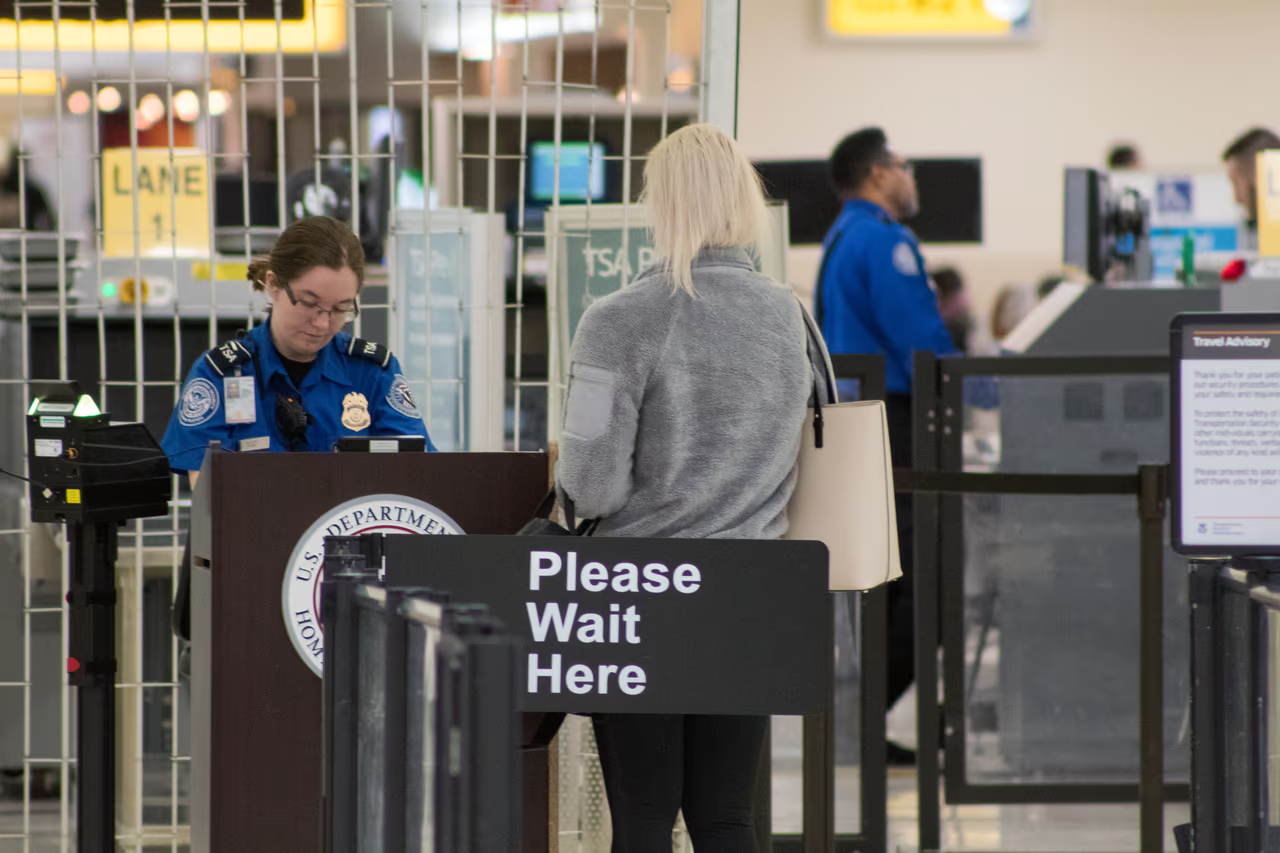
TSA describes the lane experience in one sentence on its own PreCheck page:
"With TSA PreCheck leave in your bag electronics and 3-1-1 liquids and leave on belts, light jackets, and shoes."
So four things stay where they are. Laptops and tablets stay in the bag. Your liquids bag stays in the bag. Belts and light jackets stay on. Shoes stay on.
TSA also publishes a speed claim:
"TSA PreCheck lanes move faster. About 99% of passengers wait less than 10 minutes."
That's the pitch, and for most travelers it holds up. But one part of it needs a caveat that TSA's own page doesn't give you.
The Shoe Benefit Is No Longer a Benefit
For nearly twenty years, keeping your shoes on was the single most cited reason to get PreCheck. That changed in July 2025, when TSA stopped requiring most travelers with REAL ID-compliant identification to remove their shoes in standard lanes.
The change has held. Standard screening now works the way PreCheck has worked for years on that specific point. Shoes now stay on for most travelers in the standard lane; see what changed and what still applies.
TSA's PreCheck page still lists shoes among the things you leave on, and that remains accurate. It's simply no longer a difference between the two lanes for most people.
If you were holding off on PreCheck and shoes were your reason for wanting it, the case has weakened. The remaining benefits are the laptop, the liquids, the belt and the queue, and the queue is the one that still does most of the work.
What It Costs, and Why the Price Varies
TSA's headline is "five years of benefits for $85 or less." The "or less" is doing real work, because TSA no longer runs enrollment itself.
Three companies are authorized to enroll you, and each sets its own price. TSA lists all three with their current fees and location counts:
IDEMIA charges $79.75 and lists 529 active locations.
CLEAR charges $84.95 and lists 348 active locations.
Telos charges $85.00 and lists 512 active locations.
Between them TSA says there are "over 1,300 convenient enrollment locations." The membership you get is identical whichever provider you use. Only the price and the location convenience differ.
The spread is small, but it's worth checking all three before you click the first link you see.
Renewal Prices Vary More
Renewal is where the spread widens, and where the cheapest provider isn't the same one.
IDEMIA renews online for $58.75 and in person for $66.75. Telos renews in person for $58.75 and online for $69.95. CLEAR renews online for $72.95 and in person for $84.95.
Note the pattern. IDEMIA is cheapest for a new enrollment and cheapest online for renewal, but Telos is cheapest for an in-person renewal. It's worth checking all three at renewal rather than defaulting back to whoever enrolled you.
The CLEAR Bundle
CLEAR offers PreCheck free if you join CLEAR+, which needs reading carefully. TSA publishes the terms:
"Upon completion of your TSA PreCheck pre-enrollment or online renewal, CLEAR will issue you a one-time code to enroll in CLEAR+ for $134 for new enrollments or $146 for online renewals (price of CLEAR+ minus cost of TSA PreCheck)."
So PreCheck isn't free. Its cost is deducted from the CLEAR+ price, and you pay the balance. That's a genuine saving if you wanted CLEAR+ anyway, and a large extra cost if you didn't. Our CLEAR Plus guide covers whether that membership earns its keep.
How Enrolling Works
TSA breaks the process into three steps, and the whole thing is shorter than people expect.
First, apply online. TSA says the initial application takes "as little as 5 minutes." You give your details and pick an enrollment location.
Second, finish in person. TSA describes this step as: "Make an appointment or walk in. We'll check your documents, take fingerprints and photo, then collect the payment in about 10 minutes." Note that payment happens at the appointment, not online.
Third, get your Known Traveler Number and actually use it. TSA is explicit that this step is on you:
"Enter your Known Traveler Number (KTN) in airline reservations and travel profiles to get TSA PreCheck on your boarding pass."
This is where most PreCheck complaints originate. Membership does nothing on its own. If the KTN isn't in the booking, the indicator doesn't appear on the boarding pass, and you queue with everyone else. Put it in every airline profile you hold, and check it survived after any booking made by someone else.
What to Bring to the Appointment
The in-person step fails if you turn up with the wrong paperwork, and this is the most common reason a ten-minute appointment becomes two.
TSA publishes the required documents in two lists. You need one document from List A, or two documents from List B.
List A is a single document that proves both who you are and your status. An unexpired US passport, book or card, is the simplest one. A permanent resident card counts, as does an enhanced driver's license, an enhanced tribal card, a FAST card or an unexpired re-entry permit.
If you don't have any of those, List B needs two documents instead: a valid photo ID, which must be REAL ID compliant if it's a state license or state identity card, plus a separate document that proves citizenship.
Two rules catch people out.
The names must match exactly. TSA states that "the names on all documents must match exactly with the name provided on the application," and that a legal name change needs an original or certified name change document, such as a marriage certificate or divorce decree, on top of everything else.
Photocopies don't count. TSA requires an original or a certified copy issued by an authority "bearing an official seal," and rules out two things specifically: "Short form or abstract birth certificates and notarized copies of documents are not acceptable."
A notarized copy feels official and isn't accepted. If your plan involves one, change the plan before the appointment rather than at it.
Children Travel Free With You
One of the better-value details is easy to miss. TSA states it plainly:
"Children 17 and under can join an adult in the TSA PreCheck lane for free."
TSA's families page splits that by age. Children 12 and under go through the PreCheck lane with a parent or guardian who has the PreCheck indicator on their boarding pass, and the child's boarding pass doesn't need the indicator. Children 13 to 17 can use the lane only when the indicator is on their own boarding pass, which happens when they're on the same airline reservation as the adult whose boarding pass shows it.
So a family doesn't need to enroll everyone. One enrolled parent covers the children through the lane, which changes the arithmetic for family travel considerably. TSA publishes the detail on its PreCheck for families page.
Adults are different. A partner or an adult child needs their own membership.
Getting the Fee Covered
Plenty of travel credit cards reimburse the application fee as a statement credit, usually once every four or five years. TSA maintains its own list of participating card offers, which is a better starting point than any roundup because TSA has no incentive in it.
The credit is typically framed as covering "Global Entry or TSA PreCheck," and this is where a decision is worth making rather than defaulting.
If the card credit covers either, Global Entry is usually the better use of a single credit. Global Entry includes PreCheck. PreCheck doesn't include Global Entry. Our Global Entry guide covers what the extra step involves, and our comparison of PreCheck against Global Entry works through when the simpler option is the right one anyway.
Cards that commonly carry the credit include the Platinum Card from American Express, the Capital One Venture X and the Chase Sapphire Reserve. Our roundup of cards with PreCheck and CLEAR benefits goes through the current terms, and there are also routes to the fee that don't involve a card at all, which we cover in nine ways to get these programs free.
Where PreCheck Sits Against the Alternatives
Three programs get confused with each other constantly. They do different things.
TSA PreCheck speeds up the security screening itself. It's domestic, it's run by TSA, and it changes what you take off and out.
Global Entry speeds up your arrival back into the United States at customs and immigration. It includes PreCheck as part of the membership. It costs $120 and requires an interview.
CLEAR Plus doesn't screen you at all. It verifies your identity so you skip the document-check queue, then delivers you to the front of a screening lane. It's a private service with its own annual fee.
They stack rather than compete. PreCheck and CLEAR together get you past the ID queue and through a faster screening lane. Our PreCheck against CLEAR comparison covers why frequent flyers often carry both.
Face-Based Screening Is Now Optional at Some Lanes
TSA has been rolling out Touchless ID, which uses a facial match instead of handing over a physical document. TSA describes it as "the fastest way through security with exclusive lanes using only your face as ID."
It's opt-in, it requires a separate enrollment through a participating airline, and it isn't available everywhere. The privacy trade is real and personal, and worth a decision rather than a shrug. We cover the mechanics, the coverage and the opt-out in our Touchless ID guide.
Whether It Is Worth the Money
The arithmetic is unusually simple here, because the cost is low and fixed.
At $79.75 for five years with the cheapest provider, PreCheck is one of the least expensive travel upgrades there is. The question is whether saving a few minutes at every checkpoint is worth that to you.
For most people who fly more than once or twice a year, it clearly is. For someone flying once every couple of years, it's marginal, and the weakening of the shoe benefit has made it more marginal than it was.
The stronger argument is the family one. One adult membership at $79.75 covers children 17 and under traveling with them, for five years, as long as the teenagers are on the same reservation. A family that flies twice a year is getting a great deal from a single enrollment.
And if a card you already hold reimburses the fee, the calculation stops being a calculation. Take the credit, and consider spending it on Global Entry instead, since that includes PreCheck anyway.
Three Things PreCheck Does Not Do
Setting expectations correctly avoids most of the disappointment.
It doesn't guarantee a PreCheck lane exists. Not every checkpoint at every airport runs one, and those that do run them on a schedule rather than around the clock. At a small airport or an early departure, the lane may simply be closed, and you go through standard screening with the indicator on your pass and no benefit from it.
It doesn't skip the identity check. You still present a document or use a facial match. What PreCheck changes is the screening after that point. Skipping the document queue is what CLEAR sells, which is why the two stack rather than overlap.
It doesn't travel abroad with you. PreCheck is a US domestic screening program. It does nothing at a foreign airport, and it does nothing on your way back into the country, which is the gap Global Entry fills.
There's also no refund if any of this disappoints you. The fee buys five years of eligibility, not five years of guaranteed faster queues.
None of that's an argument against enrolling. It's an argument for knowing what the fee covers, so a closed lane at six in the morning reads as normal rather than as a failure of something you paid for.
The Bottom Line
PreCheck is cheap, quick to get and still worth having, but for slightly different reasons than it was two years ago. Shoes are no longer the selling point. The lane, the laptop and the liquids are.
Three things decide whether you get full value. Pick the cheapest provider for what you're doing, since enrollment and renewal have different winners. Put your Known Traveler Number in every airline profile, because the membership does nothing without it. And if a card credit is paying, look hard at Global Entry first, because it includes what you were about to buy.
CLEAR Enrolls at the Airport
Enrollment means applying online and then finishing in person. CLEAR adds something worth knowing if you're flying anyway. TSA's own announcement naming CLEAR an enrollment provider says travelers "will enroll at CLEAR's dedicated TSA PreCheck airport enrollment pods," starting at Orlando, Sacramento and Newark and expanding to more CLEAR airport locations over time.
CLEAR's own page says you can pre-enroll online and finish at the nearest participating CLEAR location, and that "no appointment is necessary." That turns the in-person step into something you do on a trip you were already taking, rather than a separate errand.
Check CLEAR's location finder for the airport you're flying through before you plan around it, since the pods sit at participating CLEAR locations.
Updated October 19, 2026: added a link to our shoe rule article.