



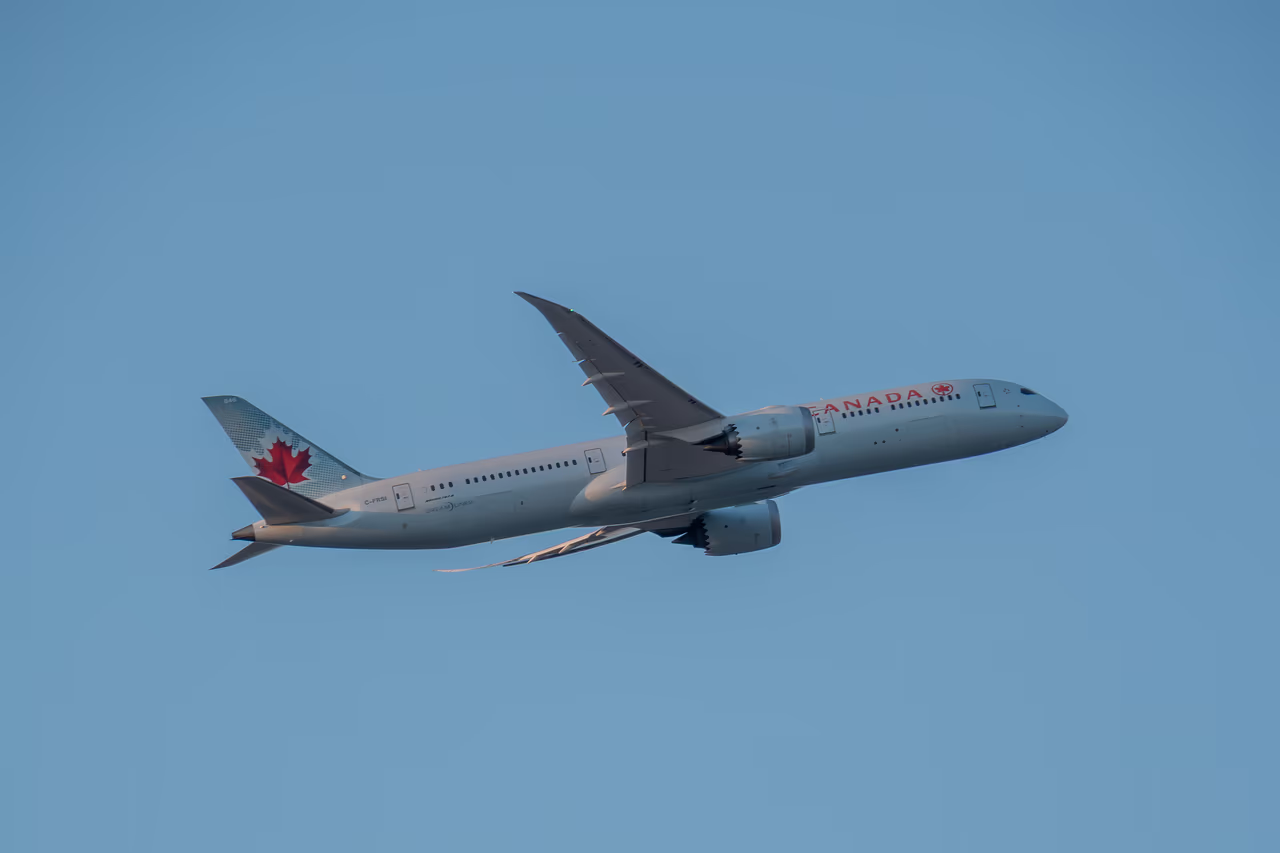
The Chase Air Canada Aeroplan Card now carries a $195 annual fee, automatic Aeroplan 25K Status, 15% off eligible Air Canada award flights and 3X on travel. Chase refreshed it on September 10, 2026. It's still a co-brand card whose value comes mostly from the program behind it, and the refresh ties more of that value to flying Air Canada itself.
Aeroplan is Air Canada's loyalty program, and it's a Star Alliance program with its own award chart. That combination, plus the Star Alliance member list, is what makes this card worth attention from someone who has never flown Air Canada. Our Turkish Miles&Smiles sweet spots cover the same alliance from a different program.
The Card Was Refreshed
Chase and Air Canada changed the card on September 10, 2026, for new and existing cardmembers alike. The sections below have been updated to match. What changed, per the Chase release, Chase's card page and its pricing and terms:
- The annual fee is $195.
- Automatic Aeroplan 25K Status, with no spending requirement. It brings Priority Check-In, Priority Boarding in Zone 2 and 5 eUpgrade Credits each year.
- Earning changed. Up to 5X on Air Canada (3X from the card plus 2X from Air Canada on eligible flights as a 25K member), 3X on travel, 3X on dining and groceries through December 31, 2026 (2X after that), 2X on gas, 1X on everything else.
- 15% off eligible Air Canada flight redemptions booked with Aeroplan points.
- Up to $100 a year in Air Canada statement credits, as up to two $50 credits, one in each half of the year.
- A 4th Day Free on car rentals booked for four days with points, starting January 2027.
- A new welcome offer of up to 115,000 points: 75,000 after $4,000 in purchases in the first 3 months, plus 40,000 after $20,000 in purchases in the first 12 months.
What the Card Earns
The refresh replaced the old three-category structure with a tiered one.
Up to 5X on Air Canada purchases. 3X from the card, plus an additional 2X from Air Canada on eligible flights when you travel as an Aeroplan 25K member.
3X on travel purchases. A new category with the refresh.
3X on dining and grocery stores through December 31, 2026, then 2X. Dining includes takeout and eligible delivery. Chase's card terms count a purchase at 3X if it posts to your account by December 31, 2026. Some cardholders also have a targeted spending offer.
2X on gas stations.
1X on all other purchases.
The everyday categories still matter. Groceries, restaurants and gas are ordinary household spending, which means the card still earns a travel currency from a household budget. But from 2027 the top rates go to Air Canada and travel.
Why the Program Matters More Than the Card
Aeroplan points transfer nowhere, but they buy travel across the whole Star Alliance network. That's roughly two dozen airlines, which is a wider set of destinations than any single carrier can offer.
The program prices awards on its own chart rather than mirroring the cash fare, which is the structural feature that creates outsized redemptions. Programs that moved to dynamic pricing lost that, and Aeroplan has retained a published structure.
Aeroplan also permits a stopover on a one-way award for a fixed additional cost, which allows two destinations on a single booking. That's a genuine planning tool rather than a marketing line, and it's the feature experienced members build itineraries around.
Is the $195 Fee Worth It?
At $195, whether the fee pays for itself depends on how often you fly Air Canada.
The new benefits that offset it are tied to Air Canada. The up to $100 in Air Canada statement credits, the 25K Status, the eUpgrade Credits and the 15% award discount all pay off when you fly or redeem on Air Canada. If you do that a few times a year, the refreshed card is built for you.
Your points can also cover the fee itself. With Chase's Pay Yourself Back, you can turn the annual fee charge into a statement credit paid with Aeroplan points within 90 days of it posting, and Chase shows the redemption value on the transaction page before you confirm.
If you held the card mainly for groceries and dining, the case is weaker. Those categories earn 3X through December 31, 2026 and 2X after that, against a $195 fee. Put this card against what your other cards earn on the same spending before your next renewal.
The Welcome Bonus Does the Heavy Lifting in Year One
The current offer is up to 115,000 points, in two parts. The first 75,000 come after $4,000 in purchases in the first 3 months. The other 40,000 need $20,000 in purchases in the first 12 months.
Treat the first year as the program trial. If you find the award space and the routings work for how you travel, the ongoing benefits can justify keeping it. If you never find a use, closing it before the second fee is a reasonable decision.
Who This Fits
Someone who flies Air Canada a few times a year. The refresh is aimed squarely at this cardmember, and the status, credits and discount all reward it.
Someone who wants access to Star Alliance award space without committing to a US carrier's program.
Someone who plans trips well ahead. Award space at the lowest levels opens early and goes first, and this program rewards the people looking eleven months out.
Who Is Served Better Elsewhere
Someone who wants flexibility should look at a transferable currency instead. Points earned here are Aeroplan points from the moment they post, with no option to move them somewhere else if the program changes.
Someone who rarely flies Air Canada. Most of what the refresh added is tied to the airline, and the fee is $195.
Someone who won't research award space will struggle to reach the values that justify a co-brand card at all. A flat-rate cash-back card asks nothing and returns a predictable amount.
Surcharges Deserve a Check Before You Commit
Award pricing is only half the cost. Partner awards across Star Alliance vary considerably in the cash component attached to them, and some carriers pass through substantial surcharges.
The same mileage cost can carry very different out-of-pocket totals depending on which airline operates the flight. Price two or three options before booking rather than accepting the first result.
This is the most common way a strong-looking Aeroplan redemption becomes an ordinary one, and it's entirely avoidable with one extra search.
Points Are Committed the Moment They Are Earned
This is a co-brand card, so the points are Aeroplan points immediately. There's no intermediate flexible currency and no transfer decision to make later.
That removes a risk and adds one. You never face the irreversible transfer problem that flexible points create, which our guide to why points transfers can't be undone covers in detail. You also carry full exposure to any repricing the program does, with no ability to move the balance elsewhere.
What a Stopover Actually Buys You
The stopover allowance is the feature most worth understanding, because it changes what a single award is capable of.
On a one-way award, a stopover lets you break the journey in an intermediate city for an extended period rather than connecting straight through. In practice that turns a flight to one destination into a trip to two, for a fixed additional points cost rather than the price of a second ticket.
Used deliberately, it's the difference between visiting one European city and visiting two on the same award. Members who plan around it get materially more out of the program than members who book point to point.
It requires planning, because the routing has to make sense to the program's engine and the award space has to exist on both segments. This isn't a feature you stumble into at booking time.
Booking Partner Space Takes Patience
Award space across a large alliance isn't uniformly available, and the search tools don't always surface everything.
Some partner availability appears reliably online. Some historically hasn't, and finding it means checking a partner's own site to confirm space exists before searching again. That workflow is familiar to experienced members and unfamiliar to everyone else.
Budget time for it on a first booking. The second one is considerably faster, because you'll know which partners and which routes to check first.
Holding It Long Term
The renewal question now comes down to how often you fly Air Canada.
If you use the Air Canada credits, the status and the award discount, the $195 has something to set against it every year. If you never fly Air Canada and never found award space that suited you, a transferable currency would serve you better, and closing before the next fee is a reasonable decision.
Elite Status Is Now Part of the Card
Automatic Aeroplan 25K Status comes with the card, with no spending requirement. Chase says it includes Priority Check-In, Priority Boarding in Zone 2 and 5 eUpgrade Credits each year, and it unlocks the extra 2X from Air Canada on eligible flights.
Status earned this way suits people who fly the airline often enough for the benefits to apply. If you're buying into the program mainly for award redemptions on partner airlines, status on Air Canada does less for you. Be honest about which of those describes you.
The Case for Holding It Alongside a Flexible Card
The strongest position is usually not choosing between a co-brand card and a transferable currency, but holding both.
The flexible card covers general spending and keeps its options open. The co-brand card takes the Air Canada and travel spending where its rates are highest, and builds a balance in a specific program you have decided you want.
That split gives you a committed balance for the redemptions you already know you want, and an uncommitted balance for the ones you haven't planned yet. It also means a single program devaluation can't reach your whole points position.
The Short Version
The Chase Air Canada Aeroplan Card is now a $195 card built around flying Air Canada: automatic 25K Status, up to $100 in Air Canada credits, 15% off eligible Air Canada awards and up to 5X on the airline. Aeroplan's published award chart and stopover allowance are still the reasons to want the points.
It suits Air Canada flyers and planners who book early. It suits people who want flexibility less well, because the points are committed from day one. If that's you, see the current offer on the Aeroplan card page. If flexibility is what you want instead, our transfer-bonus guide and the note that transfers are one-way are the two things to read first.
Updated October 7, 2026: annual fee and paying it with points.