



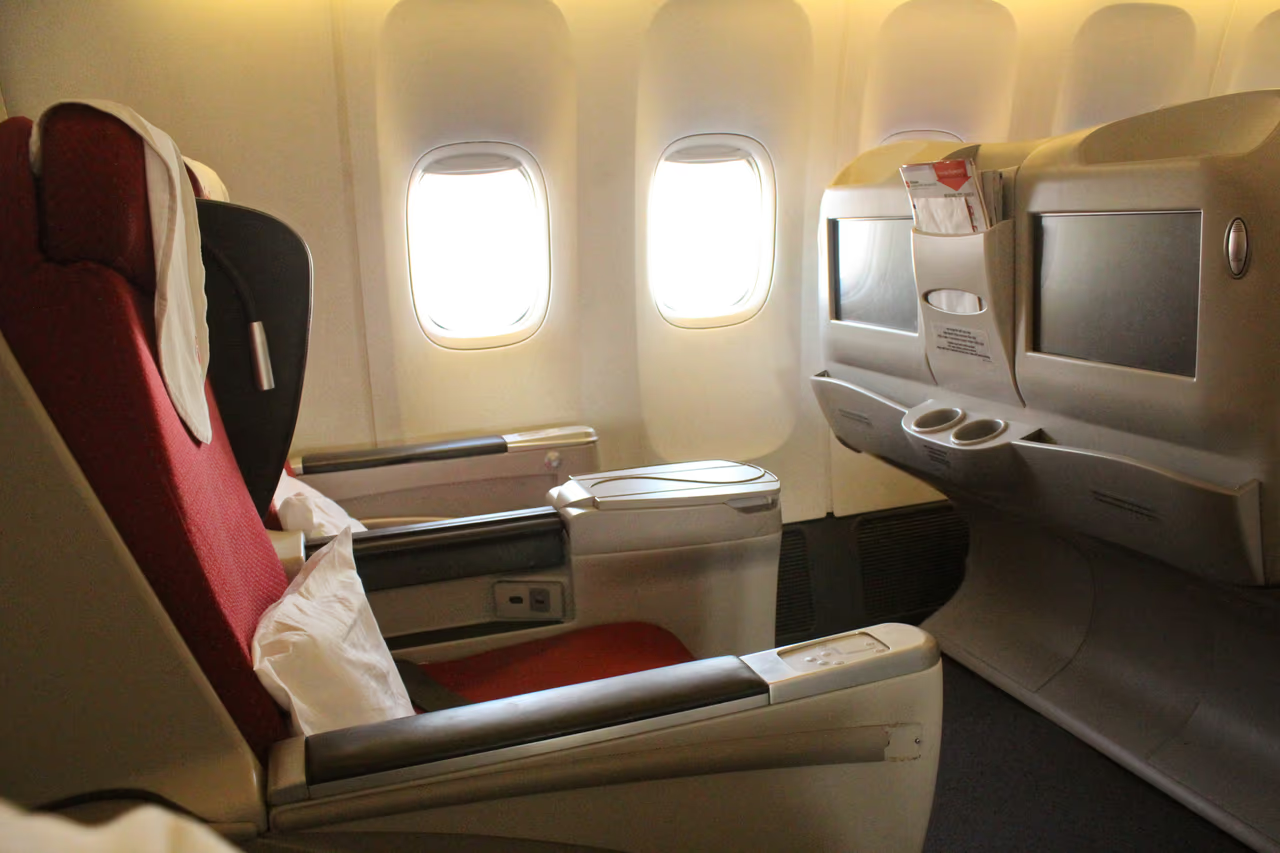
The Chase Sapphire Reserve welcome bonus is 100,000 points after $6,000 of spending in the first three months, and the card carries a $795 annual fee. If you arrived here looking for 150,000, that is not the offer on Chase's page today, and the rest of this guide works from the number that is.
100,000 points is enough for a long-haul business class seat, but only if you spend it the right way. This guide covers what the bonus is actually worth through each route, the arithmetic that decides between them, and the mechanics that catch people out.
Every figure below was read on Chase's own pages on September 4, 2026.
The Offer, As Chase States It
Chase's Sapphire Reserve page states the bonus as: "Earn 100,000 points after you spend $6,000 in purchases in the first 3 months from account opening."
The fee is stated as "$795 annual fee; $195 for each authorized user."
Both numbers belong in the same sentence when you are deciding. A 100,000-point bonus against a $795 first-year fee is a net position, not a windfall, and the business-class question is really whether the redemption clears that gap by enough to be worth the application.
Our guide to how welcome bonuses work covers the eligibility rules, and the Chase 5/24 rule is the specific test most likely to produce an approval with no bonus attached on a Chase card.
The Two Ways to Spend It, and What Each Is Worth
This is the whole decision, and Chase publishes enough to make it concrete.
Through Chase Travel. Chase states that "points earned with your card are worth $0.01 each when redeemed through Chase Travel," and that "100 points are worth $1, but with a Points Boost promotion 100 points could be worth up to $2.00."
So 100,000 points is $1,000 of travel booked through the portal, or up to $2,000 where a Points Boost promotion applies.
Through a transfer partner. Chase says you can "transfer your points to leading airline and hotel loyalty programs," at which point the value stops being fixed. A transferred point is worth whatever the partner's award chart or pricing says on the specific seat you book, which can be far more than a cent or considerably less.
That gives you a hard number to beat, and it is the most useful thing in this article.
The Break-Even, Stated Plainly
Transferring is worth it when the business class seat you can book with 100,000 partner points would cost more than $1,000 in cash.
Where a Points Boost promotion applies to the booking you want, the bar rises to $2,000.
That is the entire test. It is not "is business class nice." It is whether the specific seat, on the specific dates, beats the number the portal would have given you for the same points.
Two consequences follow, and both cut against the way this is usually written.
Long-haul business class usually clears the bar, but not always by much. A transatlantic business fare frequently sits above $2,000, which clears even the Points Boost bar. A domestic first-class seat or a short-haul business seat frequently does not, and transferring points to book one is a way of turning a cent per point into less than a cent.
A Points Boost promotion can beat a transfer. This is the part people miss. If the portal is offering up to two cents on the trip you want, a transfer needs to produce more than two cents to be worth doing, and plenty of award redemptions do not. Check the portal before assuming the transfer is better.
Our guide to Chase Ultimate Rewards redemptions covers the portal side in more detail.
What the Transfer Partners Open Up
Chase's own newsroom is specific about at least one partner that matters for business class.
When Air Canada Aeroplan joined the program, Chase stated that "one Ultimate Rewards point is equal to one Aeroplan point" and that cardmembers can "redeem for travel and flight rewards with Air Canada and their more than 40 airline partners," adding that "Aeroplan rewards can be used for flights to more than 1,300 destinations across the globe."
That single partner is the reason the transfer route matters. Aeroplan reaches the entire Star Alliance network, which means a 1:1 transfer of your Chase points buys access to business class on a very large number of carriers rather than on one airline.
Chase also names the cards that can transfer at all: "Sapphire Reserve, Sapphire Preferred and Ink Business Preferred are the cards that offer Chase cardmembers the ability to transfer points to travel partners." The Reserve is one of the three, which is a large part of what the annual fee buys. The Sapphire Preferred transfers to the same partners at a much lower fee, and the Ink Business Preferred does it on the business side.
One honest limitation. Chase does not publish the full partner list on a public page and instructs cardholders to "sign in to the Chase Travel portal" to see eligible partners. So this article does not reproduce a list it could not verify, and neither should any other. Sign in and read the current one before you plan around a partner.
Why the Headline Number Moves, and Why It Matters Here
Welcome bonuses on this card have been quoted at a range of figures over the past few years, and readers arrive at articles like this one carrying whichever number they saw.
That is worth naming rather than glossing over, because it changes the arithmetic materially. At $795 a year, the difference between a 100,000-point bonus and a 150,000-point one is not decoration. Using Chase's own portal valuation, 50,000 points is $500 through Chase Travel, which is most of the annual fee.
So the discipline is the same as with any offer: read the number on the issuer's page on the day you apply, and rebuild the arithmetic around it. A guide written six months ago against a different bonus is not wrong about the method and is entirely wrong about the conclusion.
The same applies in the other direction. If a larger offer appears later, the arithmetic in this article still works. Substitute the number, keep the break-even test, and the answer changes on its own.
The Mechanics That Catch People Out
Four rules, all from Chase's own pages, and each one has cost somebody a booking.
Transfers move in 1,000-point increments. You cannot send 43,500 points. Round up, and expect a remainder stranded on the Chase side.
Transfers are not instant. Chase says "the points should post within several business days." Some partners are faster in practice, but you cannot plan on it. An award seat you find on a Friday may not be bookable until the middle of the next week.
Transfers are one-way. Points that leave Chase do not come back. This is the single most important sentence in any transfer article, and it is why the order of operations below is not optional.
Find the seat first. Confirm award availability with the partner before you transfer anything. The failure mode is transferring 100,000 points to chase a seat that was gone, or that never existed at the price you assumed, and then holding a balance in an airline program you did not want.
Our roundup of award search engines covers the tools that show partner availability before you commit, which is exactly the step that makes this safe.
Making 100,000 Points Reach a Business Class Seat
Three practical shapes, in rough order of how reliably they work.
One-way, long-haul, one passenger. The most achievable use of a 100,000-point bonus. Business class one-way on a long sector is where partner award pricing most often beats a cent per point by a wide margin, and a one-way lets you pair points with cash on the return rather than needing double the balance.
Two passengers, one-way, shorter sector. Possible on some partners, and the right answer if the trip is for two and the alternative is one person in business and one behind.
Round trip for one. Ambitious on 100,000 points alone for a premium long-haul, and usually needs the bonus plus ongoing earning, or a transfer bonus, to get there. Treat the welcome bonus as most of a redemption rather than all of one.
The pattern across all three: the bonus is a large deposit, not an unlimited one, and the redemptions that work are the ones sized to it rather than aspirational.
The $6,000 Is Part of the Price
A welcome bonus is not free points. It is points in exchange for routing a fixed amount of spending through one card inside a fixed window, and on this card the window is short and the number is large.
$6,000 in three months is $2,000 a month. For a household with a mortgage, groceries and insurance running through a card, that is ordinary spending redirected. For someone whose monthly card spend is $800, it is not, and the gap has to come from somewhere.
The failure mode is well documented and expensive: manufacturing spending to reach a threshold, then discovering the purchases earned nothing, or paying interest on a balance carried to hit a date. Either one erases the bonus and then some. Our guide to hitting a minimum spend covers the approaches that work and, more usefully, when the right answer is to let the bonus go.
Time the application rather than the spending. A card opened the month before a planned large purchase clears $6,000 without any strain; the same card opened in a quiet month does not.
Waiting for a Transfer Bonus, and When Not To
Transfer bonuses appear periodically on flexible currencies, and a 25 or 30 percent bonus on a 100,000-point transfer is 25,000 or 30,000 extra partner points for nothing.
That is a genuine reason to wait, with one condition attached: only wait if you have no booking in hand. Award seats on a specific date do not wait for a promotion, and a bonus you caught on a seat that had gone is worth nothing at all.
The rule that survives both pressures: if you have found the seat, book it. If you have not, and your travel is months out, watching for a transfer bonus costs you nothing and can add a quarter to your balance.
What you should never do is transfer speculatively into a partner because a bonus is running, without a seat identified. That converts a flexible currency into a fixed one at a moment chosen by the promotion rather than by your trip, and Chase points that have become airline miles cannot become Chase points again.
Whether the Card Is Worth It Beyond the Bonus
The bonus is year one. The fee is every year, and $795 is a serious number that the second year has to justify without a bonus attached.
The Reserve's case in year two rests on its credits and benefits rather than on earning, and those changed materially in 2026. Our guide to the 2026 Sapphire Reserve changes covers the hotel credit and how it works, and our piece on whether the Reserve is still worth it works through the year-two arithmetic honestly.
If lounge access is part of your reasoning, our lounge card roundup compares the networks, and it is worth checking your actual airport rather than the marketing.
The transfer ability itself is a benefit with no dollar value on the statement and real value in practice, because it is the thing that lets a point be worth more than a cent. Our comparison of transferable currencies sets out how Chase's program differs from the others once the points are in your account.
Before You Transfer Anything
Four checks, in this order, and the order is the point.
Find the award seat. With the partner, on your dates, at a price you have seen rather than one you expect.
Price the same trip in the portal. Including any Points Boost promotion. That is the number the transfer has to beat.
Do the division. Cash fare divided by partner points required. If it is under a cent, book through the portal instead. If it is under two cents and Points Boost applies, still book through the portal.
Then transfer, in 1,000s, and wait. Only once the seat is confirmed available and the arithmetic says transferring wins. Points that leave do not come back.