


Introduction
Status: Spirit Airlines ceased operations on May 2, 2026. The airline announced an orderly wind-down effective immediately, canceled all flights and closed customer service. With no Spirit flights operating, Free Spirit points can no longer be redeemed for Spirit flights. Everything below is a record of how the program worked while Spirit was flying, not advice to join it or build a balance.
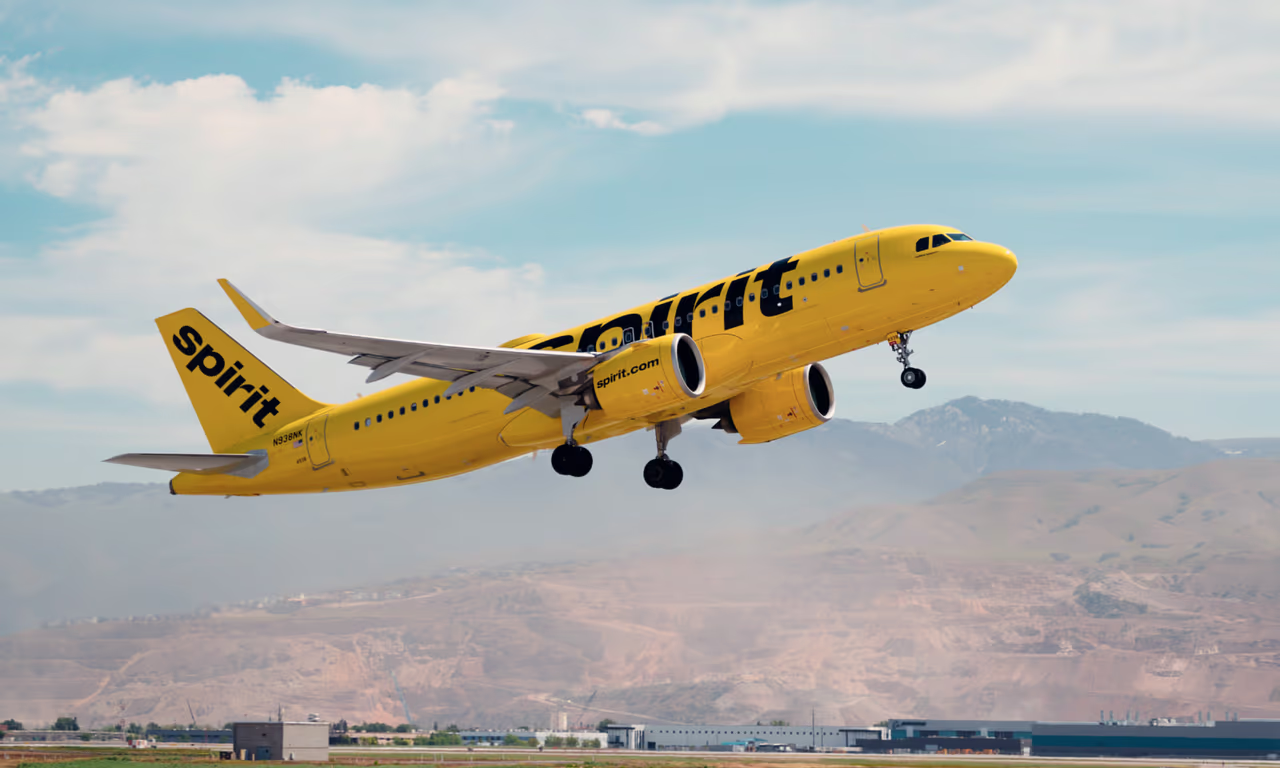
Spirit Airlines filed for Chapter 11 protection a second time in August 2025, less than five months after emerging from its first restructuring in March 2025, according to court filings and contemporaneous reporting at the time. That second filing is how the story ended. This review was written while the airline was still flying, and it covers how Free Spirit earned and redeemed, where the elite tiers paid off, how the cobranded credit card worked, and how the program compared with Frontier Miles and Allegiant Allways Rewards.
Quick Summary
Who it suited: Cost-sensitive domestic flyers who already booked Spirit a few times a year and wanted baggage and seat value out of the program rather than aspirational redemptions.
Standout benefit: Award flights started at 2,500 points with no blackout dates, every seat on every flight was available for points, and Free Spirit elites and Free Spirit Travel More Mastercard holders were eligible for complimentary upgrades to Big Front Seat and Go Comfy at boarding.
Biggest drawback: Spirit had no airline transfer partners, and the second Chapter 11 ended in the airline closing.
The card: The Free Spirit Travel More World Elite Mastercard waived its $79 annual fee in year one and earned Status Qualifying Points on card spend, with complimentary upgrades and two free checked bags.
Free Spirit Program Overview
Free Spirit was the loyalty program for Spirit Airlines, a U.S. ultra-low-cost carrier headquartered in Dania Beach, Florida. The program was free to join, had three membership levels (base, Silver, Gold), and was fully revenue-based. Members earned points on what they spent, not on the distance flown. Spirit confirmed that earning and redemption framework in its May 2025 guest-experience announcement and carried it through the August 2025 Chapter 11 filing.
While the program ran, these were the key facts. Award seats started at 2,500 points one-way for the shortest domestic routes. Award pricing was dynamic, scaled to the underlying cash fare. Every seat on every flight was bookable with points, including the Go Comfy extra-legroom bundle and the Go Big bundle that includes the 36-inch Big Front Seat. Free Spirit points expired 12 months after the last earning or redemption activity, so any flight, credit card transaction, or partner-portal purchase reset the clock.
Earning Free Spirit Points
Free Spirit earning rates were tiered by elite status. Every member earned one Status Qualifying Point per dollar on fares and fare add-ons, which was the currency that drove elite qualification.
Earning on Spirit flights:
- Base members earned 6 points per dollar on fares and 12 points per dollar on À La Smarte add-ons, including bags, seats, and onboard purchases.
- Silver members earned 8 points per dollar on fares and 16 points per dollar on add-ons.
- Gold members earned 10 points per dollar on fares and 20 points per dollar on add-ons.
The cobranded credit card was the second meaningful earn channel. The Free Spirit Travel More World Elite Mastercard, issued by Bank of America, earns 6 points per dollar on Spirit purchases, 2 points per dollar on dining and grocery store purchases, and 1 point per dollar on everything else. The card also earns 1 Status Qualifying Point per $10 spent, which meant $20,000 of card spend reached Silver and $50,000 reached Gold without flying. The entry-level Free Spirit Travel Mastercard earns 2 points per dollar on Spirit purchases and 1 point per dollar elsewhere with no annual fee.
Free Spirit also ran a dining program (up to 5 points per dollar at participating restaurants for VIP members), an online shopping portal that occasionally posted at 20 or more points per dollar, and a points-purchase option for members topping off an award. Bilt Rewards was the lone outside transfer partner, at 1:1, and for a while that was the most flexible way to feed a Free Spirit balance on a recurring basis. Bilt's current transfer partner list does not include Spirit, so that pathway is no longer open. We covered the Bilt-to-Spirit transfer mechanics when the partnership launched.
Redeeming Free Spirit Points
Free Spirit redemptions were dynamic and revenue-based. The Points Guy valued Spirit points at 1.4 cents per point, slightly above Bankrate's 1.0-cent assessment. In real-world bookings, redemptions landed in the 1.1 to 1.6 cent range depending on the route and the cash fare. The lower end showed up on heavily discounted base fares; the upper end on last-minute itineraries and the Big Front Seat.
The most important 2025 change to the redemption framework was that points covered every fare bundle. Pre-2025, Free Spirit points only paid for base fares. After it, the same points paid for Standard, Go Comfy, and Go Big on the same booking flow, and Spirit cited a Nashville-to-Boston Big Front Seat redemption at roughly 15,000 points plus taxes as the example fare it used to anchor the pitch. Layering an upgraded bundle into a points booking was where Free Spirit produced its strongest per-point value, particularly on flights over two hours.
Spirit charged a $50 fee on award bookings made within 28 days of departure. The fee was waived for primary cardholders of the Free Spirit Travel More Mastercard and for Silver and Gold elites. Awards could also be booked as Points + Cash starting at 1,000 points plus a residual fare. There were no airline partners on the redemption side. Free Spirit points only flew on Spirit-operated flights.
Free Spirit Elite Status
Spirit published two elite tiers, Silver and Gold, and confirmed the qualification thresholds in its 2025 program update.
Free Spirit Silver: Required 2,000 SQPs in a calendar year or 30 qualifying flight segments. Benefits included enhanced earning (8 points per dollar on fares), complimentary seat selection at check-in (excluding Big Front Seat), exit-row assignment 180 minutes before departure, shortcut security and Zone 1 boarding, same-day standby at no charge, points pooling with other Free Spirit members, the waived $50 last-minute redemption fee, and one free carry-on bag.
Free Spirit Gold: Required 5,000 SQPs in a calendar year. All Silver benefits plus 10-points-per-dollar earning on fares, one free carry-on and one free checked bag, free seat selection at booking, free Big Front Seat and exit-row selection at booking, free in-flight snacks and beverages, free Wi-Fi on equipped aircraft, and one free Flight Flex change up to 24 hours before departure.
The complimentary upgrade benefit, which extended to Free Spirit Travel More Mastercard holders as well as Silver and Gold elites, is what changed the value calculus on the program in 2025. Upgrades were awarded at boarding and prioritized by status level. They landed on the Big Front Seat and on Go Comfy, both of which were revenue products in the cabin Spirit actually sold, not minor seat-selection perks. For travelers who flew Spirit four or more times a year, the math on Silver via $20,000 of card spend or organic flying was genuinely favorable.
Free Spirit Travel More World Elite Mastercard
The cobranded card was the closest thing the program had to a hub. The Bank of America-issued Free Spirit Travel More World Elite Mastercard charges a $79 annual fee, waived the first year, and bundled three benefits that drove the program's economics for cardholders.
First, the card earns 6 points per dollar on Spirit purchases, matching the base flying rate, plus 2 points per dollar on dining and grocery purchases and 1 point per dollar elsewhere. Second, the card added two free checked bags for the cardholder and companions on the same reservation, a benefit Spirit confirmed during the 2025 launch, which paid back the $79 fee inside two roundtrips for anyone checking a bag. Third, the card granted the same complimentary Big Front Seat and Go Comfy upgrade eligibility that Free Spirit elites received, awarded at boarding behind status holders.
There is also a no-fee Free Spirit Travel Mastercard, which earns 2 points per dollar on Spirit, 1 point per dollar elsewhere, and includes Zone 2 boarding and a 25% rebate on in-flight purchases. The no-fee card suited an occasional flyer; the World Elite version was the one that earned its keep for anyone using Spirit regularly.
How Free Spirit Compares to Frontier and Allegiant
Among U.S. ultra-low-cost carriers, Free Spirit was the most generous loyalty program while it ran, and it was not particularly close.
Frontier Airlines runs Frontier Miles, which earns at 1 mile per dollar on the cheapest fare class and scales up with elite status. Frontier publishes three elite tiers (20K, 50K, 100K) tied to qualification miles. Frontier's redemption chart started higher than Spirit's, premium-bundle redemption is more limited, and there is no Frontier-equivalent of Spirit's complimentary cardholder upgrade. The Frontier-branded Mastercard, issued by Barclays, earns 5 miles per dollar on Frontier and pairs with the GoWild! all-you-can-fly subscription, which we examined in our Frontier GoWild! Pass review when the latest pricing came out.
Allegiant Air's Allways Rewards program, including the myAllegiant Mastercard issued by Bank of America, earns at 3 to 5 points per dollar on Allegiant purchases. Status is informal and the program leans heavily on cash discounts and a free roundtrip after spend thresholds. Allegiant's announced acquisition of Sun Country, which we covered when the Allegiant-Sun Country deal was announced in 2025, has the potential to reshape the budget-carrier loyalty landscape if and when the regulatory review clears, but as of April 2026 the programs remain separate.
The practical translation at the time: a traveler flying all three carriers got the most value per dollar out of Free Spirit, particularly with the cobranded card. With Spirit gone, Frontier Miles and Allegiant Allways Rewards are what remain in this segment.
Pros and Cons
Pros:
- Award flights started at 2,500 points with no blackout dates, and every seat on every flight was available for points, including Go Comfy and the Big Front Seat.
- Free Spirit Travel More Mastercard holders and elites received complimentary upgrades to Go Comfy and Big Front Seat at boarding, awarded by priority order.
- The cobranded card paid back its $79 annual fee within two roundtrips for any traveler who checked a bag, and earned Status Qualifying Points on card spend.
Cons:
- Spirit had no transfer partners on either side, inbound or outbound, which limited flexibility versus major-carrier programs.
- Points expired after 12 months of account inactivity, a tight window for infrequent flyers.
- Spirit's second Chapter 11 filing, in August 2025, ended in the airline ceasing operations on May 2, 2026.
What Bankruptcy Means for Free Spirit Points
Loyalty programs are corporate liabilities, but in U.S. airline bankruptcies, including the major Chapter 11 cases at Delta, Northwest, United, and American in the 2000s and early 2010s, frequent flyer points have historically survived the process intact. Spirit's first Chapter 11, filed in November 2024 and concluded in March 2025, did not impair Free Spirit balances or invalidate awards. Spirit kept operating, selling tickets and processing redemptions through most of the second case. It stopped on May 2, 2026.
That earlier precedent should not be read as a guide to what happens now. A wind-down is not a restructuring, and neither of the outlets we could read today says anything about what becomes of existing Free Spirit balances or of the cobranded cards. We are not going to guess. If you hold one of the cards, Bank of America issued them and is the party to ask. On the points themselves we have nothing sourced to tell you.
For the broader picture on Spirit's product upgrades during the same window, including how Go Comfy slotted into the cabin and where Big Front Seat redemptions sat on the value spectrum, see our Spirit Airlines premium cabin rollout 2026 update.
Who the Program Suited, While It Ran
It worked for:
- Cost-sensitive domestic travelers who already booked Spirit two or more times a year and put the Free Spirit Travel More Mastercard to work on bag fees and complimentary upgrades.
It never worked for:
- Travelers building a long-term balance for premium-cabin international redemptions, where Alaska Mileage Plan, Air France-KLM Flying Blue or Virgin Atlantic Flying Club paid off better.
- Anyone who flew Spirit rarely enough that the 12-month expiration cycle worked against them.
Final Verdict
By early 2026 Free Spirit had become a stronger program than it was a year before, with all-bundle redemption, complimentary upgrades for elites and cardholders, and a working cobranded card. The second Chapter 11 filing in August 2025 was the variable that overrode all of that, and it is how the story ended: Spirit ceased operations on May 2, 2026. Nothing in this review is a recommendation now. It stands as a record of what the program offered while the airline was flying.
Updated October 2, 2026: Spirit Airlines ceased operations on May 2, 2026. The airline announced an orderly wind-down effective immediately and canceled all flights, so Free Spirit points can no longer be redeemed for Spirit flights. We added a status line, rewrote the title, summary fields, key points and verdict, put the body in the past tense where it described a live program, and removed advice to book or hold. Separately, Bilt's current transfer partner list no longer includes Spirit, so we corrected the transfer lines too. Spirit's own site and investor-relations page could not be read today (both fail to resolve), so the shutdown rests on two independent outlets.