


Carry-on size limits are nearly standard across US airlines and not standard at all once you leave the country. The common US number is 22 x 14 x 9 inches. Europe and the Gulf carriers measure in centimeters, cap the weight, and enforce it at the gate.
We read each airline's own baggage page on September 12, 2026. Ten airlines published their limits. Eight would not load for us at all, and those are named at the end rather than filled in from memory.
The Short Version
Buy a bag at 22 x 14 x 9 inches and you're legal on American, Delta, United, Alaska and JetBlue. That same bag is too big for Frontier's free personal item, too big for easyJet's free small bag, and heavier than Emirates allows in economy if you fill it.
Weight is the real difference. US carriers mostly don't publish a carry-on weight limit. Emirates does, and it's 7 kg in economy.
US Airlines
| Airline | Carry-on | Personal item | Weight limit |
|---|---|---|---|
| American | 22 x 14 x 9 in (56 x 36 x 23 cm), including handles and wheels | 18 x 14 x 8 in (45 x 35 x 20 cm) | Not published |
| Delta | 22 x 14 x 9 in (56 x 35 x 23 cm) and 45 linear in (114 cm), including handles and wheels | By fit, no dimensions published | Not published |
| United | 9 x 14 x 22 in (23 x 35 x 56 cm), including handle and wheels | 9 x 10 x 17 in (22 x 25 x 43 cm) | Not published |
| Alaska | 22 x 14 x 9 in, 45 linear in, including wheels and handle | One personal item, no dimensions published | Not published |
| JetBlue | 22 x 14 x 9 in (55.88 x 35.56 x 22.86 cm), including wheels and handles | 17 x 13 x 8 in (43.2 x 33 x 20.32 cm) | None, if you can lift it |
| Southwest | 10 x 16 x 24, no unit stated on the page | By fit, no dimensions published | Not published |
| Frontier | 24 x 16 x 10 in, including handles, wheels and straps | 18 x 14 x 8 in, including handles, wheels and straps | 35 lb on each |
A few of those entries need a sentence.
American measures the same 22 x 14 x 9 as most of its rivals. Its carry-on page says the bag "Cannot exceed 22 x 14 x 9 inches (56 x 36 x 23 cm) including handles and wheels." It also allows a soft-sided garment bag up to 51 inches in total dimensions.
American adds a warning most travelers meet only at the gate. On some aircraft, "If your carry-on is larger than the personal item dimensions, you must valet your bag before boarding," with a footnote that Embraer ERJ-175 planes take carry-ons normally.
Delta publishes two numbers at once. On its carry-on page, the bag must fit 22 x 14 x 9 inches and stay under "45 linear inches (114 cm)" in total, and Delta says those measurements "include any handles or wheels." Small musical instruments that fit overhead or under the seat are exempt from the linear rule.
United is stricter than it looks on the personal item, at 9 x 10 x 17 inches. Its page also limits Basic Economy: "For most trips you can only bring one personal item when you're flying in Basic Economy," with exceptions for South America, transatlantic and transpacific routes.
Two more United details are worth knowing. Star Alliance Gold members keep a free carry-on in Basic Economy. And if you fly United Express operator CommutAir, "you're only allowed one personal item," regardless of fare.
JetBlue is the most relaxed on weight. Its carry-on page says the airline "lets you bring one carry-on and one personal item on all fares, with no weight limit as long as you can lift it."
Southwest publishes "10 x 16 x 24" with no unit on the page. Inches is implied by the context, and the page says nothing about whether wheels and handles count.
Frontier is the outlier. Its carry-on allowance is bigger than everyone else's at 24 x 16 x 10 inches, but the carry-on is a paid add-on rather than a free allowance, and both bags carry a 35 pound limit "including handles, wheels and straps."
International Airlines
| Airline | Carry-on | Personal item | Weight limit |
|---|---|---|---|
| Air Canada | 23 x 40 x 55 cm / 9 x 15.5 x 21.5 in, wheels and handles included | 33 x 43 x 16 cm / 13 x 17 x 6 in | None, but you must lift it unaided |
| easyJet | Large cabin bag 56 x 45 x 25 cm, including handles and wheels, paid | Small bag 45 x 36 x 20 cm, free | 15 kg on each |
| Emirates | 55 x 38 x 22 cm (21.6 x 14.9 x 8.6 in) | Business and First add a briefcase or garment bag | 7 kg economy, 10 kg premium economy |
Air Canada answers the question most airlines dodge. Its carry-on page says "No weight limit applies to carry-on baggage, but it must be light enough that you can store it in the overhead bin without assistance." It also warns that it uses "automated carry-on baggage sizers at pre-security and/or pre-boarding."
Two Air Canada rules catch people. Economy Basic fares bought on or after January 3, 2025 "allow for only one (1) personal item on board when travelling on some itineraries." And a handbag counts as free only if it's small: "A small purse max. 25 x 30 x 14cm (10 x 12 x 5.5 in). Larger purses will be included in your carry-on allowance."
easyJet gives everyone a free under-seat bag at 45 x 36 x 20 cm and sells the larger cabin bag. Both are capped at 15 kg, and both measurements include "any handles and wheels."
Emirates is the one to plan around. On its cabin baggage page, economy gets 7 kg, premium economy 10 kg, and the size is 55 x 38 x 22 cm. Business and First get a 7 kg bag plus a briefcase or garment bag, with the briefcase capped at 45 x 35 x 20 cm.
Emirates also changes the rule by departure point. Flying out of India, "you are allowed one piece of carry-on baggage," sized no more than 115 centimeters in total. Departing Brazil, the allowance rises to 10 kg. Everything must "fit either under the seat in front of you or in one of the overhead lockers."
What the Numbers Don't Tell You
Wheels and handles count almost everywhere. American, Delta, United, Alaska, JetBlue, Frontier, Air Canada and easyJet all say so in writing. If your bag is 22 inches of shell plus wheels, it's over.
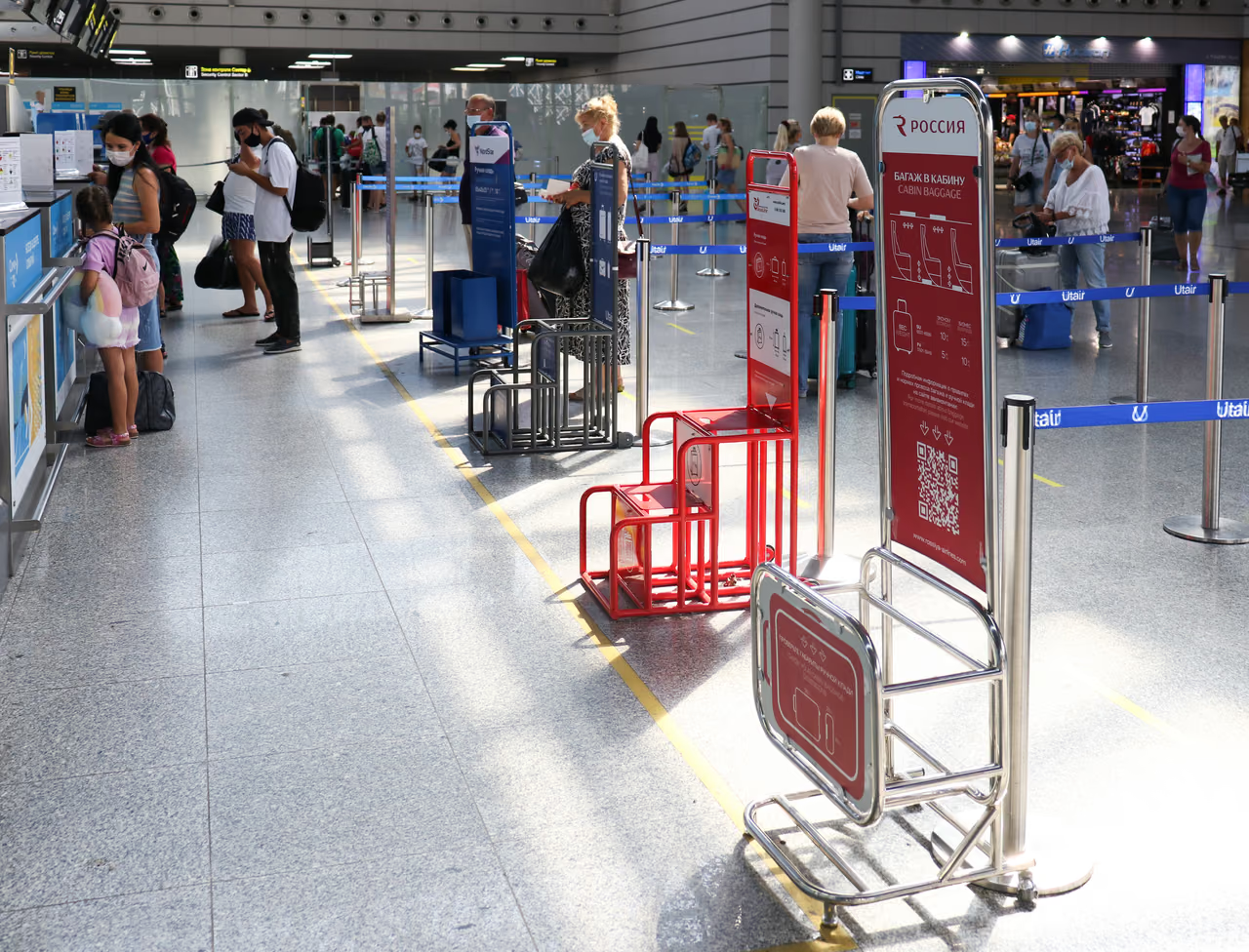
Sizers decide, not tape measures. Air Canada says it runs automated sizers before security and before boarding. A bag that fits your closet measurement and not the frame is going in the hold.
A gate check can cost you your batteries. If your bag gets taken at the gate, spare batteries and power banks have to come out and travel with you in the cabin. Our packing checklist covers that rule and the rest of what goes where.
Basic fares change the answer. United restricts most Basic Economy travelers to a personal item. Frontier sells the carry-on separately. The size chart is only half the question, and the fare is the other half.
The Eight We Could Not Read
Every airline below was tried repeatedly on September 11 and 12, 2026, by two different tools.
- Spirit: the domain did not resolve from our environment at all.
- Hawaiian: HTTP 403, then a redirect loop back to the home page.
- Allegiant: HTTP 403 behind a Cloudflare challenge whose only text is "Just a moment..."
- British Airways: every request timed out with zero bytes received.
- Lufthansa: HTTP 403 on every locale we tried.
- Air France: the connection was reset before any content arrived.
- Qatar Airways: HTTP 403 and connection resets.
- Ryanair: HTTP 200, but the page served 48 characters of text and no baggage content.
Numbers for all eight are easy to find elsewhere. They're not in this chart, because we couldn't read them on the airline's own site, and a carry-on limit you can't verify is exactly the kind of number that changes quietly.
What Counts As the Personal Item
Most airlines define the personal item by where it goes, not by what it is.
Delta puts it simply. Every passenger can bring "1 carry-on bag and 1 personal item free of charge (such as a purse, laptop bag or item of similar size that will fit underneath the seat in front of you)."
Southwest words it the same way. Its free items are a carry-on plus "one smaller, personal type item (e.g., purse, briefcase, laptop computer case, backpack, small camera), provided that such items can be stowed under a seat or in an overhead compartment."
easyJet splits the two by location. The free small bag "must be kept under the seat in front of you." The paid large one "Needs to fit in an overhead locker."
American publishes a separate list of things that count as neither your carry-on nor your personal item, which is worth reading before you assume a coat or a duty free bag is free.
The practical test is the seat in front of you. If it fits under there, it's your personal item at almost every airline in this chart.
How to Measure a Bag Properly
Measure it the way the airline does, or the sizer will do it for you.
Stand the bag upright, packed, with anything in the outside pockets. Measure floor to the top of the handle. That's the height most people get wrong, because a retracted handle still counts.
Then measure the width side to side, and the depth front to back at the thickest point. Wheels are part of the depth or the height, depending on how the bag sits.
Add the three numbers if the airline uses a linear limit. Delta and Alaska both use 45 linear inches for carry-on. A bag can pass all three individual measurements and still fail the total.
Soft bags cheat, and that's the point. A packed soft-sided bag squeezes into a sizer. A hard shell at the same nominal size does not.
What Actually Happens at the Gate
The carry-on rule is enforced twice, and the second time is the one that costs you.
At security, nobody measures your bag. At the gate, an agent might, and a full flight makes that more likely.
United says plainly that your bag "might be gate-checked if a plane runs out of overhead space, your bag is over the size limit or you're over your carry-on bag allowance." American's valet rule works the same way on smaller aircraft.
Gate-checking isn't the end of the world. It costs you time at the other end and, more importantly, it separates you from anything you shouldn't check. Take your spare batteries, power banks, medication and documents out before you hand the bag over.
Regional jets are the usual culprit. If your flight number belongs to a United Express, Delta Connection or American Eagle operator, assume the bin space is smaller than the mainline chart suggests.
How to Use This
Measure your bag with the wheels on. Write the three numbers on a tag inside the lid.
Then check the airline's own page before a trip on a carrier you don't fly often, especially outside the US. The centimeter numbers vary by two or three either way, and that's enough to matter.
If you're buying, buy for the smallest airline you fly, not the biggest.
One more thing worth knowing if you fly the ultra low cost carriers: the free bag is the small one, and the overhead bag is the product they sell. Our guide to airlines with a free carry-on sorts out which is which.