



Alaska Airlines spent most of the last decade as the boutique loyalty program everyone in the points world quietly loved and most casual flyers ignored. That changed on September 18, 2024, when Alaska Air Group completed its acquisition of Hawaiian Airlines, with a combined fleet that includes Airbus A330 and Boeing 787 widebodies, and Honolulu became its second largest hub. Today the two airlines share one loyalty program, Atmos Rewards, which took over from Mileage Plan. If you've been sitting on Alaska points waiting for a reason to care again, this is it. The program that used to live or die on a handful of Cathay Pacific and JAL sweet spots now sits on a much bigger map, with the same oneworld partner awards on top. This guide walks through what the combination changed, where Atmos Rewards still earns its reputation as one of the best US airline currencies, and where the cracks are starting to show.
What the Hawaiian Merger Actually Changed
The deal closed September 18, 2024. Alaska Air Group owns Hawaiian Airlines, and the two keep their distinct brands. The piece that matters for points-and-miles readers is the loyalty side: both airlines now run on Atmos Rewards, and you earn and redeem the same points on Alaska and Hawaiian. Alaska's status chart notes that Atmos Gold was formerly Pualani Platinum.
The fleet picture is the bigger structural change. At the close, Alaska Air Group's fleet included 24 Airbus A330s and two Boeing 787s alongside its Boeing 737s, 717s and Embraer 175s, and Honolulu became its second largest hub behind Seattle. Atmos points book awards on Alaska, Hawaiian, oneworld airlines and Alaska's other global partners, so the route map you can redeem on reaches well beyond either airline's own network.
Atmos Rewards as a Points Currency, Not a Frequent-Flyer Afterthought
Atmos Rewards still publishes a partner award chart, priced by region and distance, which is where you can still build genuine value into the math. Alaska calls the chart's figures starting rates that can vary by route, partner pricing and demand, so check the price before you count on it.
Valuations are a judgment call. Say you count on 1.2 to 1.5 cents per point as a baseline: hit the right partner premium-cabin redemption and you can do much better. The hubs are Seattle, Honolulu, Portland, Anchorage, Los Angeles, San Diego and San Francisco. The published partner chart is what makes the program worth holding points in. Once that chart goes, the conversation changes. Until then, this is one of the last US programs where the math still rewards reading the fine print.
The Partner Sweet Spots That Actually Move the Needle
If you ask longtime members which redemption keeps them locked in, most name Cathay Pacific business class. Alaska's partner chart prices Asia Pacific business class from 75,000 points for trips of 5,001 to 7,000 miles and from 85,000 for 7,001 to 10,000 miles, and those are starting rates. The hard part is availability, so if you can be flexible on dates, this is still the headline redemption of the program.
Japan Airlines is the second sweet spot worth memorizing. JAL is a oneworld airline, so its premium cabins price on the same Asia Pacific chart: first class starts at 110,000 points and business at 75,000 for trips of 5,001 to 7,000 miles. JAL first is one of the few remaining true international first products in the sky, and business is the more practical play.
Qantas to Australia is the third. Business class to Sydney or Melbourne is one of the cleanest redemptions because Alaska allows one stopover of up to 14 days on each one-way of an eligible international award. Finnair to Europe through Helsinki is the fourth, and it's underrated because most of the points crowd defaults to Star Alliance for European award space. The fifth is American Airlines flights booked with Atmos points: the partner chart starts at 4,500 points one-way in economy for trips under 700 miles and 7,500 for 701 to 1,400 miles, so if you need to position somewhere east of the Mississippi, price the trip on alaskaair.com before you spend AAdvantage miles.
Atmos Rewards Elite Status, Restructured
Status now runs on status points, which reset to zero every January 1. The tiers are Atmos Silver at 20,000 status points, Atmos Gold at 40,000, Atmos Platinum at 80,000 and Atmos Titanium at 135,000, with milestone perks at 10,000, 30,000, 55,000, 95,000, 125,000, 150,000, 200,000 and 250,000. Every tier gets complimentary First and Premium Class upgrades when available, preferred seating and free checked bags (one at Silver, two at Gold, three at Platinum and Titanium, for you and every companion on the same reservation).
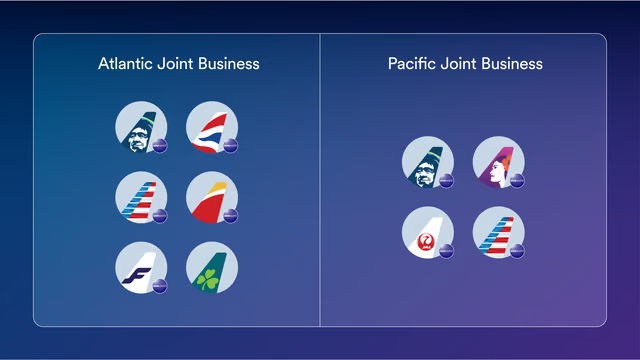
The tiers map to oneworld: Silver is oneworld Ruby, Gold is Sapphire, and Platinum and Titanium are Emerald. Gold and above get oneworld Business Class lounge access with a guest on international flights outside the US, Canada and Mexico, and Platinum and Titanium add oneworld First Class lounges. That alliance-wide reach across American, British Airways, Cathay Pacific, Qantas, JAL and Finnair is the angle that makes Atmos status worth chasing if you live in the West and fly the Pacific. You don't have to fly for all of it, either: the Atmos Rewards cards earn status points on purchases (1 per $3 on the Ascent, 1 per $2 on the Summit).
The Atmos Rewards Ascent Card: The Perk Stack That Punches Above the Fee
The Atmos Rewards Ascent Visa Signature from Bank of America is the program's cobrand workhorse, and the math holds up at the $95 annual fee. The current online offer is 50,000 bonus points and a $99 Companion Fare (plus taxes and fees from $23) after you spend $1,500 or more on purchases within the first 90 days. Say you value points at 1.2 to 1.5 cents: the 50,000-point bonus is $600 to $750 in travel, and more if you put it toward a Cathay or JAL business class seat.
The recurring perks are where the card earns its keep. Cardholders get a free checked bag and preferred boarding for themselves and up to six guests on the same reservation when they pay for an Alaska Airlines or Hawaiian Airlines flight with the card, which alone covers the fee for any family that flies the airline once a year. Three points per dollar on eligible Alaska and Hawaiian purchases, two points on gas, EV charging, cable, streaming and local transit (including rideshare), one point elsewhere. Twenty percent back on inflight purchases when you pay with the card. A $100 discount on Alaska Lounge+ membership if you put the renewal on the card. A 10 percent bonus on points earned from card purchases when you have an eligible Bank of America deposit account.
The benefit that justifies the card for most readers is the annual Companion Fare: a $99 Companion Fare (plus taxes and fees from $23) each account anniversary after you spend $6,000 or more on purchases within the prior anniversary year. Alaska says it works on Alaska or Hawaiian-operated flights within North America, including Hawaii. Say the round trip you'd buy anyway costs $500 and the taxes and fees come in at the $23 minimum: the companion seat saves you $378, almost four times the annual fee.
Earning Atmos Rewards Points Without Flying
Points earned only at the wing tip is a 2010 strategy. The current Atmos Rewards earning stack runs three deep. The cobrand carries the everyday spend. The Atmos Rewards Shopping portal handles online retail and also earns status points (1 for every 3 base points). The third lever is Bilt Rewards, which lists Atmos Rewards as a 1:1 transfer partner. If you're paying rent through Bilt, this is the fastest way to top up an Atmos balance without setting foot on an airplane. Alaska also plans to let customers with eligible Bank of America cards transfer points into Atmos Rewards in 2027.
Say you run $40,000 a year through the cobrand, mostly at 1 point per dollar, and add some portal shopping and a Bilt transfer: you're past halfway to a 75,000-point Asia Pacific business award from the card alone, and a domestic award or two is well within reach.
The oneworld Angle
Alaska and Hawaiian are both oneworld members, which is what turned the program from a regional currency into a globally useful one. American, British Airways, Cathay Pacific, JAL, Qantas, Finnair, Iberia and Qatar are all oneworld airlines, listed in the oneworld member network, and Atmos points book oneworld awards on alaskaair.com. If you've ever wrestled with British Airways Avios search or the AA partner-award flow, the Alaska interface is a relief.
What's Not Working
Three things to know before you commit your earning strategy to Atmos Rewards. First, the chart figures are starting rates: Alaska says actual prices can vary with the route, partner pricing, demand and limited availability at the lower tiers, and partner awards carry a $20 fee per person each way (waived for Summit cardholders). Second, the cobrand is solid but not best-in-class for everyday spend outside the Alaska ecosystem. If you don't fly Alaska enough to use the Companion Fare and you don't check bags often, a flexible-points card will likely out-earn it. Third, every Alaska and Hawaiian hub is in the West or the Pacific, so anyone living east of the Mississippi will lean on partners, mainly American, for domestic award space. For the Tuesday-morning Atlanta-to-Newark booking, this is not your program.
Where I'd Start
If you live on the West Coast, fly to Asia or Hawaii more than once every two years, and don't already have a strong cobrand position, the Atmos Rewards Ascent is the cleanest sub-$100-fee airline card I know of. Pair it with the Atmos Rewards Shopping portal and Bilt transfers, and you're building toward a Cathay or JAL business class seat on a timeline that actually feels achievable. The Hawaiian combination gave the program a second wind. The published partner chart is what keeps it interesting. Use both while they're still here.
Updated October 1, 2026: Corrected the card's current name, welcome offer, earning and bag benefit, and the Companion Fare's price and terms, from Bank of America's card page. Renamed Mileage Plan to Atmos Rewards where it describes the current program, replaced the old MVP elite tiers with Atmos status tiers, corrected the partner award prices to Alaska's current chart (the article had Cathay Pacific business class at 50,000 points), updated the shopping portal and Bilt transfer details, and removed unsourced claims about integration timing, transfer bonuses and the oneworld join date.