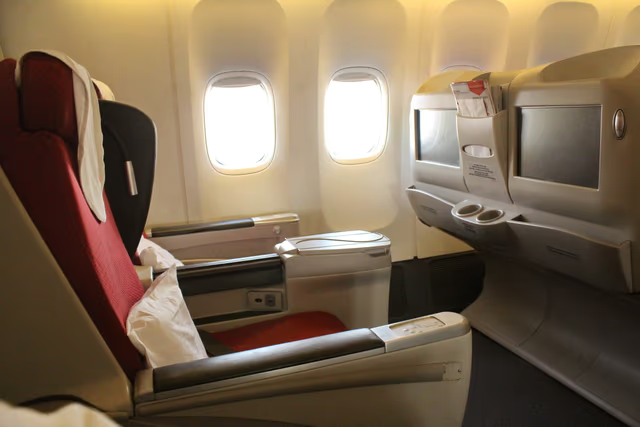



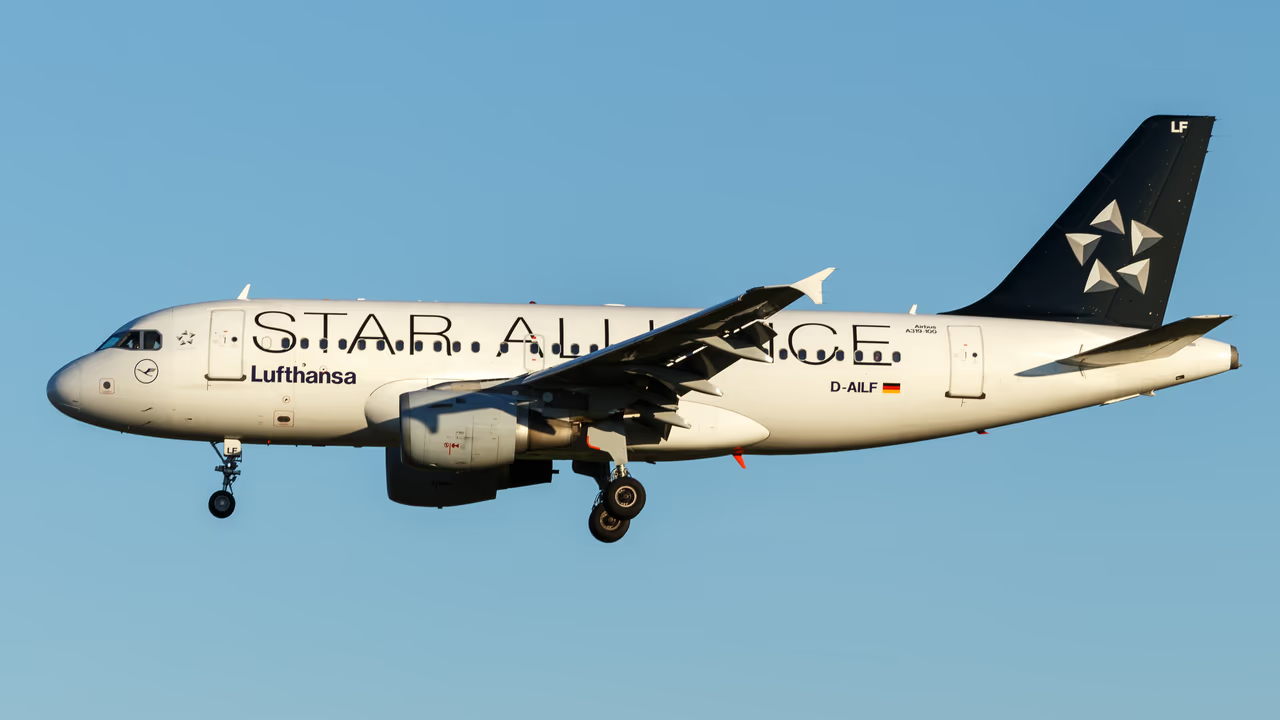
A partner flight is a seat operated by one airline that you can book with a different airline's miles. The seat is identical. The price in points is not, because each program sets its own rate for the same inventory, and the spread between programs on one route is often wide enough to change which cabin you can afford.
That spread is the whole game. Learn to price one seat in three programs and you stop overpaying for award travel permanently.
What a Partner Flight Actually Is
Two different things get called partner flights, and confusing them costs people money.
The first is a code-share. Federal regulation defines a code-sharing arrangement as one "whereby a carrier's designator code is used to identify a flight operated by another carrier," and defines the operating carrier as "the carrier that is operating the aircraft." So a flight sold as United 8842 and flown by Lufthansa metal is a code-share. United's code, Lufthansa's aircraft, Lufthansa's crew, Lufthansa's cabin.
The second is a partner award. That is when you spend Program A's miles on a seat operated by Airline B, booked under Airline B's own flight number. This is the one that saves you points.
The distinction matters because many programs price code-shares at their own rate rather than the partner rate, and some will not let you book a code-share with miles at all. If the booking page shows you a flight numbered with the program's own code but operated by someone else, you are usually looking at the expensive version of that seat.
The tell is on your screen already. Part 257 requires carriers and ticket agents to identify clearly and prominently every flight whose designator code is not the operating carrier's. That line reading "operated by" is not fine print. It is the thing you are shopping for.
Airline Alliances and Bilateral Partners
Most partner access runs through the three global alliances.
Star Alliance says it unites 26 airlines reaching over 1,150 airports in 190 countries. It also runs two categories most explainers miss: Connecting Partners, currently Juneyao Air, which are regional carriers integrated into the wider network, and Intermodal Partners, currently Deutsche Bahn and ÖBB, which put trains on an airline ticket.
oneworld covers more than 900 destinations across 170 territories. Note that S7 Airlines has been suspended from the alliance since 19 April 2022.
SkyTeam lists 18 active members, including Air France, KLM, Delta, Korean Air, Virgin Atlantic, China Eastern, Vietnam Airlines and Saudia. Aeroflot is suspended.
Outside the alliances sit bilateral partnerships, and those are often where the real value hides, because fewer people look there. Alaska and Emirates, Virgin Atlantic and ANA, Qatar and JetBlue: none of those pairs share an alliance, and all of them let one program's miles buy the other's seats.
Why One Seat Has Several Prices
The operating airline decides how many award seats to release. It loads that inventory once. Every partner program then sees the same seats and prices them under its own rules.
Four things drive the spread.
Fixed chart against dynamic pricing. Some programs still publish a table: this region to that region, this cabin, this many miles, regardless of what the cash fare is doing. Others price awards off demand. On an expensive date, a chart program is dramatically cheaper for the identical seat, and on a cheap date the dynamic program can win.
Surcharge pass-through. Carrier-imposed surcharges are a cash amount the operating airline attaches to the fare, and each program decides whether to pass them to you. Aeroplan, for example, states plainly that there are no cash surcharges on flight rewards with Air Canada. Whether a given program absorbs surcharges on a given partner is a per-program, per-partner question, and it is worth several hundred dollars on a transatlantic business class ticket.
Partner premiums. Several programs charge more for a partner seat than for their own metal, as a deliberate policy. That premium is why the obvious program is often the wrong one.
Cabin banding. Programs disagree about what counts as business versus premium economy on some aircraft, and about whether a mixed-cabin itinerary prices at the highest cabin flown or a blend.
None of that is arbitrary. It is four independent policy choices, made by four different loyalty departments, applied to one physical seat.
How to Price the Same Seat in Three Programs
This is a mechanical process and it takes about ten minutes once you know the route.
- Find the operating flight first. Search the route as a cash booking and note the operating carrier and flight number on the segment you want. Not the marketing code. The operator.
- List that carrier's partners. Its alliance plus its bilateral partners. That list is your set of candidate programs.
- Search the same date in each candidate program. You are looking for the same flight number to appear. If it does, that program can sell you that seat.
- Record two numbers per program, the miles and the cash. A booking that is 20,000 miles cheaper and $480 more in surcharges is not cheaper.
- Check what it costs to change your mind. Change and cancellation rules follow the program that issued the ticket, not the airline flying you, and they vary from free to punitive.
Step three is where most people stop early. If a partner program does not show the flight, that is not always proof the seat is gone. Some programs hide certain partners from online search entirely and will only ticket them by phone, and a handful still do not display partner space at all on some routes.
Where the Miles Come From
You do not need to fly an airline to hold its currency. Transferable points from a bank program move into most major airline schemes, most commonly at 1:1, and that is what makes this strategy practical rather than theoretical.
The sequence is: find the seat, identify the cheapest program that can book it, then transfer in the exact number of points needed. Transfer after you have confirmed the space, never before. Transfers are one-way and mostly irreversible, and a speculative transfer into a program whose seat has gone is how people end up with 60,000 orphaned miles in a scheme they will never use again.
If you are choosing a card to build that flexibility with, the American Express Gold Card sits on the Membership Rewards side of the fence, and our comparison of the top airline programs for international travel covers which schemes are worth transferring into once you have the balance.
The Programs Worth Learning First
You do not need all of them. You need two or three that cover the regions you actually fly.
For Star Alliance metal, Aeroplan against United MileagePlus is the comparison that decides most transatlantic and transpacific bookings, and Turkish Miles and Smiles has sweet spots that beat both on specific routes. Avianca LifeMiles is the third one in that ecosystem worth knowing.
For domestic US flying the partner picture is thinner, and the answer is usually the program of the airline you fly. Southwest is the one to understand separately, because its value comes from bank and hotel transfer partners rather than from airline partners.
Watch for partner bonus promotions too. Programs periodically run bonus earning on partner-operated flights, as Emirates Skywards has done on partner airline flights, and those windows change the math on a paid ticket as well as an award.
What You Actually Get on a Partner Ticket
The cabin is the operating airline's, and so is everything inside it. Seat, catering, entertainment, crew. The program you booked with has no influence on any of that, which is the point: you are buying somebody else's product at your program's price.
Elite benefits are the part people get wrong. Within an alliance, recognized status generally travels: an alliance gold tier gets you lounge access and priority handling on member airlines. On a bilateral partnership outside an alliance, that reciprocity is negotiated pair by pair, and it is frequently narrower or absent.
Baggage allowance usually follows the operating carrier on the segment it operates, but the rules for an itinerary that mixes carriers are genuinely inconsistent between programs. Check the allowance on the booking confirmation rather than assuming, especially on an itinerary that starts on one alliance member and finishes on another.
Seat selection is the most common friction. Many partner tickets cannot be seated on the operating airline's website until the ticket number propagates, and some require you to call the operating carrier directly. Book early enough that this is an errand rather than a crisis.
What Happens When a Partner Itinerary Breaks
The disclosure rule is the thing to lean on here. Part 257 exists because passengers were buying tickets without knowing which airline was actually flying them, and it requires the operating carrier to be identified clearly and prominently on itineraries and schedules, disclosed in oral communication the first time a flight is offered, and named in advertising.
Practically, that means you should never be in an airport unsure who to talk to. The operating carrier handles you on the day: the delay, the rebooking, the bag. The program that issued your ticket handles the ticket: refunds, cancellations, and putting miles back.
When those two disagree, the operating carrier usually cannot reissue a partner award ticket into a different partner's inventory without the issuing program's involvement. That is the scenario worth planning around, and it is a reason to leave real connection time on award itineraries that cross carriers rather than shaving it to the legal minimum.
Why Quoted Award Prices Go Stale
You will not find a table here of what each program charges for a business class seat to Europe, and that is deliberate.
Those tables are published inside the programs' own booking engines, which refuse automated access, and the numbers move. Any article quoting them is quoting a snapshot with no date on it, and a stale award chart is worse than no award chart, because it sends you to the wrong program with confidence.
The method above survives a devaluation. A table does not.
Common Partner Award Booking Mistakes
Booking the code-share instead of the operating flight. Same seat, often a much higher price, and sometimes fewer rights when the itinerary breaks.
Transferring points before confirming space. Irreversible, and the seat can vanish while the transfer processes.
Comparing miles without comparing cash. Surcharges are the difference between a good redemption and a bad one on long-haul premium cabins.
Assuming online search is complete. Some programs do not display all partners online. A phone call is occasionally the difference between a seat and no seat.
Forgetting who owns the ticket. Change fees, cancellation rules and refund policy come from the issuing program. Check them before you book, not when your plans change.
Treating a shortage of space as a shortage of seats. Award inventory and the seat map are different things. A flight can be half empty and release nothing, and it can be nearly full and release two business class seats the week before departure.
Ignoring the return. Pricing one direction brilliantly and the other direction badly is the most common way a good redemption turns average. Price both, and be willing to book them in two different programs.
What I Would Actually Do
Pick one route you fly regularly and price it in three programs on the same date. Write down the six numbers, three in miles and three in cash. That single exercise teaches more about partner pricing than any chart, because it shows you the size of the gap on a route you care about.
Then hold your points in a transferable currency rather than committing them to one airline, and keep them there until you have a confirmed seat in front of you. Star Alliance and Aeroplan publish their own member and partner lists, and those are the lists to price against. The whole advantage of this approach is optionality, and the moment you transfer, you have spent it.
Do that twice a year and you will book premium cabins for what other people pay for economy, on exactly the same airplane.