



The Altitude Reserve is closed to new applicants. U.S. Bank no longer lists it among the cards it offers, and the application page now redirects to the rest of the lineup. Everything below still applies if you already hold the card; it is no longer a card you can apply for.
The U.S. Bank Altitude Reserve earns 3x on travel and on mobile wallet purchases, and that second category is the reason the card has a following. It carries a $400 annual fee and a 50,000-point welcome bonus.
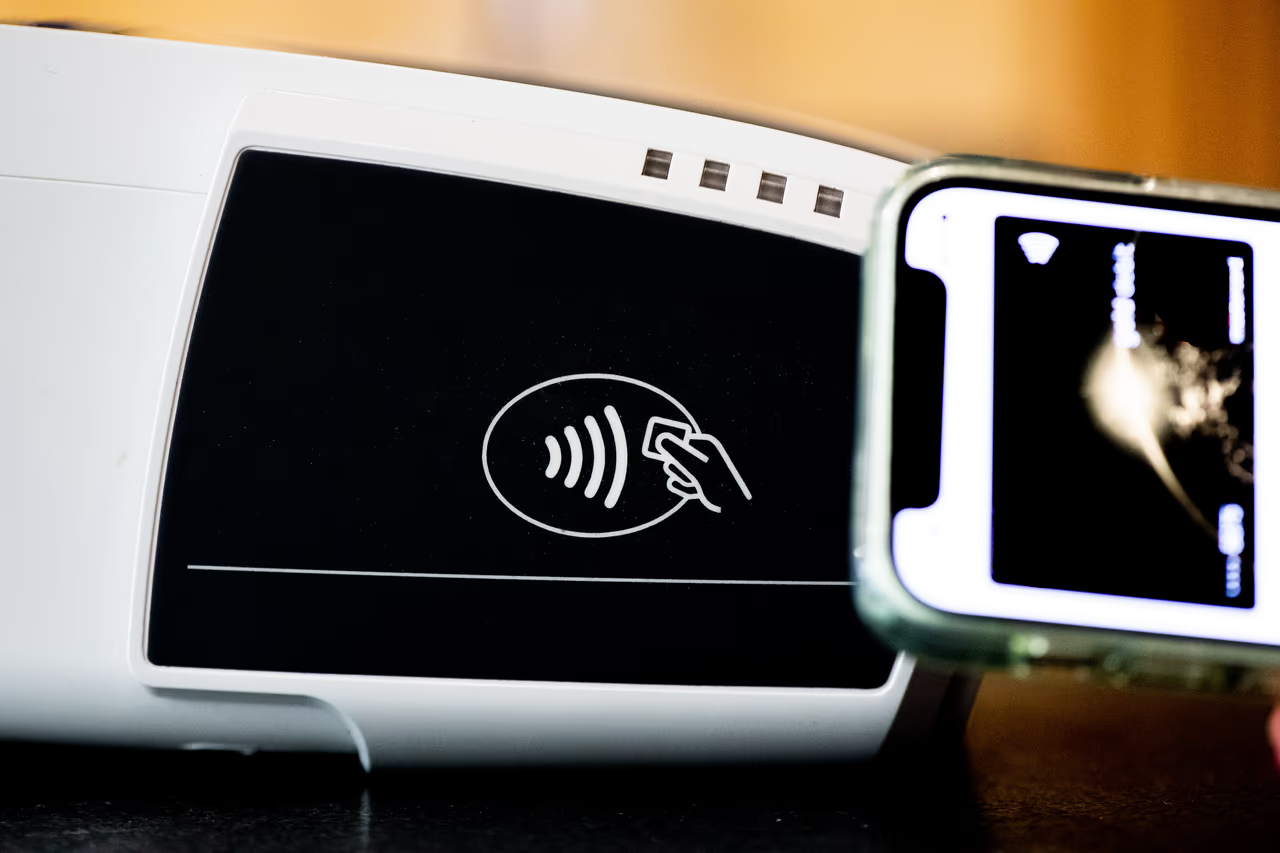
Mobile wallet is not a merchant category. It is a payment method, which means the 3x applies wherever you can tap, regardless of what the store sells.
What the Card Earns
Two rates, and one of them is unusual.
3x points per $1 on travel and mobile wallet purchases. Travel is the ordinary half. Mobile wallet is the half that makes this card interesting, because it covers any merchant that accepts Apple Pay, Google Pay or Samsung Pay.
1x point per $1 on everything else. Anywhere you cannot tap, the card is a flat 1x, and there is no middle tier.
That structure produces an unusually binary card. Your return depends almost entirely on what proportion of your spending can go through a phone.
Who the Mobile Wallet Category Actually Fits
Contactless acceptance has expanded enormously, and in most cities a large share of everyday spending can now be tapped. Grocery stores, pharmacies, coffee, transit, fast food and an increasing number of restaurants all take it.
The gaps are predictable. Most online spending cannot use a mobile wallet in the way the category requires. Recurring bills, insurance premiums, rent and anything you pay by bank transfer sit outside it. Some large retailers still decline contactless entirely.
The honest test is to look at last month's statement and mark which lines could have been tapped. If that number is above roughly two thirds, the card earns like a premium 3x card on most of your spending. If it is under a third, it earns like a 1x card with a $400 fee.
The Break-Even, in Points
The fee is $400. Working out what that requires is the most useful thing you can do before applying.
If your points are worth 1.5 cents to you, the fee costs 26,667 points of value each year. Earning that back through the 3x category alone takes about $8,900 of tappable spending, before counting any statement credits the card carries.
At 2 cents per point the fee costs 20,000 points, and the required spending drops to about $6,700. At 1 cent it costs 40,000 points and you need roughly $13,300.
Those three numbers are the whole decision. Pick the one matching your realistic redemption rate and compare it against what you actually tap in a year.
The Welcome Bonus in Context
50,000 points is a meaningful opening balance, and at most sensible valuations it covers the first year's fee with room left over.
Treat it as a first-year subsidy rather than as the reason to hold the card long term. A welcome bonus is paid once, and the question that matters is whether the earning structure justifies year two.
Where This Card Sits Against Its Siblings
U.S. Bank runs several cards in the same family, and they solve different problems.
The Altitude Go carries no annual fee and leans toward dining. The Altitude Connect sits between the two. The Cash+ lets you choose bonus categories, which suits people whose spending concentrates in a few predictable places.
The Altitude Reserve is the only one built around the payment method rather than the merchant. That is what you are paying the $400 for.
Who Should Not Carry It
Someone whose spending is mostly online, mostly recurring, or mostly at merchants that do not accept contactless will earn 1x on the bulk of it. The fee is difficult to justify from earning alone in that situation, and a no-fee flat-rate card will do better.
Someone who wants a card they never think about is also poorly served. Getting value here requires remembering to tap, which sounds trivial and is the most common reason people underperform the card's headline rate.
Anyone in that position is better off with a straightforward 2 percent card, or with one of the no-fee options above.
The Habit the Card Demands
This is a card that rewards a behavior change, and the behavior is small but constant.
Set the Altitude Reserve as the default card in your phone wallet. Leave the physical card at home for anything you can tap. When a merchant's terminal does not take contactless, that purchase belongs on a different card, because 1x is not competitive.
People who do this consistently report the card performing close to its ceiling. People who tap sometimes and swipe otherwise end up somewhere in the middle, paying a premium fee for a mid-tier return.
How It Compares to a Flat-Rate Card
A 2 percent cash-back card returns a known 2 cents per dollar with no thought required and no annual fee.
The Altitude Reserve returns 3 points per dollar on tappable spending. At 1.5 cents per point that is 4.5 cents per dollar, which is comfortably ahead. At 1 cent per point it is 3 cents per dollar, still ahead, but the $400 fee then needs $13,300 of tapping to neutralise.
The comparison turns on redemption rate more than on earning rate. If you do not have a plan for the points, the flat-rate card quietly wins.
What to Check Before Applying
Confirm the current welcome bonus and its spending requirement directly with the issuer, because offers change and this review records what the catalog holds today.
Check whether an existing banking relationship is required or advantageous, since U.S. Bank has historically weighted that in approvals more than some issuers.
Look at your own tap rate first. Every other consideration is secondary to that single number.
Two Spending Profiles, Run Through the Numbers
The abstract break-even is easier to trust with real spending attached.
Profile one: a city-based renter. $600 a month on groceries, $250 on restaurants, $120 on transit, $180 on pharmacy and convenience, $90 on coffee. Almost all of it taps. That is roughly $1,240 a month, or $14,880 a year, at 3x.
That produces 44,640 points from the bonus category alone, plus 1x on whatever else runs through the card. At 1.5 cents the bonus category is worth $670 against a $400 fee. The card clears comfortably.
Profile two: a suburban household with a mortgage. $900 a month on groceries at a warehouse club that does not take contactless, $400 on utilities paid by bank draft, $300 on insurance billed annually, $250 online.
Very little of that taps. The same $1,850 a month earns 1x, or 22,200 points a year, worth $333 at 1.5 cents. The fee is not covered, and a no-fee 2 percent card would have returned $444 in cash with no effort.
Same fee, same card, opposite outcomes. Nothing about the card changed between those two households except where they shop.
The Category Has a Quiet Ceiling
Mobile wallet spending is limited by acceptance, and acceptance is not uniform.
Warehouse clubs are the most common gap, and they are exactly where high-spending households concentrate grocery budgets. Several large retailers have historically run their own wallet or declined contactless outright, and a card built on tapping earns nothing extra there.
Before applying, check the three merchants you spend the most at. If any of them decline contactless, subtract that spending from your estimate before running the break-even, because it will not come back.
Redemption Is the Other Half
Earning 3x is only half the equation. What those points convert to determines whether the card is a strong performer or an average one.
A points currency that reliably converts above 1.5 cents makes this card excellent. One that you only ever cash out near a penny makes it a 3 percent card with a $400 fee, which is a much narrower proposition.
Decide how you will redeem before you apply rather than afterwards. The break-even table above moves by a factor of two across the plausible range, and that is a larger swing than any difference between competing cards.
If you have not set a working number for your own points, our guide to the break-even math between cash and points walks through how to arrive at one and how to apply it at the moment of booking.
Holding It Alongside Other Cards
This card is not a one-card wallet, and it is not designed to be.
The natural pairing is something that covers what the Reserve does not: online spending, recurring bills, and merchants without contactless. A flat-rate 2 percent card handles all three and costs nothing to hold.
Run the Reserve as the tap card and the flat-rate card as the everything-else card. That combination captures most of the available value without asking you to track rotating categories or quarterly activations.
The Short Version
The Altitude Reserve is a strong card for someone whose everyday spending runs through a phone, and an expensive 1x card for someone whose spending does not. The 3x mobile wallet category is genuinely differentiated, and no other major card treats the payment method as the bonus category.
Work out your tappable share of spending, pick your realistic points valuation, and check the break-even. The answer will be obvious once those two numbers are in front of you.