


The best-kept secret in Alaska's loyalty program is that you never have to fly Alaska Airlines to use it. The program is called Atmos Rewards now. Alaska made the switch on August 20, 2025, telling members, "As of today, Mileage Plan members are now Atmos Rewards members." Your points book award travel on Alaska, Hawaiian, oneworld alliance member airlines and Alaska's global partners.
The partner side is where it gets interesting. Alaska's airline partners page lists 30+ airline partners: 14 oneworld airlines, eight global partners and ten regional ones.
This guide is about spending points on those partners: which airlines you can book, how the partner award chart works and how to read it, how to search and book, and the rules that trip people up. If you want the earning side and the status levels in full, our Atmos Rewards guide covers that end.
Atmos Rewards in One Minute
Mileage Plan miles became Atmos Rewards points one for one. Alaska's announcement put it plainly: "The value of points does not change, and points do not expire." HawaiianMiles moved into Atmos Rewards on October 1, 2025, so Alaska and Hawaiian now sit under one program.
Status runs on status points: Atmos Silver at 20,000, Gold at 40,000, Platinum at 80,000 and Titanium at 135,000. Award travel counts toward it. Alaska's award chart page promises "1 status point earned for every mile flown on award flights, including trips taken using our global partners." From January 1, 2027, that depends on how you've chosen to earn.
The cards help with status too. The Atmos Rewards Summit card earns 1 status point per $2 spent, and the Ascent, Business and Hawaiian Airlines cards earn 1 status point per $3, uncapped since January 1, 2026. Our breakdown of how Atmos status works in 2026 and what changes in 2027 goes deeper.
Alaska's Airline Partners
Alaska splits its partners into three groups.
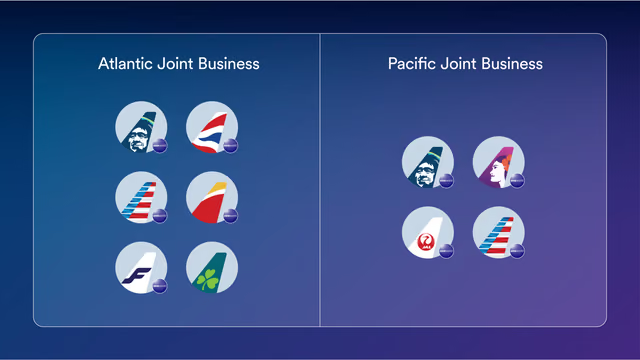
oneworld (14): American Airlines, British Airways, Cathay Pacific, Fiji Airways, Finnair, Iberia, Japan Airlines, Malaysia Airlines, Oman Air, Qantas, Qatar Airways, Royal Air Maroc, Royal Jordanian and SriLankan Airlines.
Global partners (8): Aer Lingus, Air Tahiti Nui, Condor, Hainan Airlines, Icelandair, Korean Air, Philippine Airlines and STARLUX Airlines.
Regional partners (10): Air Rarotonga and Air Tahiti (both marked "coming soon"), Aleutian Airways, Bahamasair, Cape Air, Contour Airlines, Jetstar, Mokulele Airlines, Porter Airlines and Southern Airways Express.
Alaska notes that "participating airlines, routes, and cabins may change over time," so check the list again before you build a trip around one carrier. Alaska also says to check each airline's page on that list for its booking instructions.
Six Partners to Know
You don't need all of them. These six cover Japan, Hong Kong, the South Pacific, Europe, the Middle East and Africa, plus flights closer to home. Alaska's page for each one says to book awards online through Alaska Airlines or Hawaiian Airlines.
Japan Airlines. Alaska describes JAL as "connecting the United States to Japan and beyond." Its trip ideas include San Francisco to Tokyo Haneda, Los Angeles to Osaka and Honolulu to Tokyo Narita.
Cathay Pacific. Cathay flies from its Hong Kong hub to destinations across Asia, including Bangkok and Kuala Lumpur. Alaska's trip ideas run to Hong Kong from Los Angeles, San Francisco, Honolulu and Vancouver.
American Airlines. The partner closest to home. Alaska says you can book American award travel on AlaskaAir.com or HawaiianAirlines.com, and its trip ideas range from San Diego to Miami and Seattle to Puerto Rico out to Los Angeles to London and Los Angeles to Sydney.
Fiji Airways. Alaska calls it "your connection to the South Pacific," with trip ideas to Nadi from Los Angeles, San Francisco, Vancouver and Honolulu.
British Airways. Alaska's page points to nonstops to London from West Coast cities including Seattle, Portland, San Francisco and Los Angeles, and its trip ideas include Seattle to Barcelona, Lisbon and Paris.
Qatar Airways. The hub is Doha, and Alaska's trip ideas reach past it: Seattle to Nairobi and Seattle to Johannesburg, alongside Seattle and San Francisco to Doha.
Alaska and Hawaiian Flights Use Their Own Chart
Hawaiian Airlines sits inside the program, not on the partner list. Alaska describes Atmos Rewards as bringing together "the best of Alaska Airlines and Hawaiian Airlines under a single loyalty brand," and awards wholly on Alaska or Hawaiian use their own Alaska and Hawaiian chart. On that chart, North American economy awards start at 4,500 points for trips under 700 miles. When HawaiianMiles moved over in October 2025, Alaska said Neighbor Island awards "now start at just 4,500 points one-way," and there are no blackout dates on Alaska or Hawaiian flights.
How the Partner Award Chart Works
Alaska publishes partner award charts for three regions: the Americas; Europe, Middle East, Africa; and Asia Pacific. Each region's grid sets distance bands against four cabins: economy, premium economy, business and first. Every number in the grid is labeled "starting at."
Reading it takes three steps. Pick the region where you're going, find the distance band for the trip, then read across to your cabin. The Americas chart covers travel from the US to the Americas and within the Americas, and the Europe, Middle East, Africa chart works the same way for its region.
The Asia Pacific chart is the exception: it covers travel from the US to Asia Pacific, within Asia Pacific and between Asia Pacific and Europe, the Middle East and Africa. So an Asia to Middle East trip prices from the Asia Pacific chart, not the Europe one, and a US to Seoul business class trip is another example, which we price in our guide to business class to Seoul with Atmos Rewards points.
To give you a sense of the range, the lowest figure on the partner charts is 4,500 points for economy under 700 miles on the Americas chart. The highest is 195,000 points for first class on the Asia Pacific chart's top band, 10,000 miles and above. Alaska also shows sample destinations: Iceland starting at 22,500 points, Japan starting at 30,000, Sydney starting at 30,000 and Tahiti starting at 25,000.
Here's the catch, in Alaska's own terms: "Actual redemption rate requirements may vary based on route-specific factors, including city pair combinations, partner airline pricing, market demand, number of flight segments in the itinerary and limited availability at lower tiers." The chart tells you where pricing starts, not what your seat will cost. The search result is the price.
A few more chart rules matter for planning:
- Alaska says premium economy awards start "at only 30% more than an economy ticket."
- Mixed-cabin trips price at the highest cabin on the itinerary, even if that segment is the short one.
- Partner awards carry a $20 nonrefundable fee per person, each way, on top of taxes and fees that start at $5.60. Atmos Rewards Summit cardholders don't pay the partner award fee.
- Alaska runs limited-time Global Getaways offers of "up to 50% off" travel to selected international destinations.
The Stopover Rule
Alaska allows one stopover of up to 14 days per one-way on eligible international itineraries. On an international round trip, you get two, one in each direction.
Price your exact itinerary before you commit, since Alaska's terms say the number of flight segments can change the rate.
How to Search and Book a Partner Award
- Sign in and search on Alaska's site. Award tickets can be booked online for Alaska, Hawaiian and partners. Alaska says to check each airline's partner page for its booking instructions, so start there for a carrier you haven't booked before.
- Search one direction at a time. Alaska's stopover allowance and its $20 partner fee both apply per one-way.
- Set an alert if space is thin. If you're hunting a premium cabin on fixed dates, an award-alert tool saves a lot of manual searching. Our ExpertFlyer breakdown covers whether the subscription is worth it for your travel pattern.
- Book online when you can. New awards booked over the phone carry a $30 nonrefundable call center charge per person.
- Watch the clock on trips abroad. Award flights that start and end outside the US must be booked at least 72 hours before departure.
- Know your exit. You can change or cancel an award at any point before departure. Cancel, and your points and taxes come back, though the partner award fee and any phone booking charge don't. If you don't cancel before the flight leaves, the ticket is forfeited.
Who This Program Isn't For
If the airlines you fly aren't on Alaska's partner list, read that list before you collect points here. The program pays off when your trips line up with the airlines on it.
If your travel is all short domestic economy booked at the last minute, the partner chart isn't the draw. Short-haul awards from 4,500 points are useful, but our last-minute flight guide is a better starting point for that pattern.
The Mistakes That Cost the Most
Treating a chart number as the price. Every figure is a starting rate. Route, partner pricing, demand, segments and availability can all push it higher.
Mixing cabins without noticing. One business class segment on an otherwise economy trip prices the whole award as business.
Forgetting the fees. The $20 partner award fee applies per person, each way, unless you hold the Summit card, and Alaska says taxes on international travel "may be significantly more" than the $5.60 security fee on US trips.
Booking a lap infant on an international partner award. Alaska doesn't accept lap infants on those awards. You'd need to buy the infant a seat.
Expecting partner perks on an award. When you redeem Atmos Rewards points, you can't add another airline's frequent flyer number, so you won't get that program's benefits on the trip.
Letting a trip lapse. If plans change, cancel before departure. A no-show forfeits the ticket.
Where I'd Start
Pick one trip and one region. Look up the band on Alaska's chart so you know the starting rate, then search the actual dates on Alaska's site, one direction at a time, and add the $20 partner fee each way to your budget. If the trip is international, decide where you'd want a stopover of up to 14 days before you search.
If it would be your first premium-cabin award, our step-by-step guide to booking business class with points walks the whole process.
Updated October 3, 2026: Atmos Rewards.