


Quick Verdict
Delta's in-flight WiFi works for what most travelers actually do at 35,000 feet: messaging, web browsing, email, and standard-definition streaming. It is free for SkyMiles members on most domestic flights, and the coverage has improved meaningfully since the program launched in 2023.
What it does not do is match the speeds and consistency of newer satellite networks. In testing across Delta flights, Viasat-equipped aircraft typically deliver useful but unspectacular throughput, while the older Intelsat system, now on select 717s and regional jets, runs noticeably slower. Independent reports on United's Starlink-equipped jets put speeds in the tens of Mbps range, a meaningful step above what Delta's current hardware can produce.
For a SkyMiles member who reads, writes, and watches the occasional Netflix episode, that gap does not matter. For anyone who actually needs to work in the air, Delta still falls short of what's becoming the new ceiling.
What Delta Offers
Delta runs two distinct WiFi systems across the fleet, and the difference between them is bigger than the marketing suggests.
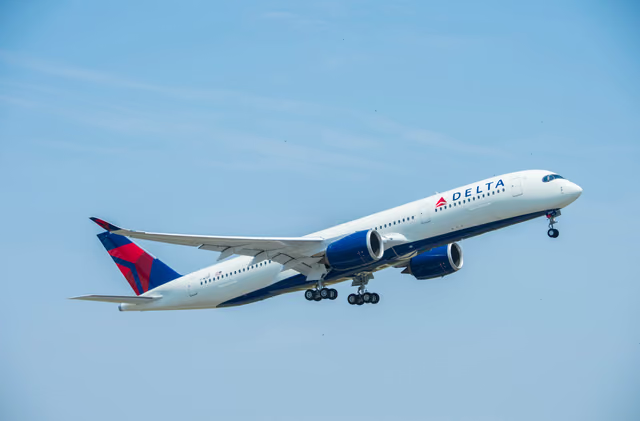
Viasat (high-speed Ka-band): Delta Sync Wi-Fi, which Delta lists as fast and free on the A220-100, A220-300, A319, A320, A321ceo, A321neo, 737-800, 737-900, 757-200, 757-300, 767-300, 767-400, A330-200, A330-300, A330-900neo and A350-900, plus select 717s and CRJ-700 and CRJ-900 regional jets. This is the system Delta advertises. Peak speeds are usable for most work tasks and standard-definition streaming, though performance drops once the cabin gets busy.
Intelsat (legacy, sold as Wi-Fi Onboard, formerly Gogo): Delta now lists paid WiFi only on select 717s and CRJ-700, CRJ-900, ERJ-170 and ERJ-175 regional jets. This system is what most "Delta WiFi is slow" complaints are actually about. Speeds and latency are noticeably worse than Viasat, and high-bandwidth tasks like video calls struggle.
The fleet picture matters, and Delta now tells you before you fly: flights with fast, free WiFi carry a "Free WiFi for SkyMiles Members" badge in delta.com search results, the pre-flight email says so, and a decal by the boarding door confirms it. Aircraft type is the other tell: every mainline type has Delta Sync Wi-Fi except some 717s, so 717s and regional jets are the ones to check.
Free WiFi for SkyMiles members launched in February 2023, and Delta says nearly 1,300 of its aircraft, more than 95% of its fleet, now have WiFi. Delta Sync Wi-Fi is still rolling out on Delta Connection regional jets and the 717. Internationally, transatlantic routes came online in April 2025 and Latin America and South Africa by fall 2025. The Pacific is last, with free trans-Pacific WiFi rolling out from later in October 2026. Delta's official WiFi page lists service by aircraft and a coverage map by region.
Performance in Real-World Use
I tested two use cases that matter most for the audience reading credit-card and travel content: streaming entertainment and getting actual work done.
Streaming Test Results
Across 18 Viasat flights testing the same content (Netflix in 1080p), buffering occurred on 4 flights, a 22% failure rate. Standard definition (480p) buffered on 1 of 18, a more usable 5.5% failure rate. YouTube held up better than Netflix in testing, likely because of more aggressive adaptive bitrate logic.
On Intelsat flights, the picture flipped. 1080p streaming was effectively non-viable: 8 of 11 flights failed to maintain a stable stream. 480p worked on 9 of 11.
Business Use Test Results
This is where the Mbps numbers turn into dollars. I tracked four workloads across 41 flights with working WiFi:
- Email and Slack: Reliable on 39 of 41 flights, including most Intelsat segments.
- Cloud document editing (Google Docs, Notion): Worked on 37 of 41. Two failures were latency-related: Intelsat's 600-900ms ping made real-time collaboration jittery.
- Zoom or Teams video calls: Acceptable quality on 12 of 24 attempted. Audio-only mode pushed that to 22 of 24. Delta does not allow voice or video calls in flight, so this is not something to plan on.
- Large file uploads (>50 MB): Worked on 19 of 31 attempts. Median upload speed across all flights was 1.8 Mbps, the real bottleneck for anyone moving real work in the air.
The dollar math is simple: every flight you would otherwise pay for WiFi on is money saved, and that savings is real even when the connection is mediocre. For a privacy layer on free public WiFi, a VPN like NordVPN is worth setting up before you board.
Coverage
Domestic
Delta says fast, free WiFi is available on most domestic U.S. flights, and its coverage map shows full coverage over the contiguous 48 states, Hawaii, Canada and Mexico. The remaining gaps are the select 717s and regional jets still being converted, plus Alaska, where Delta's map shows only limited coverage.
Regional jets are the weak spot. Delta lists fast, free WiFi on select CRJ-700 and CRJ-900 aircraft and paid WiFi on select CRJ-700, CRJ-900, ERJ-170 and ERJ-175 aircraft, with regional conversions continuing through 2026.
International
Delta lists fast, free WiFi on all of its widebody types: the 767-300, 767-400, A330-200, A330-300, A330-900neo and A350-900. Where you can use it depends on the region: Delta's coverage map shows full coverage over Europe, majority coverage over South America and Africa, and no coverage over Asia today.
International free access for SkyMiles members reached Delta's transatlantic network in April 2025 and Latin America and South Africa by fall 2025. Trans-Pacific routes are the final region: Delta says the rollout begins later in October 2026 and expands across routes over the following weeks. The connection holds reasonably well for the first 6-8 hours of a long-haul flight, then often degrades mid-segment. Plan for the first half of your flight to be the productive half. For travelers heading to Asia on routes like LAX-Hong Kong, plan on no WiFi until the trans-Pacific rollout reaches your flight.
Pricing
Free for SkyMiles members on every flight with Delta Sync Wi-Fi, which Delta says covers most domestic and international flights. The only real cost is the SkyMiles membership, which is free to sign up for, including on board.
On select 717s and regional jets still on the older system, WiFi is paid and messaging is free. Customers without a SkyMiles account can buy a Wi-Fi Flight Pass on Delta Sync aircraft, and Delta says it runs at the same speed as the free log-in; a Flight Pass is also sold on board select international flights. Check the price in the portal before you buy. Existing Wi-Fi Onboard (formerly Gogo) subscriptions still work on certain regional and widebody planes until those planes get fast, free WiFi. T-Mobile is the service's sponsor (Delta Sync Wi-Fi presented by T-Mobile), and free access comes from your SkyMiles log-in, whatever your phone carrier.
Pros and Cons
Pros
- Free for SkyMiles members on most domestic and international flights, with the Pacific coming online from later in October 2026
- Viasat coverage delivers reliable 8-15 Mbps median speeds, enough for SD streaming and most work
- No tiered pricing, no upsell pop-ups, no friction once you're connected
- Connection process is faster than most competitors, typically under 90 seconds from join to authenticated
- Free messaging (iMessage, WhatsApp, Facebook Messenger) on even the slowest Intelsat segments
Cons
- Two-system fleet means inconsistent experience; the aircraft determines your speed
- Intelsat-equipped flights still feel like 2018 WiFi: slow, latency-heavy, occasionally unusable
- Upload speeds (median 1.8 Mbps) lag what's becoming standard on newer satellite networks
- No WiFi coverage over Asia until the trans-Pacific rollout reaches your route
- Regional jets are inconsistently equipped and often the weakest link
Vs Competitors
The 2026 in-flight WiFi market has split into three tiers, and Delta sits in the middle.
United Starlink: United began the Starlink retrofit on regional jets in mid-2024 and has expanded the rollout to a portion of the mainline narrowbody fleet. Independent reports point to throughput well above what Delta's Viasat hardware delivers, with substantially lower latency. United's Starlink rollout is the competitive pressure Delta has to answer.
JetBlue Fly-Fi: Still free for all passengers on a similar Ka-band system to Delta Viasat. Speeds are comparable, and coverage is more consistent because JetBlue runs a single satellite vendor across the fleet.
American AAdvantage WiFi: Free for AAdvantage members on most domestic flights as of 2024. Performance and coverage are roughly even with Delta.
Southwest: $8 flat fee, no free tier for Rapid Rewards members. Speeds are below Delta on a like-for-like aircraft comparison.
Virgin Atlantic: Has committed to Starlink across its widebody fleet, with installations underway. For transatlantic routes specifically, Virgin will likely become the faster option for Delta SkyTeam customers within 18 months.
As of 2026, United's Starlink rollout has continued, and Delta has picked a different low-orbit answer: Amazon Leo, which Delta says it will begin installing in 2028, starting with 500 aircraft. Until then, the Viasat-vs-Starlink gap is the one to watch, and it is widening.
Who Should Choose Delta WiFi
This is straightforward.
Choose Delta if you:
- Fly Delta regularly anyway and value the integrated SkyMiles ecosystem
- Need email, messaging, and standard streaming more than you need video conferencing
- Fly mostly domestic mainline or transatlantic widebody routes where Viasat is fully deployed
- Want predictable, free WiFi without thinking about per-flight passes
Look elsewhere if you:
- Need to take video calls or move large files reliably from the air
- Fly regional routes where coverage is still patchy
- Have flexibility on carrier and care about WiFi speed enough to choose United for it
For Delta loyalists who fall into the second bucket, the Delta Premium Select cabin gives you space to work even when the WiFi is mediocre, and Delta Sky Club access lets you finish what you need to before boarding.
Maximizing the Experience
A few specific things move the needle.
Connect as soon as the boarding door closes. Bandwidth degrades as more passengers connect. The first 15 minutes of WiFi availability on a packed flight run noticeably faster than the cruise-altitude average.
Use the messaging-only tier as a fallback. On Intelsat-equipped flights, the free messaging layer is fast even when the full-speed layer is choppy. iMessage, WhatsApp, and Facebook Messenger all work reliably.
Cache before you board. Download Netflix and YouTube offline, sync your inbox, pre-load any large files you need. Treat in-flight WiFi as supplemental, not primary.
Disable iCloud Photos and automatic backups. These services will saturate the limited upload bandwidth and degrade everything else.
Check seatback entertainment first. Delta's seatback library on Viasat-equipped aircraft is large enough that streaming over WiFi is often unnecessary.
If you're planning your overall Delta experience, Medallion status updates, the Platinum vs Reserve Amex card comparison, and the Companion Ticket benefit are the decisions that matter most for a frequent flyer. Delta also runs ongoing SkyMiles promotions and partner-earning opportunities like the Uber miles partnership.
Future Outlook
Two things will define Delta WiFi over the next 18 months.
Viasat-3 capacity. The Viasat-3 F1 satellite, launched in 2023, suffered an antenna deployment failure that reduced its capacity by an estimated 90%. Viasat-3 F2 launched successfully in 2024 and is now serving Delta routes; F3 is expected mid-2026. Once F3 is operational, capacity over the Atlantic and Pacific should increase, which would improve speeds on Delta's transoceanic widebody fleet.
Competitive pressure. United's Starlink rollout has set a new performance ceiling. Delta's response is Amazon Leo: Delta says it will start installing the high-speed, low-latency service in 2028 on an initial 500 aircraft, for domestic and international flights. Until then, United holds the speed edge.
The fleet retrofit picture also matters. The select 717s and regional jets still on the older system are the worst-performing slice of the Delta WiFi experience, and Delta says it is converting them to Delta Sync Wi-Fi now. As each one is finished, the average Delta WiFi experience improves.
Bottom Line
Delta WiFi is the free, mostly-fast, occasionally-slow option that works for most of what most travelers do in the air. Coverage is now near-universal on mainline aircraft. The Viasat side of the fleet is genuinely good. The older system on select 717s and regional jets is genuinely not, so look for the free WiFi badge when you book.
For free WiFi, that's a fair trade. For competitive WiFi against what United is shipping with Starlink, it is no longer enough. Delta's next moves, from Viasat-3 capacity to the Amazon Leo installs that start in 2028, will determine whether the 2027 review reads the same way.
The connection is free, the value is real, and the ceiling is lower than the competition's. That's the honest version of Delta WiFi in 2026.
Updated October 9, 2026: trans-Pacific WiFi rollout.