


Basic economy in 2026 is not the simple "give up seat selection, save twenty bucks" trade it was a decade ago. The five major U.S. airlines now use their cheapest fare class as a sorting mechanism: zero or reduced mileage earning, no upgrades, no lounge access, sometimes no carry-on, and in most cases no changes. The savings can range from $20 on a Tuesday to $300 on a peak Friday, and the right answer changes per booking.
This is a current-as-of-May 2026 walkthrough of how basic economy works at each major U.S. carrier, when the math favors booking it, and the credit-card and elite-status exceptions that quietly reverse the worst restrictions.
What Basic Economy Means in 2026
Across U.S. carriers in 2026, basic economy fares share four restrictions in some combination: no advance seat selection (seats assigned at check-in), last-group boarding, no voluntary changes, and reduced or eliminated mileage earning. The details vary. American Airlines and United now award zero miles to non-cardholders on basic economy. Delta awards zero too, after its October 2025 rebrand. Alaska awards 30% of distance flown. JetBlue awards reduced points. Southwest, after ending open seating on January 27, 2026, treats its new Basic fare more gently than the legacy carriers but adds a check-in-only seat assignment.
The single most important thing to know about basic economy in 2026: most carriers carve out exceptions for their co-branded credit-card holders. Carrying the airline's credit card often restores mileage earning, carry-on rights, and earlier boarding. If you fly one airline three or more times a year, the right credit card converts basic economy from a punitive fare class into a discounted one.
American Airlines
American made the most aggressive 2026 change. As of December 17, 2025, basic economy tickets earn zero AAdvantage miles and zero Loyalty Points (the metric that drives elite status) for any traveler who is not an AAdvantage co-branded credit cardholder. The exception applies only to travel within the U.S. and Canada on flights marketed and operated by American Airlines. International basic-economy tickets earn nothing for cardholders either.
The other basic-economy restrictions on American:
- No seat selection until check-in.
- Last group to board.
- No voluntary changes (cancel and rebook only).
- No paid or complimentary upgrades, including for elite members.
- One full-size carry-on bag allowed (American does not impose United's personal-item-only rule).
The cardholder workaround: holding a Citi AAdvantage co-branded card, such as the Citi AAdvantage Platinum Select or the Citi AAdvantage Executive, restores mileage and Loyalty Point earning on basic economy for domestic and Canada-bound flights.
United Airlines
United's basic economy has been the most restrictive in the industry for several years, and the May 2026 rules are unchanged from 2025. The defining feature: basic economy passengers on domestic and short-haul international flights are limited to one personal item that fits under the seat (17 x 10 x 9 inches). No overhead-bin carry-on. The personal-item rule does not apply on transatlantic, transpacific, or South American routes.
Other restrictions:
- No advance seat selection.
- Zone 8 boarding (last).
- No MileagePlus miles or Premier Qualifying Points earned for non-cardholders.
- No voluntary changes.
- No paid or complimentary upgrades.
The cardholder workaround: Chase MileagePlus credit cards, including the United Explorer Card, the United Quest, and the United Club Card, restore mileage earning, grant a full carry-on bag, and provide Group 2 boarding on basic economy. Premier elite members get the same treatment, plus PQPs earn normally. The Explorer has a $0 intro annual fee for the first year, then $150.
Delta Air Lines (Renamed in October 2025)
Delta renamed its fare classes in October 2025. What was Basic Economy is now Delta Main Basic. Delta Main also includes Classic and Extra tiers, replacing the prior Main Cabin / Comfort+ naming. The October 1, 2025 cutover applies to all new bookings.
Delta Main Basic restrictions in 2026:
- Zero SkyMiles earned (down from a reduced rate in prior years).
- Zero Medallion Qualifying Dollars earned, so no progress toward elite status.
- No advance seat selection.
- Zone 8 boarding, including for Medallion members on Main Basic.
- No paid or complimentary upgrades, including for Medallion members.
- No voluntary changes.
- No Delta Sky Club access, even for Sky Club members on Main Basic.
Main Basic passengers do keep one benefit the others lost: a full-size carry-on plus a personal item, no fee. For carry-on-first travelers, Delta is the gentlest legacy carrier on basic.
The cardholder workaround is narrower than at American or United. Co-branded Delta SkyMiles cards from Amex, including the Delta SkyMiles Gold, the Delta SkyMiles Platinum, and the Delta SkyMiles Reserve, do not restore SkyMiles earning on Main Basic. They do provide free checked bags and Main Cabin 1 priority boarding. The only way to earn SkyMiles on a Delta flight in 2026 is to buy Delta Main Classic or higher.
Alaska Airlines
Alaska's Saver fare (their basic economy) treats mileage earning more generously than the big-three legacies but applies its own restrictions:
- 30% of distance flown earned as Mileage Plan miles for non-elite, non-cardholder bookings.
- Last group to board.
- Seats assigned at check-in.
- No voluntary changes (50% credit if cancelled at least 14 days out, no value inside 14 days).
- One full-size carry-on bag allowed.
- Elite members are now eligible for complimentary upgrades on Saver fares (added in late 2024), with the upgrade list opening 2 hours before departure.
The 30% earning rate on Saver fares is the cleanest math in the industry: you do earn miles, just at roughly a third of the regular rate. The Bank of America Alaska Airlines Visa gets free checked bags for the cardholder and up to six companions on the same reservation but does not boost Saver-fare miles earning. For Mileage Plan elite hopefuls, Saver fares are the wrong tool: the 30% rate applies to status-qualifying activity too, so two Saver flights count as one Main flight toward elite thresholds.
JetBlue
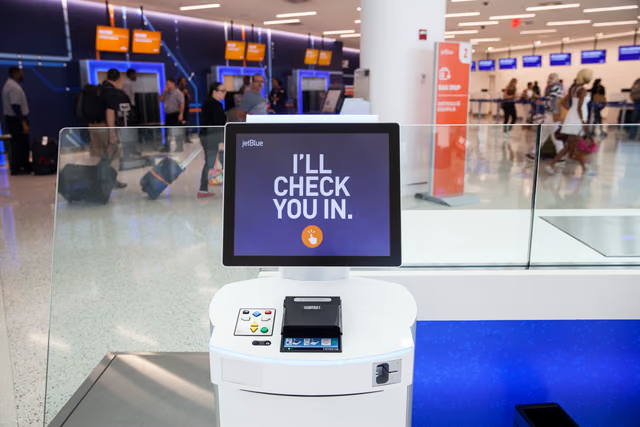
JetBlue's basic economy fare, Blue Basic, is mostly aligned with the legacy carriers, with a few JetBlue-specific quirks:
- 2 TrueBlue points per dollar (vs. 6+ on higher fares).
- One free carry-on bag (added September 2024, JetBlue walked back the prior personal-item-only rule).
- Last group to board.
- Seats assigned at check-in.
- No voluntary changes.
- No JetBlue lounge access at JFK or Boston, even for JetBlue Plus cardholders who pay the annual fee specifically for lounge entry.
The cardholder workaround is partial. JetBlue's co-branded cards, the JetBlue Plus and the JetBlue Business Card, give cardholders a free first checked bag and anniversary bonus points but do not restore full TrueBlue earning on Blue Basic. The lounge restriction is the one that stings; if lounge access is why you carry the Plus card, Blue Basic forfeits that benefit. Mosaic elite members get the better deal: full TrueBlue earning on Blue Basic plus priority boarding and bag benefits.
Southwest Airlines (New Fare Structure As of January 2026)
Southwest underwent the most structural change in 2026. The January 27, 2026 cutover ended open seating across the airline. Southwest now operates a four-tier fare structure (Basic, Choice, Choice Preferred, and Choice Extra) and an eight-group boarding process.
The new Basic fare in 2026:
- 6 Rapid Rewards points per dollar (down from 8 on higher fares).
- Standard seat assigned at check-in. No advance seat selection at booking.
- Boards in the back of the new eight-group order.
- No free checked bag. Southwest retired "bags fly free" entirely: on a Basic fare the first checked bag is $45 and the second $55 for travel booked from April 9, 2026, and only the Choice Extra bundle includes bags in the fare.
- Carry-on plus personal item still included.
- Travel funds (rather than cash refunds) on cancellation, same as the old policy.
Co-branded Southwest credit cards (also the Priority and Premier versions) let cardholders select seats for free 48 hours before departure even on Basic fares. The EarlyBird Check-In product was retired with the move to assigned seating.
Southwest Basic in 2026 is the gentlest basic-economy fare in the industry. You still earn most points, still get a checked bag and a carry-on, and the only meaningful sacrifices are some point earning and boarding position. For most leisure travelers, Southwest Basic is closer to standard economy on other airlines than it is to United's basic economy.
The Real Math: When Basic Economy Actually Saves Money
The fare difference is not the number you should be comparing. The number that matters is fare difference minus lost miles value, minus lost lounge value, minus any forced bag fee. Here is how that math actually shakes out across four common scenarios.
Scenario 1: Short Domestic Trip, No Status, No Airline Card
Austin to Denver round-trip. Basic at $240; standard at $315. Upfront gap of $75. Lost miles on the basic fare range from 0 (American without card) to roughly 900 miles on Alaska Saver, worth $0 to $40 at typical valuations. Net real savings: $35 to $75. Basic economy wins for this profile.
Scenario 2: Trip That Counts Toward Elite Status
Newark to San Francisco round-trip. Basic at $380; standard at $510. Gap of $130. The harder math is that being 510 PQP short of Premier Gold at year end costs you the full year of Gold benefits the following year. United Gold delivers free checked bags worth roughly $70 per round trip, complimentary upgrade eligibility, and Star Alliance Gold internationally. Missing status by a small margin to save $130 is rarely a good trade. Standard economy wins.
Scenario 3: International Trip With Planned Lounge Use
New York to London round-trip on Delta. Basic at $650; standard at $890. Gap of $240. Two losses on the basic fare: roughly 16,000 SkyMiles foregone, valued conservatively at about $200, plus Sky Club access denied on both ends, worth two visits at the $78 day-pass equivalent (about $155). Net of those adjustments, basic costs about $100 more than standard. Standard economy wins.
Scenario 4: Family of Four, Leisure Trip, No Status
Chicago to Orlando round-trip. Basic at $200 per passenger ($800 total); standard at $285 per passenger ($1,140). Upfront gap of $340. Lost AAdvantage miles for a non-cardholder family: zero, since American zeroed out non-cardholder earning. Seat-assignment risk is real, but on most domestic routes you can request adjacent seats at check-in 24 hours out. Net savings $340. Basic economy wins by a wide margin.
The pattern: basic economy makes sense for leisure travelers without status or airline cards, on short trips, where lost miles are minimal and lounge access is irrelevant. Standard economy wins for any trip that touches status math, requires lounge access, or involves an airline-card holder who's already paying for the protection.
A Practical Booking Framework
Three questions to run before clicking buy:
1. Do I hold this airline's co-branded credit card? If yes, the math flips dramatically. United cards restore carry-on. American cards restore miles earning on domestic routes. Delta and JetBlue cards help less but still bring bag and boarding benefits.
2. Am I within striking distance of an elite-status tier this year? If you're 5,000 or 10,000 miles or qualifying segments away, the lost earning on a basic-economy ticket can cost you the full year of status benefits the following year. The math almost always favors paying up.
3. Will I want a lounge before or between flights? Delta and JetBlue both void lounge access on basic fares regardless of status or card. American and United's basic fares don't directly bar lounge access, but cardholder lounge benefits are usually tied to same-day flight on the carrier rather than to fare class.
If the answers are no card, no status threshold, no lounge plan, and a short flight, basic economy is the right call most of the time. If any of those conditions reverse, pay up.
What Tends to Work and What Doesn't
A few tactics worth knowing in 2026:
Book basic, pay to upgrade closer to departure. This still works inconsistently on Alaska and JetBlue, where the airlines sell paid upgrades or fare-class changes as departure approaches. It does not work on American or United basic fares, which are non-changeable.
Pack to the personal-item limit on United. A 40-liter backpack often passes United's 17 x 10 x 9 personal-item sizer in practice. Gate agents in 2026 are more focused on rolling carry-ons; backpacks that compress reasonably well rarely get pulled. This is not policy, this is enforcement reality.
Split-ticket basic and standard on round-trips. Booking the outbound as basic (light packing, no lounge needed) and the return as standard (souvenirs, lounge before red-eye) gets you part of the savings and most of the flexibility. This works best on legacy carriers where the basic-fare premium varies by direction.
Buy the airline credit card if you fly the carrier three or more times a year. This is the most consistently profitable move in the entire basic-economy landscape, particularly on United and American where cardholder protections are the strongest.
The Direction of Travel
Airlines have been clear in earnings calls: basic economy exists to push revenue, not to compete with Spirit and Frontier. The 2025 changes at American (zero miles for non-cardholders) and Delta (rebrand plus zero miles) are part of a multi-year shift. Expect more restrictions, wider basic-to-standard price gaps, and more value gated behind co-branded card ownership. Delta has openly discussed basic-fare versions of business and first class, with the same earning and change restrictions in a premium cabin.
The traveler's response: know the rules per carrier, hold the card of any airline you fly often, and run the four-line math (fare difference minus lost miles minus lost lounge minus forced bag fees) before booking. The headline savings are real on some trips and a mirage on others, and the only way to tell which is to run the numbers.
Updated October 1, 2026: Corrected the United Explorer's annual fee and the United Club Card's name, and removed the Barclays AAdvantage Aviator Red as a card to apply for, since American names Citi its exclusive U.S. card issuer.