

Back

Should You Buy Miles and Points? Your Complete 2026 Guide

Travel
April 10, 2026
The Points Party Team
luxury hotel pool with ocean view

Key Points:

  • Buying miles rarely beats earning them through credit card bonuses, but specific situations like topping off for an award ticket can deliver excellent value.
  • Current promotions offer bonuses up to 125%, making purchased points cost as little as $0.0075 per point depending on the program and purchase amount.
  • The decision comes down to math comparing purchase price to redemption value, with sweet spot redemptions delivering 2-5 cents per point making purchases worthwhile.

Introduction

You're 5,000 miles short of booking that business class flight to Europe. Should you buy them? Or maybe you've spotted a promotional bonus offering 100% extra points. Is it a good deal?

Buying miles and points is one of the most controversial topics in the points community. Some experts call it a waste of money. Others argue it's a strategic tool when used correctly. The truth? Both are right depending on your situation.

This guide breaks down when buying miles makes sense, current promotions worth considering, and the math you need to know before clicking "purchase."

When Does Buying Miles Actually Make Sense?

The Top-Off Strategy

Imagine you've found the perfect award flight. It costs 60,000 miles, but you only have 55,000. Transferring points from a credit card isn't an option, and the flight availability might disappear tomorrow.

This is the classic top-off scenario and the most common legitimate reason to buy miles. You're not buying miles speculatively; you're completing a specific redemption you've already identified.

Real example: You need 5,000 United miles to book a Polaris business class seat to Tokyo worth $4,200 in cash. United is selling miles at $0.035 each during a promotion. That 5,000-mile purchase costs $175 but secures a $4,200 ticket. That's an 8.4 cents per point redemption value – exceptional by any measure.

Taking Advantage of Exceptional Promotions

Occasionally, loyalty programs offer bonuses so generous that buying miles becomes worthwhile even without an immediate redemption planned. These promotions are rare but worth jumping on when they appear.

What makes a promotion exceptional?

  • 100% or higher bonus on purchased miles
  • Effective cost per mile below $0.01
  • Programs with valuable redemption sweet spots

Historical example: In late 2024, IHG One Rewards offered a 100% bonus on purchased points. At $0.01 per point including the bonus, you could effectively prepay for hotel nights at properties that typically cost 30,000-50,000 points (worth $200-$400 in cash). That's a guaranteed 2-4 cents per point value – better than most credit card welcome bonuses deliver.

Manufactured Spending Alternatives

If you're experienced with manufactured spending, buying miles during bonus promotions can sometimes deliver better returns than your usual MS methods, especially when considering time and effort.

Let's say your typical MS strategy nets 2 cents per dollar spent after fees. A promotion offering Hilton points at an effective cost of $0.005 per point (with 100% bonus) gives you 200 points per dollar. If you typically redeem Hilton points for 0.5 cents each on average, that's still 1 cent per dollar – not quite as good as your MS, but it requires zero time or effort.

The math shifts if you target high-value redemptions. Hilton points can deliver 1+ cent per point value at premium properties, making the purchase worthwhile.

Extended Account Activity

Some programs require account activity every 12-24 months to prevent points expiration. If you're not actively earning miles and don't want to lose your balance, a small purchase can reset the expiration clock.

Cost-benefit example: You have 150,000 American Airlines miles that will expire in 30 days. You could book a cheap revenue flight for $150, or you could buy 1,000 miles for $35 to extend your points another 18 months. The small purchase costs less and keeps your valuable mileage balance alive.

When Buying Miles Is a Terrible Idea

Instead of Earning Welcome Bonuses

This is the biggest mistake beginners make. They see a promotion advertising "60,000 bonus miles for just $600!" and think they're getting a deal.

The reality? That same $600 could meet the minimum spending requirement on a credit card offering 70,000-100,000 welcome bonus miles, plus you'd earn 2-3x points per dollar on your purchases.

The math: Buying 60,000 miles at $0.01 each = $600 spent, 60,000 miles earned.Opening a card with a welcome bonus = $600 spent toward minimum spend, earning 70,000+ bonus miles plus 1,200-1,800 miles from the spending itself. That's 71,200-71,800 total miles – up to 20% more for the same outlay.

For Speculative Accumulation

Buying miles "because I might use them someday" rarely works out. Programs constantly devalue their currencies, and what seems like a good deal today often isn't when you're ready to redeem years later.

Delta SkyMiles is the perfect cautionary tale. In 2015, you could buy miles at $0.035 each during promotions. Many did, planning to use them for specific redemption sweet spots. Then Delta eliminated award charts entirely in 2024, moving to dynamic pricing that often requires 2-3x more miles for the same flights.

Those speculatively purchased miles lost 50-70% of their value overnight.

When You Don't Have a Specific Redemption Planned

The cardinal rule: Never buy miles without knowing exactly how you'll use them.

Programs love selling miles because most purchasers never redeem them optimally. They buy during an exciting promotion, then months later book a domestic economy flight delivering 1 cent per point value – terrible returns on their $0.01-0.02 per point purchase cost.

Current Miles and Points Promotions Worth Considering (April 2026)

Let's break down the current landscape of buying opportunities. I'll focus on programs offering meaningful value, skip the mediocre deals, and show you the math on each.

Hotel Programs

Hilton Honors: 100% Bonus Through May 29, 2026

Hilton offers the most generous hotel points purchase bonuses in the industry. Their current 100% bonus promotion runs through May 29, making points cost $0.005 each.

The opportunity: Hilton operates 7,000+ properties worldwide with massive redemption value variance. Standard redemptions deliver 0.4-0.6 cents per point, making purchases at 0.5 cents barely worthwhile. But here's where it gets interesting.

Hilton's premium properties often require 70,000-95,000 points per night but cost $400-800 in cash. That's 0.6-1.1 cents per point value – a 20-120% return on your $0.005 purchase price.

Best uses:

  • Conrad Maldives Rangali Island (95,000 points vs. $1,200 cash = 1.26 cpp)
  • Waldorf Astoria properties during peak season
  • Top-off for fifth night free on award stays

Purchase limits: 160,000 base points (320,000 after bonus)Effective cost: $0.005 per pointSweet spot redemption value: 0.6-1.2 cents per pointVerdict: Worth considering for specific high-value redemptions

The Hilton Honors American Express Aspire Card offers a more cost-effective way to accumulate these points, earning 14x at Hilton properties plus automatic Diamond status.

IHG One Rewards: 80% Bonus Through April 30, 2026

IHG's current 80% bonus brings the effective cost to $0.0075 per point when purchasing the maximum.

The challenge: IHG properties vary dramatically in quality and redemption value. You're playing a game of finding the diamonds in the rough.

The best value comes from their top-tier brands (InterContinental, Kimpton) in expensive markets. An InterContinental in Tokyo might cost 70,000 points or $400 in cash (0.57 cpp), making the purchase marginally worthwhile. But a Holiday Inn Express requiring 40,000 points for a $120 room delivers just 0.3 cpp – a money-losing proposition.

Purchase limits: 200,000 base points (360,000 after bonus)Effective cost: $0.0075 per pointSweet spot redemption value: 0.5-0.8 cents per pointVerdict: Only buy if you have specific high-tier properties targeted

The IHG One Rewards Premier Credit Card earns 10x points at IHG hotels and includes an annual free night certificate – a better long-term strategy than buying points.

Choice Privileges: Up to 35% Bonus Through April 28, 2026

Choice's bonus structure is tiered, maxing out at 35% for purchases of 18,000+ points. Even with the maximum bonus, you're paying $0.00763 per point.

The problem: Choice hotels rarely deliver redemption values exceeding 0.6 cents per point. Their properties trend budget-friendly, and award nights typically require 8,000-35,000 points for hotels valued at $80-200.

The math doesn't work unless you're hitting their absolute premium properties during peak pricing, which is rare in Choice's portfolio.

Effective cost: $0.00763-$0.00792 per pointTypical redemption value: 0.4-0.6 cents per pointVerdict: Skip this one

Wyndham Rewards: Up to 100% Bonus Through May 1, 2026

Wyndham's 100% bonus sounds impressive until you realize you're still paying $0.0065 per point for a program where points are consistently worth 0.5-0.7 cents each.

Wyndham has one saving grace: their 15,000-point free night certificates work at any property, including their upscale brands. But you can't buy your way to enough certificates to make this worthwhile.

Effective cost: $0.0065 per pointTypical redemption value: 0.5-0.7 cents per pointVerdict: Pass

Airline Programs

JetBlue TrueBlue: 125% Bonus Through April 18, 2026

JetBlue's current promotion offers 125% bonus points, bringing the effective cost to $0.0143 per point when buying the maximum amount.

Why this matters: JetBlue uses revenue-based redemptions with points typically valued at 1.3-1.4 cents each. That's a clean 9-10x return on your purchase cost.

The math: Buy 100,000 base points for $1,430 (receives 225,000 total points after bonus). Those 225,000 points book approximately $3,150 worth of JetBlue flights. That's a $1,720 profit on your purchase.

Important considerations:

  • JetBlue serves limited routes; make sure they fly where you need
  • Points must be used for JetBlue flights (limited transfer partners)
  • Revenue-based redemptions mean this value is relatively stable

Purchase limits: 100,000 base points (225,000 after bonus)Effective cost: $0.0143 per pointRedemption value: 1.3-1.4 cents per pointPotential profit: $1,500-2,000 on maximum purchaseVerdict: One of the best current offers if JetBlue serves your routes

For regular JetBlue flyers, the JetBlue Plus Card earns 6x points on JetBlue purchases and saves you $100 annually on purchases instead of buying points speculatively.

Alaska Airlines Atmos Rewards: Up to 100% Bonus Through May 2, 2026

Alaska Airlines offers tiered bonuses topping out at 100% for purchases of 20,000+ miles, making the effective cost $0.0175 per mile.

The sweet spots: Alaska partners with oneworld airlines and offers some of the industry's best redemption rates for premium cabin travel. Business class to Asia on Japan Airlines or Cathay Pacific can deliver 4-8 cents per mile value, making Alaska miles incredibly lucrative to buy.

Example redemption: Tokyo on JAL business class requires 60,000 miles one-way. That same ticket costs $4,500 in cash, delivering 7.5 cents per mile. If you bought those 60,000 miles during this promotion (30,000 base + 30,000 bonus), your cost is $1,050 for a $4,500 ticket. That's 76% savings.

The catch: Award availability on partner airlines can be challenging, especially during peak travel periods. Don't buy speculatively; confirm availability first.

Purchase limits: 100,000 base points (200,000 after bonus for max tier)Effective cost: $0.0175-$0.0194 per mileSweet spot redemption value: 4-8 cents per mile on premium cabin partner awardsVerdict: Excellent value if you have specific partner award space confirmed

American Airlines AAdvantage: Up to 40% Discount Through April 30, 2026

American's structure differs from most programs – they offer discounts rather than bonuses. Their top tier provides a 40% discount on purchases of 151,000+ miles, bringing the cost to $0.0226 per mile.

The reality check: American has significantly devalued their program over recent years. Domestic economy awards now often require 20,000-35,000 miles for flights you could buy for $200-300 cash, delivering poor 0.7-1.0 cpp value.

The potential value comes from their partner awards, particularly to Europe on off-peak dates (22,500 miles one-way) or business class on Iberia/Qatar. But at $0.0226 per mile, you need to consistently hit 2+ cpp redemptions to break even.

Effective cost: $0.0226-$0.0339 per mile depending on tierRedemption value: Highly variable, 0.7-2.5 cpp averageVerdict: Only consider for specific partner award bookings you've confirmed

The Citi / AAdvantage Platinum Select earns 2x miles on American purchases and gas/restaurants, making it a better accumulation strategy than buying miles.

United Airlines MileagePlus: Up to 45% Discount Through May 4, 2026

United's promotion offers up to 45% off for purchases of 40,000+ miles, bringing the cost to $0.01925 per mile.

The opportunity: United partners with Star Alliance, offering extensive redemption options. Their own Polaris business class and partner airlines like ANA, Lufthansa, and Singapore Airlines provide premium cabin redemptions that can deliver 4-7 cents per mile.

Example: San Francisco to Frankfurt on Lufthansa business class requires 77,000 miles one-way but costs $6,200 in cash. That's 8 cents per mile value. Purchasing those miles during this promotion costs $1,482.25 for a $6,200 ticket – a $4,717.75 savings.

The catch: United has introduced "dynamic pricing" on some routes, significantly increasing mile requirements. Always price your specific route before buying.

Purchase limits: 50,000 miles maximumEffective cost: $0.01925-$0.02625 per mileSweet spot redemption value: 3-8 cents per mile on premium cabin long-haulVerdict: Good value if you have confirmed business/first class availability

Rather than buying miles, consider the United Quest Card or United Club Infinite Card for earning miles through everyday spending and welcome bonuses.

Air France/KLM Flying Blue: Up to 80% Bonus or 45% Discount Through April 16, 2026

Flying Blue offers choice of bonus miles or discounted pricing. The 80% bonus delivers the best effective rate at $0.0169 per mile for maximum purchases.

The advantage: Flying Blue uses dynamic pricing, but they also have monthly Promo Rewards offering 25-50% discounts on specific routes. Combining purchased miles with Promo Rewards can deliver exceptional value.

Strategic approach: Wait for Promo Rewards to be announced (typically first of each month), identify routes you want that are discounted, then buy miles to book those awards.

Purchase limits: 100,000 miles (300,000 for elite members)Effective cost: $0.0169-$0.0211 per mileRedemption value: 1.5-5 cents per mile depending on route and promo rewardsVerdict: Good value if you can align purchase with Promo Rewards

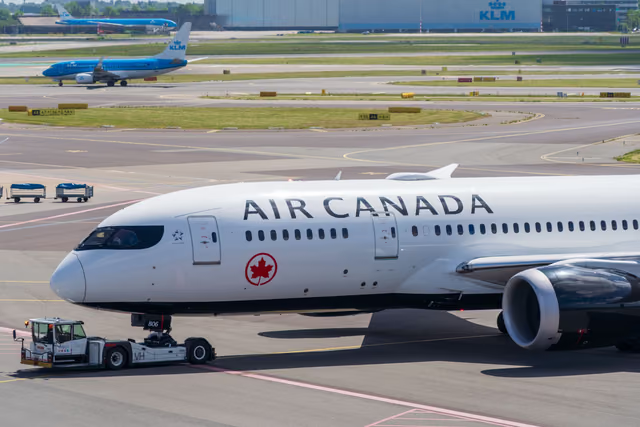
Air Canada Aeroplan: Up to 30% Discount Through May 13, 2026

Aeroplan's 30% maximum discount brings purchase cost to around $0.027 per mile for top-tier purchases.

The challenge: At nearly 3 cents per mile, you need exceptional redemptions to justify the purchase. Aeroplan's sweet spots exist (Europe in business class, around-the-world awards) but you're starting at a significant disadvantage.

Effective cost: $0.027-$0.033 per mileRequired redemption value: 3+ cents per mile to break evenVerdict: Skip unless you have confirmed premium cabin space

Frontier Miles: 100% Bonus Through April 24, 2026

Frontier's 100% bonus brings the cost to $0.0125 per mile, but here's the problem: Frontier uses revenue-based redemptions where miles are consistently worth exactly 1 cent each.

The math: Pay $0.0125 per mile, redeem for 1 cent each = 20% loss on every redemption. Hard pass.

Verdict: Never buy Frontier miles

How to Calculate If a Miles Purchase Makes Sense

Here's the simple formula that determines whether buying miles is worth it:

Redemption Value ÷ Purchase Cost = Return Multiple

You want this number to be 2.0 or higher (200% return). Anything below 1.5 (150% return) generally isn't worth the complexity.

Step-by-Step Evaluation

Step 1: Know Your Purchase Cost

Calculate the effective cost per point including bonuses. If buying 10,000 points costs $100 and you receive a 50% bonus (total 15,000 points), your effective cost is $100 ÷ 15,000 = $0.0067 per point.

Step 2: Research Your Redemption Value

Find the specific award you want to book. Check the cash price for the same booking. Divide the cash price by the miles required.

Example: Business class ticket costs $4,000 cash or 80,000 miles. Redemption value = $4,000 ÷ 80,000 = $0.05 per mile (5 cents per mile).

Step 3: Calculate Your Return

Redemption value ($0.05) ÷ Purchase cost ($0.0175) = 2.86x return. That's a 186% profit margin – worth doing.

Step 4: Consider Hidden Costs

Don't forget:

  • Taxes and fees on award bookings
  • Potential point devaluations before you redeem
  • Opportunity cost of the cash you're spending
  • Whether you could earn these points through credit card spending instead

Real-World Examples

Good Purchase Decision:

  • Program: Alaska Airlines
  • Purchase: 30,000 base miles + 30,000 bonus = 60,000 miles for $525
  • Redemption: JAL business class to Tokyo (60,000 miles + $50 taxes)
  • Cash alternative: $4,200
  • Net savings: $4,200 - $575 = $3,625
  • Return multiple: $4,200 ÷ $575 = 7.3x
  • Verdict: Excellent value

Bad Purchase Decision:

  • Program: American Airlines
  • Purchase: 25,000 base miles + 10,000 bonus = 35,000 miles for $791
  • Redemption: Domestic economy flight (35,000 miles + $12 taxes)
  • Cash alternative: $350
  • Net result: $803 spent for $350 value
  • Return multiple: $350 ÷ $803 = 0.44x
  • Verdict: Lost $453

Marginal Purchase Decision:

  • Program: Hilton Honors
  • Purchase: 100,000 base points + 100,000 bonus = 200,000 points for $1,000
  • Redemption: 4 nights at mid-tier property (50,000 points/night + $0 taxes)
  • Cash alternative: $800 (4 nights × $200/night)
  • Net result: $1,000 spent for $800 value
  • Return multiple: $800 ÷ $1,000 = 0.8x
  • Verdict: Lost $200 – should have booked cash rate

The difference? The first example targeted a premium cabin international flight where award pricing delivers 7x value. The third example used points for a standard hotel stay where cash rates were actually cheaper.

Alternative Strategies to Consider Before Buying

Transfer From Credit Card Points

Before buying miles directly, check if you can transfer from flexible point currencies like Chase Ultimate Rewards, American Express Membership Rewards, Citi ThankYou Points, or Capital One miles.

Why this matters: Credit card points earned through welcome bonuses and category spending typically cost you 1-2 cents per point in actual outlay (the money you had to spend to earn them). That's cheaper than most mile purchase promotions.

Example comparison:

  • Buying 50,000 United miles at $0.01925 each = $962.50
  • Transferring 50,000 Chase points earned from $4,000 welcome bonus spending on dining (4x) = $1,000 spent, but you needed that dining spending anyway
  • Net advantage: Chase points are "free" if you were making those purchases regardless

The Chase Sapphire Preferred and Chase Sapphire Reserve both transfer to United, making them far superior to buying miles outright.

Book Cash Rates Through Shopping Portals

Major shopping portals offer 8-15% cash back on hotel bookings and 1-3% on airline tickets. That's equivalent to getting an 8-15% discount without touching your points.

The math: A $1,000 hotel booked through Rakuten at 12% cash back saves you $120. That same hotel might cost 50,000 points you could have bought for $500 during a promotion. The cash booking with portal saves you $380 compared to buying and redeeming points.

Credit Card Category Bonuses

Using the right credit card for travel purchases can earn you 3-10x points per dollar, effectively "buying" miles at $0.003-$0.01 each through your regular spending.

Example: Chase Sapphire Reserve earns 10x points on hotels and rental cars booked through Chase Travel, plus 5x on flights. A $1,000 booking earns 10,000 points worth $150 (1.5 cpp through Chase Travel). That's a 15% return – better than most mile purchase promotions.

Check our guide to the best travel credit cards to find cards with strong category bonuses.

Airline/Hotel Shopping Portals

United MileagePlus Shopping, Alaska Airlines Mileage Plan Shopping, and hotel program shopping portals often offer 2-10x miles per dollar spent on normal online purchases.

The opportunity: You're buying things anyway (clothing, electronics, gifts). Route those purchases through shopping portals and earn miles for free instead of buying them.

A $500 electronics purchase through United Shopping at 5x earns 2,500 miles. At United's current purchase price of $0.01925, that's $48 worth of miles you earned for free.

Red Flags: Promotions to Avoid

"Mystery Bonus" Offers

Programs that don't disclose the bonus percentage upfront are counting on you to buy impulsively without doing the math. If they're not transparent about the deal, it's probably not a good deal.

Gifting Miles at Premium Prices

Some programs charge higher rates for gifting miles to others. Unless you have a specific reason (like combining accounts for a family award), avoid gifting entirely.

"Limited Time" Pressure Without Details

Many programs run similar promotions quarterly. The "limited time" creates false urgency. Take time to calculate whether it's actually worth it.

Tiered Bonuses That Don't Pencil Out

Programs often advertise their maximum bonus (like "up to 100%!") but bury that you need to buy massive quantities to hit that tier. Always calculate the effective cost at the tier you'll actually buy, not the maximum tier.

Tax Implications of Buying Miles

Buying miles is generally not tax-deductible, even if you use them for business travel. The IRS views purchased miles as a personal consumer transaction.

Exception: If you're self-employed and buy miles specifically for documented business travel that you book immediately, there's a gray area where it might be deductible as a business expense. Consult a tax professional.

Award booking tax/fees: The cash taxes and fees you pay when booking award tickets are potentially deductible for business travel. Keep those receipts separate from your mile purchase.

The Bottom Line: Should You Buy Miles and Points?

Here's the honest truth most blogs won't tell you: buying miles is usually a bad deal for most people, most of the time.

The math works in very specific situations:

  • Top-offs for awards you've already found
  • Exceptional promotions (100%+ bonuses) on programs with proven sweet spots
  • Premium cabin international flights where you've confirmed availability

If you're even asking "should I buy these miles," the answer is probably no. The best opportunities are obvious when you see them because the math clearly works in your favor.

The better strategy for 99% of readers: Focus on earning welcome bonuses from credit cards, using category bonuses on everyday spending, and taking advantage of transfer partners. You'll accumulate points faster, cheaper, and with more flexibility than buying them directly.

But when that perfect award pops up and you're 8,000 miles short? Sometimes buying miles is exactly the right move. Just run the math first.

This article contains affiliate links. If you apply through our links, we may earn a commission at no cost to you, which helps us continue sharing points and miles strategies with the community.

No items found.
Tags: 
Travel