
Back

TSA Wait Times Soar Amid Shutdown: Survival Guide for Smart Travelers

Travel
March 24, 2026
The Points Party Team
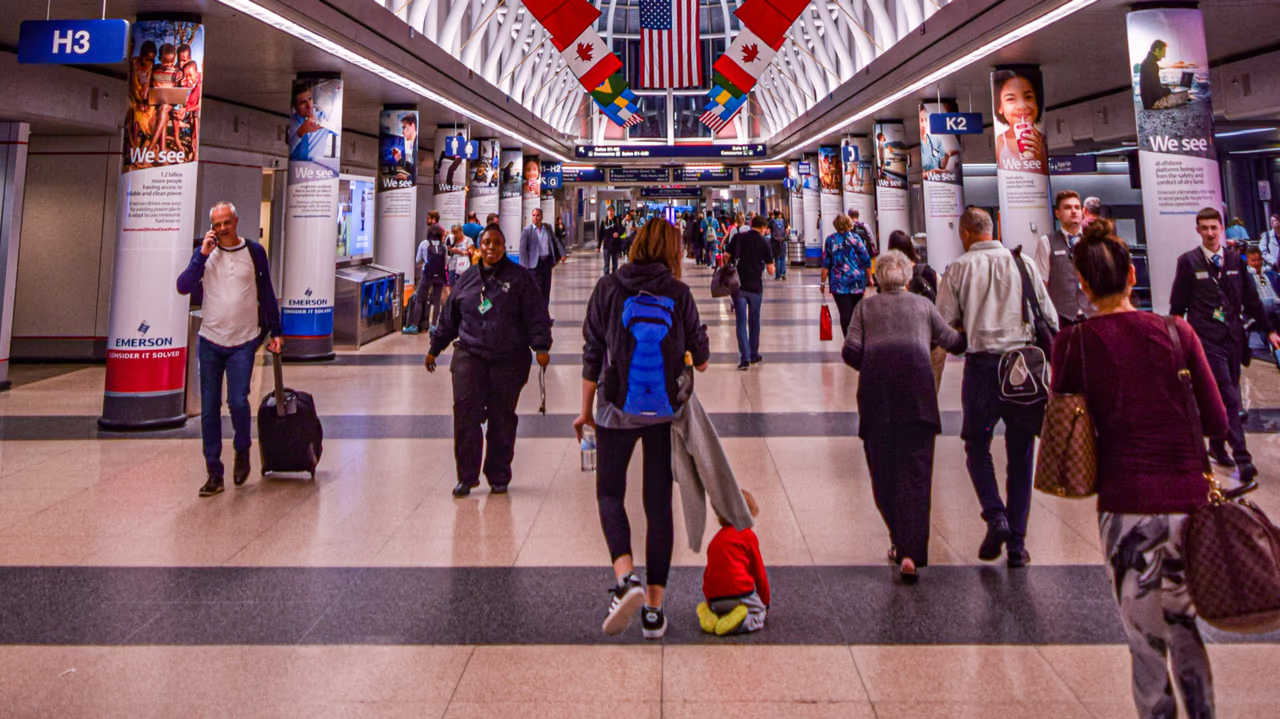
Travelers walking through airport terminal with luggage

Key Points

  • TSA wait times have spiked to 2-3 hours at major airports during the government shutdown, with officers working without pay and over 400 quitting since mid-February.
  • The MyTSA app and individual airport websites provide real-time wait time tracking, helping travelers plan arrival times and choose the fastest checkpoints.
  • TSA PreCheck ($78 for 5 years) and CLEAR ($189/year) dramatically reduce wait times, with PreCheck members experiencing under 10 minutes 99% of the time even during the crisis.

You're standing at airport security watching the line snake out the terminal doors and into the parking garage. Your flight boards in 90 minutes. You're not making it.

This nightmare scenario became reality for thousands of travelers in March 2026 as a partial government shutdown created the worst airport security crisis in years. Wait times at major hubs reached 153 minutes in Atlanta, 120 minutes in Houston, and over 75 minutes at JFK—and those numbers can spike even higher during peak travel windows.

The good news? You don't have to be a victim of TSA chaos. Smart travelers armed with the right tools and strategies can navigate airport security in under 10 minutes, even when standard lanes are backed up for hours.

Understanding the Current TSA Crisis

The Department of Homeland Security shutdown that began February 14, 2026, has created a perfect storm at airport security checkpoints. TSA officers—classified as essential workers—continue working without pay, leading to predictable consequences.

More than 400 TSA officers have quit since the shutdown began. On March 22, call-out rates (unscheduled absences) reached crisis levels at major airports:

  • Louis Armstrong New Orleans International: 42% of officers out
  • Hartsfield-Jackson Atlanta International: 42% absent
  • George Bush Intercontinental (Houston): 39% call-outs
  • Baltimore/Washington International: 38% no-shows
  • John F. Kennedy International: 35% absences

Even under normal conditions, airport security can test your patience. But when nearly half the screening workforce doesn't show up during spring break season, wait times explode.

Atlanta's security line tracking system actually stopped working because it wasn't designed to measure lines that extended outside the terminal. The airport now advises passengers to arrive at least four hours before domestic flights.

This isn't a temporary blip. Until Congress resolves the funding impasse and TSA officers receive paychecks, staffing shortages will continue creating unpredictable and often extreme wait times nationwide.

How to Check TSA Wait Times Before You Leave Home

Walking into an airport blind is a rookie mistake. Several free tools let you check security wait times in real-time, helping you decide when to leave for the airport and which checkpoint to use.

The MyTSA app remains the gold standard for wait time tracking. Available for both iOS and Android, it provides current wait estimates for over 400 airports nationwide. The app also includes historical data showing typical wait patterns by day and time, helping you identify the best travel windows.

Beyond wait times, MyTSA offers a searchable database of TSA rules for carry-on items. No more guessing whether your favorite hair product will make it through security.

Most major airports publish their own real-time wait data. Atlanta, JFK, LAX, and Denver all maintain live security checkpoint trackers on their websites, often broken down by individual checkpoint and terminal. These tend to update every few minutes and can be more accurate than third-party apps during extreme conditions.

Third-party tracking sites like AirlineAirport.com aggregate wait time data from multiple sources. While not always as current as official airport data, they provide a useful backup when airport websites are overwhelmed or down.

The catch? Wait times can change dramatically in minutes during the current crisis. A checkpoint showing 20-minute waits when you check can balloon to 90 minutes by the time you arrive if a wave of flights boards or several officers call out sick.

That's why smart travelers check wait times multiple times before leaving home, then check again when they arrive at the airport. Many airports have checkpoint-specific wait time boards, allowing you to switch to a faster line if you arrive early enough.

Strategic Arrival Time Planning

The old "arrive two hours early for domestic, three for international" advice doesn't cut it during a government shutdown with staffing shortages.

Current recommended arrival times vary wildly by airport. Atlanta is telling passengers to budget four hours for domestic flights. Houston's Hobby Airport suggests three hours minimum. Even airports with shorter posted waits are recommending extra buffer time because conditions change rapidly.

A few airports buck this trend. San Francisco International and Kansas City International use private security contractors instead of TSA officers, so they're not experiencing shutdown-related delays. If your route offers a choice, connecting through these airports could save significant stress.

Peak travel windows remain consistent even during disruptions. Early morning departures (5-8 AM) and late afternoon rushes (4-7 PM) create the longest waits. Mid-morning and early afternoon flights typically face shorter lines, though this advantage diminishes when overall staffing is severely reduced.

Weekend travel amplifies every problem. Spring break season layered on top of government shutdown created the perfect storm in March 2026. If you have flexibility, flying midweek instead of Friday through Monday can cut wait times substantially.

The nuclear option? Arrive absurdly early. If security is catastrophically backed up, at least you'll make your flight. If it's surprisingly manageable, you'll have time to access airport lounges and catch up on work. Missing a flight because you underestimated wait times costs hundreds of dollars and ruins travel plans—arriving early costs nothing but time.

The TSA PreCheck Advantage

During the March 2026 crisis, one number stood out: 99% of TSA PreCheck members waited less than 10 minutes at security checkpoints, even at airports where standard lanes stretched for hours.

That's not marketing hype. While standard security passengers at Atlanta faced 153-minute waits, PreCheck lanes moved steadily under 10 minutes. While Houston Hobby hit 120 minutes, PreCheck members breezed through in single digits.

TSA PreCheck works by pre-screening travelers through background checks, then granting them access to dedicated security lanes with streamlined procedures. Members keep their shoes on, laptops stay in bags, and 3-1-1 liquids don't need to come out. The simplified screening process means lanes move faster even when checkpoint staffing is reduced.

The program costs $78 for five years—that's $15.60 annually. Many premium travel credit cards reimburse this fee entirely, making PreCheck effectively free for cardholders.

Enrollment takes about 15 minutes. You pre-enroll online, then visit an enrollment center for fingerprinting and identity verification. Most applicants receive approval within 3-5 days, though it can take up to 60 days during busy periods.

TSA PreCheck works at over 200 U.S. airports and 90 airlines. Once approved, you add your Known Traveler Number (KTN) to your airline profiles and the PreCheck indicator automatically appears on your boarding passes when available.

Children 17 and under can use PreCheck lanes for free when traveling with an enrolled parent on the same reservation. This makes family travel dramatically less stressful.

The July 2025 policy change allowing all passengers to keep shoes on in standard lanes prompted questions about PreCheck's value. But PreCheck's real benefits were never about shoes—they're about dedicated faster lanes and keeping laptops and liquids packed. The shoe change didn't diminish PreCheck value at all.

For travelers who fly even twice a year, the math is simple: $15.60 annually to potentially save hours of standing in security lines. During a crisis like the March 2026 shutdown, PreCheck becomes invaluable.

CLEAR: The Premium Fast Track

CLEAR takes a different approach to expedited security. Instead of pre-screening for risk, CLEAR uses biometric technology (fingerprints and iris scans) to verify your identity at the checkpoint, then escorts you directly to the front of the security line.

Here's how it works: CLEAR members step up to a kiosk, scan their fingerprint or iris, and within seconds a CLEAR ambassador walks them past the entire ID check line straight to the physical screening area. If you have TSA PreCheck, you go directly to the PreCheck lane. Without PreCheck, you skip to the front of the standard screening line.

The speed advantage is dramatic. While other passengers wait 30, 60, or 120 minutes in the ID check line, CLEAR members bypass it entirely. Combined with PreCheck, CLEAR creates the fastest possible airport security experience—typically under five minutes total even during peak periods.

The catch? Cost. CLEAR runs $189 annually—significantly more than PreCheck's $15.60 per year. For many travelers, that premium doesn't make sense. But for frequent flyers or business travelers who consistently face long lines, the time savings compound quickly.

Many premium credit cards cover CLEAR membership as a benefit. The American Express Platinum Card, Delta SkyMiles Reserve, and United Club Infinite all provide CLEAR credits, making it effectively free for cardholders.

CLEAR currently operates at about 60 U.S. airports, compared to PreCheck's 200+. Coverage includes all major hubs (JFK, LAX, ORD, ATL, DFW, SFO, Denver, Miami, Seattle), but you'll find gaps at smaller regional airports. Check CLEAR's airport list before enrolling to confirm your home airport has access.

For travelers who value absolute speed and fly frequently from CLEAR-equipped airports, the combination of CLEAR and PreCheck delivers unmatched efficiency. But for most people, PreCheck alone provides the best value.

Maximizing Your Credit Card Benefits

Premium travel credit cards don't just earn points—many include built-in security expediting benefits worth hundreds of dollars annually.

The Chase Sapphire Reserve provides up to $100 credit for Global Entry or TSA PreCheck enrollment every four years. Since Global Entry costs $100 and includes TSA PreCheck benefits plus expedited customs on international returns, Reserve cardholders should always choose Global Entry over standalone PreCheck.

The American Express Platinum Card goes further, offering up to $189 annually in CLEAR Plus credit plus up to $100 for Global Entry. That's free CLEAR and free PreCheck/Global Entry combined—a $289 annual value.

Capital One Venture X Rewards Credit Card provides up to $100 Global Entry credit every four years, while the Citi Prestige Card (no longer available for new applicants) includes the same benefit.

Even mid-tier cards participate. The Chase Sapphire Preferred, while not covering fees directly, earns transferable points that can deliver outsized value—more than offsetting the PreCheck cost through a single redemption.

If you're planning to get a travel credit card anyway, choosing one with PreCheck or CLEAR credits makes enrollment essentially free. Check your current cards' benefits—you might already have unused credits available.

What to Do When PreCheck Lanes Close

During the March 2026 crisis, some airports periodically closed PreCheck lanes due to severe staffing shortages. When this happens, PreCheck members get funneled into standard lanes—losing their time advantage exactly when they need it most.

If you arrive at security and discover the PreCheck lane is closed, you have options. First, check if other checkpoints in your terminal are still operating PreCheck lanes. Large airports like JFK and LAX have multiple checkpoints, and staffing allocation can vary.

If all PreCheck lanes are closed and you have CLEAR membership, use your CLEAR access to bypass the ID check line at least. You'll still face standard screening procedures, but you'll save significant time.

Without CLEAR, you're stuck in the standard line. Use this time to prepare for screening—liquids in a bag, laptop ready to remove, shoes loose. The more prepared you are, the faster you'll move through.

Most important: build extra buffer time into your schedule. During the shutdown crisis, even PreCheck couldn't guarantee short waits if lanes closed unexpectedly. Arriving extra early ensures you make your flight regardless of security conditions.

Airport-Specific Intelligence

Not all airports face equal pressure. Some handle crises better than others, and knowing which airports to avoid or target can influence your routing decisions.

San Francisco International and Kansas City International use private security contractors instead of TSA officers. During the shutdown, these airports maintained normal operations with minimal delays. If you have routing flexibility, connecting through SFO or MCI instead of TSA-staffed hubs could save hours.

Some airports offer reservation systems for security screening. Orlando International's MCO Reserve program allows travelers without PreCheck to book specific security time slots, reducing wait uncertainty. During crisis periods, these reservations can be worth their weight in gold.

Smaller regional airports often move faster than major hubs, even without PreCheck or CLEAR. If you live between two airports, the less-trafficked option might offer faster security despite fewer expedited lanes.

Terminal choice matters at large airports. JFK's Terminal 4 might show 75-minute waits while Terminal 8 shows 30 minutes. If you have airline flexibility, check terminal-specific wait times before booking.

The Real Cost of Long Wait Times

Missing a flight due to security delays isn't just inconvenient—it's expensive. Same-day rebooking fees start around $200 for domestic flights and can exceed $500 for international travel. Peak travel periods might have no same-day availability, forcing you to buy entirely new tickets at last-minute prices.

Beyond direct costs, missed flights destroy travel plans. Your hotel might charge a no-show fee. Your rental car reservation gets forfeited. If you're headed to an event or meeting, you might miss it entirely.

The stress factor is harder to quantify but equally real. Standing in a security line watching your boarding time approach while the line barely moves ranks among travel's most anxiety-inducing experiences.

Compare these costs and frustrations to $78 for five years of PreCheck or $189 annually for CLEAR. Even one avoided missed flight pays for years of membership.

What Happens After the Shutdown Ends

Eventually, Congress will resolve the funding impasse and TSA officers will receive paychecks. Call-out rates will normalize, staffing will stabilize, and wait times will drop back to manageable levels.

But the underlying challenges won't disappear. U.S. air travel continues growing faster than TSA can hire and train officers. Record passenger volumes create crowded checkpoints even under normal conditions. Holiday periods and peak summer travel still generate long waits.

TSA PreCheck and CLEAR provide value year-round, not just during crises. The difference is that during normal operations, PreCheck might save you 10-15 minutes instead of 2-3 hours. That's still 10-15 minutes you get back for every airport visit.

Travelers who enrolled in PreCheck or CLEAR during the March 2026 crisis won't regret their decision once things normalize. The programs simply shift from "essential survival tool" back to "convenient time-saver."

Making Your Decision

For the vast majority of travelers, TSA PreCheck is a no-brainer. At $15.60 annually, it pays for itself in 2-3 trips through time savings alone. During crisis periods, it becomes absolutely essential. If you fly even occasionally, enroll in PreCheck.

CLEAR makes sense for specific traveler profiles. If you're based at a major airport with CLEAR, fly more than 20 times annually, or have a credit card covering the annual fee, CLEAR's premium speed often justifies the cost. For occasional travelers or those at smaller airports without CLEAR access, it's harder to justify.

The combination of CLEAR and PreCheck delivers the absolute fastest airport security experience available. If you're a road warrior based at a major hub, getting both is worth it—especially if credit card benefits offset the costs.

Don't let the government shutdown crisis catch you unprepared. Whether you're traveling next week or next year, taking 15 minutes to enroll in TSA PreCheck or sign up for CLEAR could be the difference between making your flight and missing it entirely.

This article contains affiliate links. If you apply through our links, we may earn a commission at no cost to you, which helps us continue sharing points and miles strategies with the community.

No items found.
Tags: 
Travel