Key Points
- Booking your trip with the right travel rewards card can provide up to $100,000 in emergency medical evacuation coverage and $2,500 in trip interruption protection at no extra cost.
- A travel health consultation scheduled 4–6 weeks before departure helps you catch destination-specific vaccine requirements, prescription needs, and documentation rules that can block entry or derail your trip.
- Even the most comprehensive travel insurance policy has gaps — knowing exactly what your credit card covers before you buy standalone insurance can save you hundreds of dollars on duplicate coverage.
Getting sick abroad is never part of the plan. But for points travelers especially, a medical emergency overseas can do more damage than just ruining your vacation. It can wipe out thousands of dollars in award bookings, cancel hard-to-rebook business class seats, and drain your savings paying out-of-pocket for care that your domestic health insurance flat-out won't cover internationally.
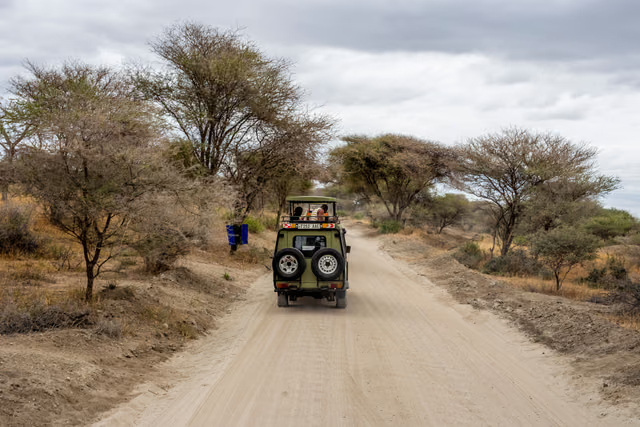
The good news? Most of the risk is manageable — if you prepare the right way. And if you're already carrying a premium travel rewards card, you may have more protection than you realize. This travel health checklist walks you through every step, from the CDC's destination lookup tool all the way to what happens if you need emergency evacuation from a remote safari camp. Think of it as the version your doctor, your insurance broker, and your points advisor would co-author together.
Step 1: Research Your Destination's Health Risks
Before you book anything beyond a flight, spend 20 minutes on the CDC's Travelers' Health site. Enter your destination and you'll get a country-specific breakdown of vaccine recommendations, current disease outbreaks, food and water safety guidance, and entry requirements.
Don't skip this step even for popular, well-touristed destinations. The CDC currently recommends the measles-mumps-rubella (MMR) vaccine for essentially all international travel — measles is on the rise globally, and the majority of U.S. cases are brought home by unvaccinated travelers. Some destinations add complexity on top of that baseline. Tick-borne encephalitis vaccines are recommended for outdoor time in parts of Austria. Yellow fever vaccination proof is required for entry into dozens of African and South American countries. Pregnant travelers need to avoid certain destinations entirely due to active Zika risk.
The State Department's travel advisories layer in security and political context on top of health concerns. You want the full picture before you go — especially if you're planning a first major international trip and haven't built up the pre-travel routine yet.
Also check: Whether your destination has entry restrictions tied to medications you carry. Some Gulf states, Japan, and Singapore, among others, require advance authorization for controlled substances that are legal and ordinary in the United States.
Step 2: Schedule a Travel Health Consultation (4–6 Weeks Out)
Your primary care doctor likely isn't the right call here. Travel medicine is a specialty, and general practitioners often don't stock travel-specific vaccines or stay current on fast-moving regional outbreaks. The International Society of Travel Medicine clinic directory helps you find a certified travel health provider near you.
Book your appointment 4–6 weeks before departure. Some vaccine series require multiple doses spaced weeks apart — you can't rush a hepatitis B series or a Japanese encephalitis protocol.
At a typical travel consultation you can expect:
- A destination-specific vaccine review (what's required for entry vs. recommended for your itinerary)
- Guidance on antimalarial medications if applicable — timing, dosing, and side effects vary by drug
- Food and water safety rules specific to your destination
- A prescription for traveler's diarrhea antibiotics to carry and use only if needed
- Altitude sickness medication for high-elevation destinations
- Advice on DVT prevention for long-haul flights
- Documentation letters for any controlled substances in your bag
One practical note on cost: your health insurance may not cover travel preventive care. HSA and FSA funds can be used for these expenses, and some travel credit cards' annual statement credits are broad enough to cover wellness visits — worth checking your specific card's terms before paying out of pocket.
Step 3: Sort Your Medications and Documentation
This is where the stress usually lives, and where preparation pays off the most.
For existing prescriptions: You need enough medication to cover your full trip plus a buffer of 5–7 days in case of delays coming home. Getting an early refill requires a conversation with your doctor, and your insurance may refuse to cover a refill that's more than a few days before the scheduled date. Don't wait until the week before you leave — pharmacies can't solve this problem on short notice.
Pack medications in original containers with pharmacy labels intact. This matters at customs, especially for controlled substances. A letter from your prescribing physician explaining what you take and why adds another layer of protection.
For controlled substances specifically: The rules vary dramatically by country. Codeine is legal over the counter in many countries but tightly controlled in others. ADHD medications like Adderall are banned or heavily restricted in Japan, Indonesia, and several other destinations. Cannabis products, including CBD, are illegal in many countries regardless of their status at home. Check the destination country's embassy website or contact them directly if you're uncertain — the consequences for getting this wrong range from confiscation to arrest.
For over-the-counter medications: Some staples in U.S. medicine cabinets require prescriptions in Europe. Stock up before you go on anything you use regularly.
Step 4: Understand What Your Credit Card Actually Covers
This is the section most travel health guides skip entirely, and it's one of the most valuable things a points traveler can know.
Premium travel rewards cards — the ones you're already carrying to earn miles on flights and hotels — include travel protection benefits that most cardholders never read. If you've ever wondered whether travel credit cards are worth it, this is one of the strongest arguments in their favor.
Emergency Medical EvacuationThe Chase Sapphire Reserve provides up to $100,000 in emergency evacuation and transportation coverage when you pay for travel with the card. This matters because medical evacuation from a remote location can cost $50,000–$300,000, and your domestic health insurance won't touch it. See the full breakdown of what triggers this benefit in our Chase Sapphire Reserve benefits guide.
Trip Interruption and CancellationIf a covered medical emergency forces you to cut your trip short, both the Chase Sapphire Reserve and Chase Sapphire Preferred cover non-refundable trip costs up to $10,000 per person. You'll need to pay for your trip — or at least the taxes and fees on an award booking — with the card to trigger coverage.
Travel Accident InsuranceMost premium cards include accidental death and dismemberment coverage for travel paid on the card, often up to $500,000.
What cards typically don't cover:
- Pre-existing conditions (with some exceptions if you purchase trip protection within a window of your initial deposit)
- Trip cancellation due to fear of a disease outbreak — this requires a separate Cancel For Any Reason policy
- Routine medical care abroad
- Dental emergencies (this is a common gap)
For a deep dive on exactly what each card's protections include, our Credit Card Travel Insurance Complete Guide breaks it down card by card. It's the most thorough resource we've published on this topic, and worth reading before you book any major international trip.
Step 5: Decide Whether You Need Standalone Travel Insurance
Once you know what your card covers, you can make a smart decision about whether additional insurance fills a real gap or just duplicates coverage you already have. This is exactly the costly mistake many travelers make with their cards — paying for coverage they already carry.
You probably need standalone travel insurance if:
- You're traveling to a high-risk destination where medical costs could exceed your card's evacuation limit
- You want Cancel For Any Reason (CFAR) protection — most credit card policies don't include this
- You have a pre-existing condition that your card's policy excludes
- Your total trip cost exceeds your card's cancellation coverage limits
- You're doing adventure activities (diving, mountaineering, motorbike riding) that trigger exclusions on standard card policies
CFAR specifically: If you want it, buy it within 14–21 days of your first trip deposit — most policies require this. CFAR typically reimburses 50–75% of prepaid, non-refundable costs, and it costs roughly 40–50% more than a standard policy. For a high-stakes trip with expensive award bookings, the peace of mind is often worth it.
Faye Travel Insurance is one of the strongest standalone options for international travelers, particularly because of its app-based claims process — you file, track, and receive payment directly from your phone rather than navigating a call center. For adventure-heavy itineraries, Freely Travel Insurance offers customizable plans that include coverage for high-risk activities most standard policies exclude.
If you want to compare multiple providers side by side before committing, InsureMyTrip lets you filter by coverage type, medical limits, evacuation coverage, and price across dozens of plans simultaneously. It's the fastest way to find genuine gaps vs. duplicates relative to what your card already provides.
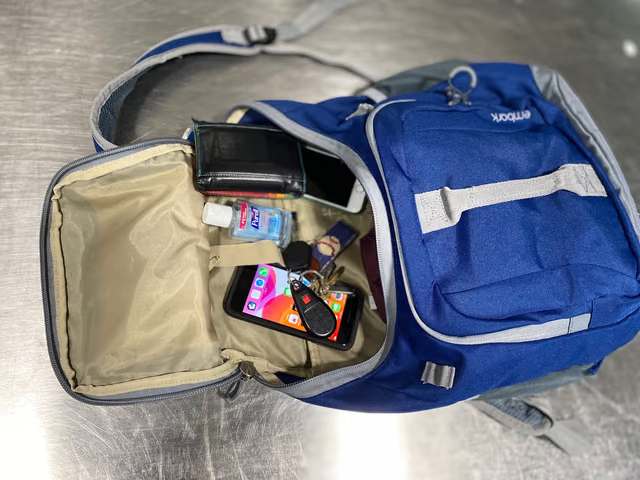
Step 6: Build Your Travel Health Kit
What goes in your kit depends heavily on where you're going, but here's what belongs in almost every traveler's bag.
Documentation (keep in carry-on, not checked bag):
- Copies of all prescriptions (digital and paper)
- Vaccination records, including yellow fever card if required
- Doctor's letter for any controlled substances
- Travel insurance policy summary and emergency contact number — for both your card's benefit and any standalone Faye or Freely policy you've purchased
- List of medications with generic names (brand names vary by country)
Medications and supplements:
- Prescription medications in original bottles, plus buffer supply
- Prescription traveler's diarrhea antibiotic (ask your travel doctor)
- Antimalarial medication if required for your destination
- Over-the-counter antidiarrheal, antacid, and pain reliever
- Zinc lozenges or immune support if you're prone to catching colds on planes
- Melatonin for jet lag management
- Antihistamines
Physical health supplies:
- DEET-based insect repellent (30–50% DEET for high-risk malaria/dengue zones)
- Sunscreen, SPF 30+
- Small first-aid kit: bandages, antiseptic wipes, blister treatment, medical tape
- Motion sickness medication if applicable
- Compression socks for flights over 6 hours
The goal isn't to pack a pharmacy — it's to cover the scenarios where you can't easily get what you need locally, or where delayed treatment makes things worse.
Step 7: Enroll in STEP and Verify Your Emergency Contacts
The U.S. State Department's Smart Traveler Enrollment Program (STEP) is free, takes five minutes, and lets the nearest U.S. Embassy reach you during a health emergency, natural disaster, or civil unrest. You can enroll once and register each subsequent trip directly from the app.
Before departure, also verify:
- Your travel insurance policy's 24-hour emergency assistance number is saved in your phone
- Your Chase Sapphire Reserve or other card's travel assistance line is saved — premium cards include dedicated emergency services lines, not just general customer support
- At least one person at home has your full itinerary, accommodation addresses, and emergency contact details
- Your primary care doctor's after-hours line is accessible in case you need a prescription clarification while abroad
Step 8: On the Ground — Stay Healthy in Transit and at Your Destination
Long-haul flights are genuinely high-risk environments for viral transmission. Low cabin humidity, recycled air, and close proximity to hundreds of strangers create conditions where viruses thrive. A few practical habits reduce your exposure significantly:
- Use the air vent above your seat pointed slightly away — it creates a gentle airflow barrier
- Wipe down tray tables, armrests, and seatbelt buckles before the flight (studies show these surfaces carry high bacteria loads)
- Wash hands before eating and after using the lavatory, every time
- Stay hydrated — dehydration weakens your immune response and makes jet lag worse
At your destination, the biggest health risks for most travelers are foodborne and waterborne illness. The standard guidance is "boil it, cook it, peel it, or forget it" in high-risk regions — but the nuance matters. Ice in drinks is made from tap water. Salads are washed in tap water. Street food that's been sitting out is higher risk than food cooked fresh in front of you. "Upscale restaurant" isn't a reliable proxy for food safety in every country.
For blood clot prevention on long flights: get up and walk the aisle every 1–2 hours, do calf raises in your seat, stay hydrated, and consider compression socks. If you have a history of DVT or other clotting risk factors, ask your doctor about aspirin or prescription anticoagulants before a multi-leg trip.
The Points Angle: Medical Emergencies and Award Bookings
Here's something the general travel health guides won't tell you: a medical emergency abroad creates a cascade of points-and-miles complications that are worth planning for.
Award tickets are notoriously difficult to change or cancel. Most programs charge redeposit fees of $75–$150 per person. Some business class awards on partner carriers are essentially non-refundable in the 24 hours before departure. If you're hospitalized and your travel companion needs to change their return flight, they may face the same fees unless your travel insurance policy explicitly covers companions.
When you book travel with a card like the Chase Sapphire Preferred, the trip interruption benefit can cover reasonable additional expenses including replacement economy tickets home — but it won't necessarily cover the cost of rebooking that business class seat at a last-minute cash rate. Understanding this gap before it becomes a $4,000 surprise is part of maximizing your Chase Sapphire travel benefits.
If this risk is real for your itinerary, a standalone policy from InsureMyTrip can help you find a plan that specifically covers companion travel interruption and award ticket redeposit fees — search for policies that list "award ticket" coverage explicitly.
Also worth knowing: our Credit Card Travel Insurance Complete Guide explains how to properly document a medical claim — including the specific steps that determine whether a claim is approved or denied. Most denied claims fail not because the event wasn't covered, but because the traveler didn't follow the documentation process correctly.
Frequently Asked Questions
Does my U.S. health insurance cover me abroad?Most domestic health insurance — including employer plans, ACA marketplace plans, and Medicare — provides little to no coverage outside the United States. Some plans cover emergency stabilization care, but won't cover medical evacuation, ongoing inpatient care, or specialist visits. Check with your insurer directly before any international trip.
What vaccinations do I need before international travel?It depends entirely on your destination. Required vaccines (for entry) are different from recommended vaccines (for your health). Yellow fever vaccination proof is required for entry into many African and South American countries. Beyond that, the CDC's Travelers' Health site and a travel medicine consultation will give you the specific list for your itinerary.
Does travel insurance cover pre-existing conditions?Most standalone travel insurance policies cover pre-existing conditions only if you purchase the policy within 14–21 days of your initial trip deposit (the "look-back window"). Credit card travel insurance typically excludes pre-existing conditions. If you have ongoing medical conditions, standalone insurance purchased promptly after booking is essential.
Can I use my HSA or FSA for travel health expenses?Yes. Travel vaccines, antimalarial medications, travel health consultations, prescription medications, and many over-the-counter items are HSA/FSA-eligible. Check the IRS-eligible expense list and your specific plan for confirmation.
What should I do if I get sick abroad?Call your travel insurance or credit card's emergency assistance line first — they can help locate appropriate local medical facilities and coordinate direct billing so you don't have to pay out of pocket and submit for reimbursement. Keep all medical receipts, doctor's notes, and any diagnosis documentation for your claim.
How do I bring prescription medications through customs internationally?Carry medications in original prescription bottles with pharmacy labels. Carry a physician's letter explaining what you take and why. For controlled substances, check the specific rules for every country you're transiting through — not just your final destination. Some countries require advance permits for medications that are routine prescriptions in the U.S.
Bottom Line
Staying healthy while traveling isn't about becoming paranoid about risk. It's about doing a handful of specific, time-boxed tasks in the weeks before departure so that you can actually enjoy the trip you worked hard to plan and earn.
The prep isn't complicated: research your destination, see a travel medicine specialist, sort your medications and documentation, understand what your credit card already covers, and buy supplemental insurance only for the real gaps. Do those five things and you've handled 95% of the scenarios that send unprepared travelers scrambling.
If you're not sure which travel card gives you the best built-in protections for your travel style, start with our Credit Card Travel Insurance Complete Guide. And if you want to compare standalone policies quickly, InsureMyTrip is the fastest way to see what's actually available for your destination and trip length.
This article contains affiliate links. If you apply through our links, we may earn a commission at no cost to you, which helps us continue sharing points and miles strategies with the community.