
Back

2026 Travel Changes: New Airport Rules, Free Wi-Fi & What You Need to Know

Travel
January 2, 2026
The Points Party Team
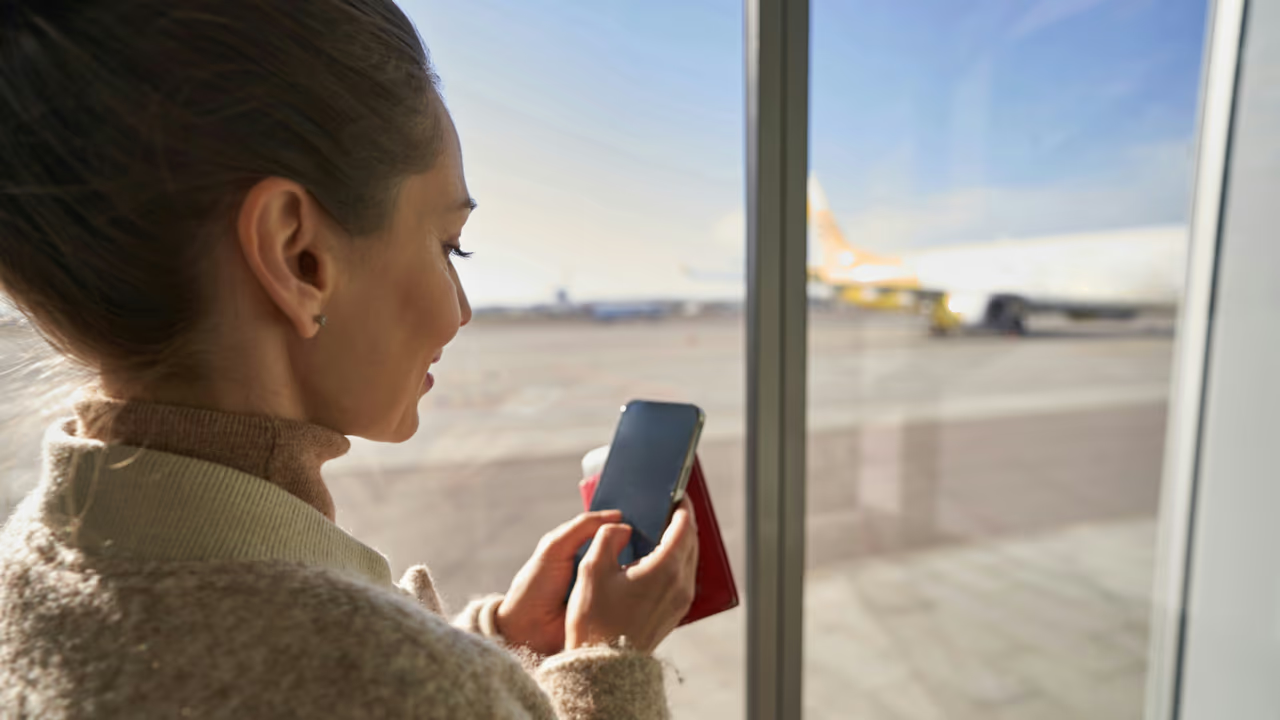
Traveler at airport gate with phone and passport

Key Points

  • TSA will charge a $45 fee for travelers without REAL ID starting February 1, 2026, and biometric screening is expanding rapidly.
  • American Airlines launches free Wi-Fi for AAdvantage members in January 2026, covering 90% of its fleet.
  • Southwest Airlines ends open seating on January 27, 2026, switching to assigned seats with premium options.

Introduction

If you haven't flown in a while, 2026 is bringing some of the biggest changes to air travel in over a decade. From mandatory REAL ID requirements and biometric screening at TSA checkpoints to free Wi-Fi becoming standard across major airlines, the flying experience is getting a significant overhaul. Some changes will speed things up, while others might catch unprepared travelers off guard with unexpected fees or confusion at security. Whether you're planning trips with points and miles or paying cash, here's everything you need to know to navigate these changes smoothly and avoid costly surprises.

The Big TSA Changes: REAL ID and Biometric Screening

REAL ID Is Now Mandatory (With a Catch)

After multiple delays spanning nearly two decades, REAL ID enforcement finally took effect on May 7, 2025. The requirement means you need a REAL ID-compliant driver's license, passport, or other approved identification to board domestic flights.

Here's what qualifies as acceptable ID:

  • REAL ID-compliant driver's license (look for the star symbol)
  • U.S. passport or passport card
  • Military ID
  • Trusted Traveler cards (Global Entry, NEXUS, SENTRI)
  • Enhanced Driver's License (available in some states)

The catch? Starting February 1, 2026, if you show up without acceptable ID, you'll have the option to pay a $45 fee for TSA ConfirmID, a modernized identity verification system. This fee covers a 10-day travel period, but here's the reality: the ConfirmID process takes longer than standard screening, and you should expect significant delays.

What TSA ConfirmID Actually Involves

The $45 isn't just paying to skip the line—it's quite the opposite. TSA agents will verify your identity through additional screening, including answering security questions and having your identity verified through multiple systems. You'll likely face longer wait times, more detailed bag checks, and possibly additional pat-downs.

According to TSA, more than 94% of passengers already use REAL ID or other acceptable forms of identification, which means those without proper ID will stand out and slow down security lines.

The Biometric Screening Expansion

TSA is rapidly rolling out facial recognition technology at security checkpoints. The Credential Authentication Technology 2 (CAT-2) units combine ID document scanning with live facial comparison, verifying whether a traveler's face matches the image on their uploaded document.

The good news? You can opt out. TSA allows passengers to decline the biometric feature and undergo standard ID verification instead. But as these systems become more widespread, expect them to be the default at most major airports by mid-2026.

One Rule Gone: Shoe Removal

Finally, some good news. On July 8, 2025, the Department of Homeland Security ended the long-standing shoe-removal requirement at TSA checkpoints. Advanced computed tomography scanners and improved explosive-detection capabilities made this change possible.

However, there's been some initial confusion. Many travelers, accustomed to the old procedure, still automatically remove their shoes at security, only to be told to put them back on, causing congestion. The rule is simple now: keep your shoes on unless a TSA agent specifically asks you to remove them.

Free In-Flight Wi-Fi Becomes the New Standard

American Airlines Joins the Free Wi-Fi Movement

In what might be the most traveler-friendly change of 2026, American Airlines will offer complimentary inflight Wi-Fi to all AAdvantage members beginning in January 2026, in partnership with AT&T. This covers over 2 million flights annually and about 90% of American's fleet.

The free Wi-Fi will be available on aircraft equipped with Viasat or Intelsat connectivity. Unfortunately, planes equipped with Panasonic connectivity, including the Boeing 777-200ER, 777-300ER, and some 787s, will not offer complimentary Wi-Fi initially.

Testing began on December 10, 2025, so you might already find free Wi-Fi on select American flights. The best part? Joining AAdvantage is completely free through this link, so every passenger can access this benefit. If you fly American frequently, consider the Citi AAdvantage Platinum Select card, which earns 2x miles on American purchases and provides other travel benefits.

Other Airlines With Free Wi-Fi

American isn't alone in this shift. Delta Air Lines began offering free Wi-Fi to SkyMiles members in 2023, while United Airlines and Southwest Airlines launched free service for loyalty members in 2024. Alaska Airlines plans to roll out Starlink-equipped planes with free Wi-Fi starting in 2026.

The trend is clear: free Wi-Fi is becoming table stakes for major airlines. If you're not already a member of your preferred airline's loyalty program, 2026 is the year to join. Better yet, consider getting an airline credit card that earns bonus miles on your everyday spending.

Southwest's Historic Change: Goodbye Open Seating

The End of an Era

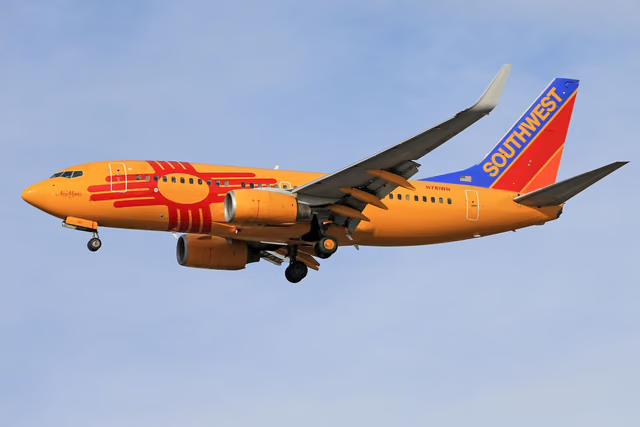
On January 27, 2026, Southwest Airlines will switch from its iconic open seating policy to assigned seating, ending a practice that defined the airline for over five decades. Southwest is already booking assigned seats for travel on or after this date.

The new seating structure includes three options:

  • Standard seats: Located in the back of the cabin with standard legroom
  • Preferred seats: Near the front of the cabin with standard legroom
  • Extra Legroom seats: Near exit rows with 3-5 additional inches of legroom

The airline will continue offering four fare bundle options with updated names: Basic (Standard seat assigned at check-in), Choice (select Standard seat at booking), Choice Preferred (select Preferred seat at booking), and Choice Extra (includes Extra Legroom seats).

If you're a loyal Southwest flyer, the Southwest Rapid Rewards Priority Card becomes even more valuable in 2026, offering four upgraded boardings per year and 7,500 anniversary bonus points. For those who want the best perks, the Southwest Performance Business Card provides even more benefits for frequent travelers.

Changes for Plus-Size Travelers

Southwest is also modifying its "Customer of Size" policy. Beginning January 27, 2026, plus-size passengers must purchase an extra seat in advance and pay any applicable seat fee. Refunds are available after travel under specific conditions, but the eligibility requirements are stricter than before.

Stricter Carry-On Enforcement

Airlines Get Serious About Size Limits

Airlines are tightening carry-on enforcement in 2025 and 2026, with some requiring bags to be checked for size at the departure gate right before boarding. Anything larger than specified dimensions might draw an excess fee at the gate, which is typically higher than checking a bag at the ticket counter.

The standard carry-on dimensions remain:

  • Most airlines: 22 x 14 x 9 inches
  • Southwest: Slightly larger allowance

But here's what's changing: enforcement. Gate agents are no longer letting oversized bags slide. If your bag doesn't fit in the sizing bin, you'll pay to check it—often $50 to $100 at the gate versus $30 to $35 at check-in.

Weight Checks Are Real Now

Many travelers are surprised to learn that airlines are now weighing carry-ons, not just measuring them. While most domestic airlines don't publish specific weight limits for carry-ons, international carriers typically enforce 15-20 pound limits. Expect this to become more common domestically as airlines look for additional revenue.

How to Prepare for 2026 Travel Changes

Get Your REAL ID Now

Don't wait until February 1, 2026, to deal with this. Visit your local DMV and bring:

  • Proof of identity (birth certificate or passport)
  • Proof of Social Security number
  • Two proofs of residency (utility bills, lease agreement, etc.)

Most states charge $10-30 for a REAL ID, and processing takes 1-4 weeks. If you travel even once or twice a year, this is worth doing immediately to avoid the $45 TSA ConfirmID fee and associated delays.

Join Airline Loyalty Programs

Even if you don't fly frequently, joining loyalty programs is now essential for free Wi-Fi access. Membership is free for:

You'll also benefit from easier rebooking during disruptions and access to member-only deals. For serious travelers, understanding how to maximize airline miles can save thousands on future trips.

Arrive Earlier at the Airport

With REAL ID enforcement ramping up and potential confusion at checkpoints, TSA recommends arriving:

  • 2 hours early for domestic flights
  • 3 hours early for international flights

The first few months of 2026 will likely see longer security lines as travelers adjust to new procedures.

Test Your Carry-On Dimensions

Measure your carry-on bag at home and weigh it. Many travelers discover their "carry-on" is actually oversized. Investing in a properly sized bag now saves money later. Consider bags with compression straps or expandable sections you can adjust to meet size requirements.

Credit Card Benefits for 2026 Travel

Cards With Travel Credits

Several premium travel credit cards offset the hassle of these changes with valuable perks:

The American Express Platinum Card includes a $200 annual airline fee credit that can cover checked bag fees if you end up needing to gate-check an oversized carry-on. It also provides access to over 1,400 airport lounges globally through Priority Pass, which can be a lifesaver during extended security delays.

The Chase Sapphire Reserve offers $300 in annual travel credits and Priority Pass lounge access, helping offset any additional travel costs from stricter policies. With the Chase Sapphire Preferred starting at a lower $95 annual fee, many travelers find it the sweet spot for travel rewards without the premium price tag.

For those who want maximum flexibility with their points, the Capital One Venture X provides 10,000 anniversary bonus miles, a $300 travel credit, and complimentary Priority Pass membership—all for an effective annual fee that's hard to beat.

Cards for Free Checked Bags

If airlines continue enforcing carry-on restrictions aggressively, airline co-branded cards become more valuable. Cards like the Citi AAdvantage Platinum Select provide free checked bags for you and up to eight companions on the same reservation, eliminating worries about carry-on size limits.

The Southwest Rapid Rewards Priority Card includes early check-in (which matters more now with assigned seating), four upgraded boardings per year, and 7,500 anniversary bonus points. For United flyers, the United Explorer Card offers the same free checked bag benefit plus two United Club passes annually.

Looking for more options? Our guide to the best airline credit cards breaks down which cards provide the most value based on your travel patterns.

What These Changes Mean for Your Travel Budget

Potential New Costs

If you're unprepared, 2026's changes could add unexpected expenses:

  • $45 TSA ConfirmID fee (if you forget your REAL ID)
  • $50-100 gate-check fees for oversized carry-ons
  • Premium seat fees on Southwest for preferred locations
  • Extra seat purchase requirements for some travelers

Ways to Save Money

Counter these potential costs by:

  • Getting your REAL ID well in advance (one-time $10-30 cost)
  • Investing in a properly sized carry-on bag ($50-150)
  • Joining airline loyalty programs for free Wi-Fi (free)
  • Using credit cards with travel benefits ($0-95 annual fee)
  • Applying for TSA PreCheck or Clear to streamline security ($78-189)

The upfront investment in proper preparation pays for itself quickly. Many of the best travel credit cards include statement credits that cover TSA PreCheck or Global Entry fees, making membership essentially free.

Looking Ahead: More Changes Coming

Digital IDs and Mobile Wallets

More airports are accepting digital IDs via Apple, Google, and Samsung Wallets. This trend will expand throughout 2026, potentially making physical IDs optional at some checkpoints. TSA is working with states to integrate digital driver's licenses into its verification systems.

Enhanced Biometric Gates

CLEAR is installing new eGates at major airports that allow members to move directly from ID verification to screening through facial recognition alone, eliminating the traditional stop-and-show process that slows down lines. Clear Plus membership costs $189 annually but can be discounted or free with certain credit cards like the American Express Platinum.

Regional Jet Wi-Fi Expansion

American is on pace to outfit more than 500 regional aircraft with high-speed Wi-Fi by the end of 2025, making connectivity available on smaller routes that previously lacked internet access.

Frequently Asked Questions

What happens if I show up without a REAL ID on February 1, 2026?

You'll be directed to TSA ConfirmID, where you can pay $45 for identity verification valid for 10 days. However, this process takes significantly longer than standard screening. You're better off getting a REAL ID or bringing your passport.

Is free Wi-Fi really free, or are there hidden costs?

Completely free for loyalty program members. American Airlines' free Wi-Fi, for example, requires only AAdvantage membership, which is free to join. No catches or data limits on Viasat and Intelsat-equipped aircraft.

Can I still get Southwest's open seating for flights before January 27, 2026?

Yes. Southwest's traditional open seating continues for all flights departing before January 27, 2026. Only flights on or after that date use assigned seating.

Will other airlines follow American with free Wi-Fi?

The trend strongly suggests yes. Delta, United, Southwest, and Alaska already offer free Wi-Fi to loyalty members. The industry is moving toward free connectivity as a standard amenity rather than a premium add-on.

How do I know if my ID is REAL ID compliant?

Look for a star symbol (usually gold or black) in the upper right corner of your driver's license. If there's no star, your ID is not REAL ID compliant. Contact your state DMV to upgrade.

Can I opt out of biometric facial recognition at TSA?

Yes. TSA allows passengers to decline biometric screening and undergo traditional ID verification instead. Simply inform the TSA officer that you wish to opt out.

Conclusion

The 2026 travel changes represent the most significant shift in air travel procedures since the post-9/11 security overhaul. While some adjustments like free Wi-Fi and no more shoe removal improve the experience, others like REAL ID enforcement and stricter carry-on rules require preparation to avoid costly surprises.

Start preparing now by getting your REAL ID, measuring your carry-on bags, and joining airline loyalty programs for free Wi-Fi. Consider applying for a travel credit card that offers benefits like free checked bags, travel credits, or lounge access to offset new costs. These simple steps transform potentially frustrating changes into minor inconveniences.

The travelers who thrive in 2026 will be those who adapt early and understand the new rules before they reach the airport. If you're working on maximizing your travel strategy, check out our complete guide to Chase Ultimate Rewards to learn how to earn points faster for all your upcoming trips.

Most importantly, don't let these changes discourage you from traveling. With proper preparation, you'll breeze through security, stay connected in the air, and actually enjoy some improvements—like keeping your shoes on and having free internet at 35,000 feet.

This article contains affiliate links. If you apply through our links, we may earn a commission at no cost to you, which helps us continue sharing points and miles strategies with the community.

No items found.
Tags: 
Travel