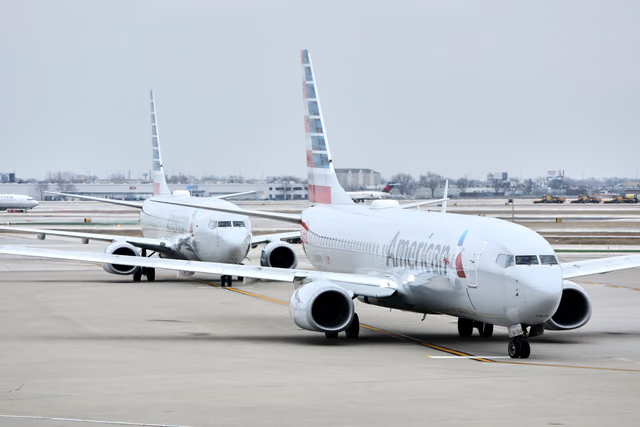




Yes, for most travelers two or three airline cards beat loyalty to one carrier, as long as each card pays for itself in free bags, a companion fare or a lounge you will actually use. Pick the cards for trip benefits rather than loyalty, and apply for Chase's cards first because of the 5/24 rule. Most points advice still says to pick an airline and stick with it, and that used to be the right answer. In 2026, with Citi now the exclusive issuer of American's AAdvantage cards in the U.S., United Quest charging $350 a year, Delta Reserve charging $650 with 15 Sky Club visits each Medallion Year unless you spend $75,000 on the card in a calendar year, and Alaska rebranding Mileage Plan as Atmos Rewards, the calculus has changed. The strongest wallet for a real-world traveler now usually holds two to three airline cards, chosen for trip-based benefits rather than loyalty.
This guide is the math behind that statement: which combinations work for which traveler, what each card's fee buys in credits and free bags, how 5/24 forces a sequencing order, and which American card to hold now that Citi issues them all.
Why Multi-Card Airline Strategy Beats Loyalty
The case for picking one airline rests on elite status. Status requires concentration, the argument goes, and concentration means one carrier. That logic still works if you're flying 25-plus times a year on a single airline. For everyone else, status earned through credit-card spend alone has become a worse deal:
- American requires 40,000 Loyalty Points just for Gold. On the Citi AAdvantage Platinum Select, you earn 1 Loyalty Point for every eligible AAdvantage mile earned from purchases, so card-only status takes heavy spending.
- Delta gates Medallion status behind Medallion Qualification Dollars (MQDs). The personal Delta SkyMiles Platinum and Reserve cards each add a $2,500 MQD Headstart every Medallion Qualification Year, and Silver Medallion takes $5,000 MQDs.
- United's PQP system on the United Explorer earns one PQP per $20 spent, up to 1,000 PQP a year, so card spend alone won't get you far toward Premier status.
Compare that to what an airline card actually delivers per trip:
- A free first checked bag saves up to $90 per person on a round-trip Delta flight, by Delta's count. American charges $45 per person each way for a first checked bag if you pay online, $50 otherwise.
- Companion certificates and companion fares (Delta Platinum, Alaska Ascent, Southwest's Companion Pass) routinely save $200 to $600 per use on routes you'd already buy.
- Award-flight discounts (Delta SkyMiles Platinum 15 percent off Delta award flights, United Quest 10,000-mile discounts each anniversary and after $20,000 in spend) cut the miles you need for a booking.
These benefits are trip-tied, not loyalty-tied. The strongest 2026 wallet stacks two or three of them across carriers and treats "which airline do I fly most" as separate from "which cards should I hold."
The Five Core Principles
1. Free Bags and Companions Are the Headline; Credits Are the Kicker
A Delta Platinum's $10-per-month Resy credit, a United Explorer's JSX credit, a Citi AAdvantage Platinum's 25 percent inflight discount: real, but noise next to the bag-and-companion math. Build your portfolio around the bags first. Treat credits as the seasoning that makes a $99 card act like a $20 card.
2. The 5/24 Rule Sets the Application Order
Chase counts every personal card opened with any issuer in the past 24 months. Chase's personal Southwest cards (Plus, Premier and Priority) and personal United cards (Gateway, Explorer, Quest and Club) are all on the 5/24 list, so applying for them first preserves room for non-Chase cards later. The standard sequencing for a multi-airline build:
- Chase cards first: United Explorer or United Quest, Southwest Premier or Priority. These need the 5/24 slot.
- After Chase is in place, move to Citi AAdvantage Platinum Select, Delta Amex Platinum, and Bank of America Atmos Ascent. None of these care about 5/24.
- Business cards from Chase (United Business, Southwest Premier Business) don't add to your 5/24 count, so they can come in between or after.
Reverse this order and you can end up locked out of the Chase cards for two years. People do this every month.
3. Welcome Bonus Timing Matters More Than Annual Fee Math
A welcome bonus on a single mid-tier airline card routinely beats two years of free bags. In March 2026, the boosted offers on personal Southwest cards included a Companion Pass straight from the welcome bonus on the Plus, Premier, and Priority cards (covered in our March 2026 Companion Pass offer breakdown). Citi's card page shows 80,000 AAdvantage miles on the Platinum Select after $3,500 in purchases within four months, as of October 17, 2026. Time applications around the bonus cycle, not the calendar.
4. Status Reciprocity Is Mostly Dead; Don't Pay for It
Airline alliances used to let elite status on one carrier translate to perks on a partner. In 2026, partner-status benefits are mostly cosmetic. A oneworld Emerald from American doesn't get you into Admirals Club lounges when flying United, and Star Alliance Gold on United gets you into Star Alliance lounges abroad but not domestic United Clubs when flying United. Don't pay for a premium card on the theory that status will spread across carriers. It won't.
5. Re-Evaluate Every February
Annual fees post on your card anniversary. The annual fee math you did when you got the card may no longer hold a year later because the issuer raised the fee, the benefit changed, or your travel pattern shifted. Run the numbers in February for every airline card and decide: keep, product-change, or close.
Top Combinations for 2026
Delta Platinum + Delta Reserve (Frequent Delta Flyer With Hub at ATL, DTW, MSP, SLC, or SEA)
The case for stacking both: the Delta SkyMiles Platinum gives you a $350 annual fee with a $120 Resy credit and a $120 rideshare credit, a 15 percent SkyMiles discount on Delta-operated award flights, and a Companion Certificate each year after renewal for a Delta Main round trip within the US or to the Caribbean or Central America. The Delta SkyMiles Reserve adds 15 Sky Club visits per Medallion year (with unlimited access kicking in at $75,000 in annual card spend), a Companion Certificate good in Delta First, Delta Comfort or Delta Main (within the US and to Mexico, the Caribbean or Central America), and a $2,500 MQD Headstart each Medallion Qualification Year, plus $1 MQD for every $10 in card purchases.
Together the two cards carry $350 and $650 annual fees. The pair only makes sense for true Delta-captive flyers who'll use the Sky Club visits and both Companion Certificates.
For everyone else, drop the Reserve. The Platinum is the better single Delta card unless you're hitting Sky Club more than a dozen times a year.
United Explorer + United Quest (United Loyalist Who Connects Through SFO, ORD, IAD, EWR, IAH, or DEN)
The United Explorer ($0 intro annual fee for the first year, then $150) covers a free first checked bag for the cardholder and one companion, two annual United Club one-time passes, 3x miles on United purchases, and 10% savings when booking United flights with miles. The United Quest at $350 adds a $200 annual United TravelBank credit, free bags extended to the cardholder and one companion at the second-bag level, a 10,000-mile award flight discount each anniversary plus another after $20,000 in purchases in a calendar year, and 4x miles on United purchases.
The pair earns its keep if you fly United five-plus times a year and use the award-flight discount at least once. If not, the Explorer solo wins on raw value.
Citi AAdvantage Platinum Select (American Airlines Flyer)
American calls Citi "the exclusive issuer of the AAdvantage co-branded card portfolio in the U.S.", and its card page lists only Citi cards. The Barclays AAdvantage Aviator Red is not among them, so it is not a card to plan around. If you already hold a Barclays Aviator card, ask Barclays how your account is being handled.
For a new American card, apply for the Citi AAdvantage Platinum Select ($0 intro annual fee for the first year, then $99).
Alaska Atmos Ascent + Atmos Summit (West Coast Flyer With Hawaii or Mexico in Rotation)
Alaska rebranded Mileage Plan to Atmos Rewards in 2026 and refreshed its co-brand lineup with Bank of America. The Atmos Ascent Visa Signature at $95 comes with a $99 Companion Fare (plus taxes and fees from $23) each account anniversary after $6,000 or more in purchases in the prior anniversary year, and a free checked bag for the cardholder and up to six guests on the same reservation when you pay for the Alaska or Hawaiian flight with the card. The Atmos Summit Visa Infinite at $395 trades the companion fare for a 25,000-point Global Companion Award annually, opens up a 100,000-point Global Companion Award after $60,000 in annual spend, and includes Alaska Lounge+ membership.
Stacking both is rare and usually unnecessary. For most readers, the Ascent solo at $95 is the highest-ROI airline card in the entire 2026 lineup if you live on the West Coast and use the Companion Fare even once a year. We covered the program rebrand in more depth in our Atmos Rewards 2026 changes breakdown.
Southwest Plus or Premier + Performance Business (Companion Pass Hunter)
The Southwest Companion Pass remains the single most valuable airline benefit available to a credit card holder. It lets a companion fly free (taxes only, around $5.60 each way) on every flight you book with cash or points, for the remainder of the year you earn it plus the entire following calendar year. Through 2026 the threshold is 135,000 Companion Pass qualifying points, and credit-card welcome bonuses count. Southwest retires Companion Pass qualifying points on December 31, 2026. From January 1, 2027, the pass is earned through tier qualifying points or flights: Platinum (140,000 points or 100 qualifying flights) gets unlimited Companion Pass trips, and a Milestone Reward at 95,000 points or 75 flights gives three. Every Rapid Rewards card will earn 1 tier qualifying point per $1 spent on purchases from that date, and new cardmember welcome bonuses will earn none. A pass you earn in 2026 keeps its benefits until its original end date.
The classic strategy times two card applications, one personal and one business, so both welcome bonuses post in the same calendar year, yielding nearly two years of Companion Pass. That play is closing, because Companion Pass qualifying points retire on December 31, 2026 and welcome bonuses earn no tier qualifying points after that. Chase says a Southwest welcome bonus posts 6 to 8 weeks after you meet the spend. In March 2026 Southwest ran a direct-from-welcome-bonus Companion Pass promo where a single card got you the Pass; check current offers before applying, because these promos cycle.
The Southwest Plus carries a $99 annual fee, and the Southwest Performance Business adds a second annual fee. The math is uncomfortably good if you have a Southwest hub and a regular travel companion.
What the Delta Card Fees Buy
Here's what each Delta card's annual fee buys:
- Delta SkyMiles Platinum ($350): up to $120 a year in Resy credits and $120 in rideshare credits, 15 percent off Delta award flights, and a free first checked bag that Delta says saves up to $90 per person on a round trip. Whether it pays for itself turns on using both monthly credits.
- Delta SkyMiles Reserve ($650): up to $240 a year in Resy credits, 15 Sky Club visits each Medallion Year, and a free first checked bag that Delta says saves up to $90 per person on a round trip. It earns its fee for frequent Delta flyers who use those visits, not for someone who flies Delta twice a year and never sees a lounge.
Who Should and Shouldn't Pursue This
Pursue a multi-airline wallet if:
- You take four-plus airline trips a year on two or more different carriers.
- You travel with at least one companion regularly. Most of the math is multiplied by the size of your party.
- You have room under 5/24 to add cards in the right order.
- You're disciplined enough to use monthly credits (Delta's Resy and rideshare especially) and won't pay an annual fee for benefits you forget to redeem.
Skip it if:
- You fly fewer than four times a year total. A single Chase Sapphire Preferred plus airline tickets paid in transferable points serves you better.
- You're chasing one airline's elite status. Concentrate spending and benefits on that carrier's premium card.
- You're under 5/24 and have other Chase cards on your shortlist. Don't burn the slot on an airline card unless that's your priority.
- You can't reliably use a Companion Pass or Companion Certificate. The annual fee math on Southwest's premium cards collapses without it.
Conclusion
Airline loyalty was the right move when status mattered, status was achievable, and partner reciprocity worked. In 2026 those conditions hold for a much smaller slice of travelers than the industry's marketing implies. The smarter wallet is two or three airline cards stacked for trip benefits, paired with one transferable-points earner like the Chase Sapphire Preferred for everything else. Pick the cards from the carriers you fly, not the carrier you wish you flew, and re-run the math every February when fees post.
Updated October 17, 2026: Companion Pass and welcome offer.