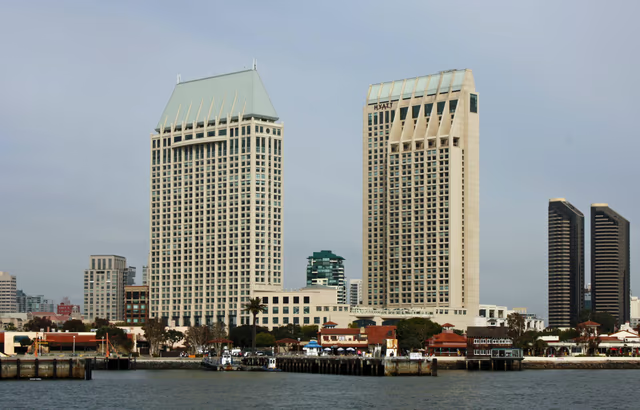




In March 2026, Air Mail published "Points Programs Are Ruining Luxury Hotels," a piece centered on a confidential meeting in which a manager at a flagship ultra-luxury property complained about award guests bringing coolers of food into the room and emptying minibar fridges to make space. The piece called loyalty members "freeloaders" who are "destroying the luxury-hotel experience." It is not the first time a luxury hotelier has said this out loud. It will not be the last. And it is mostly wrong, but not in the ways most defenses of points programs argue.
This is what is actually happening between major hotel loyalty programs and the luxury properties inside them, what changed in 2026, and how points members should adjust before booking the next aspirational redemption.
What Changed in 2026
Three program updates reshape the math.
Hyatt's award chart expansion takes effect May 20, 2026. World of Hyatt is moving from three demand levels (off-peak, standard, peak) to five (Lowest, Low, Moderate, Upper, Top). Inside Category 8, the top rate rises from 45,000 points to 75,000 points per night, a 67% increase at peak. Hyatt confirmed in its newsroom post that 136 properties are changing categories with the launch, 112 moving up and 24 moving down. The program said rollout to Upper and Top tiers will be limited in 2026, with broader adoption in future years.
Hilton's 2026 refresh, effective January 1, 2026, introduced a fourth elite tier above Diamond: Diamond Reserve, requiring 80 nights and $18,000 in eligible spend. The benefit that matters is Confirmable Upgrade Rewards, Hilton's first formal confirmed-suite-upgrade benefit, bookable at the time of reservation for up to seven nights in a one-bedroom suite. Hilton simultaneously lowered Gold to 25 nights and Diamond to 50 nights and ended rollover nights.
Marriott Bonvoy raised the bar at the top. For 2026 qualification, Titanium now requires 75 nights, and Ambassador requires 100 nights plus $23,000 in spend, a $2,000 spend increase. The program also clawed back bonus elite night credits some members had banked, surfacing as adjustments on accounts in April 2026.
Every one of these changes was designed to do the same thing: reduce the number of award guests at the highest-demand luxury properties, or extract more revenue from the ones still showing up.
Marriott published a soft-landing policy in November 2025 protecting members who fall short of their previous tier by one tier-level for 2026, which softens the optics of the tightening but doesn't change the long-term direction. Hilton's lowered nightly thresholds at Gold and Diamond pull in the opposite direction at the mid-tier, recognizing that the chain has more rooms to fill at the four-star level than at the Waldorf and Conrad properties where the new Diamond Reserve product sits. Read together, the 2026 changes are a clear segmentation: easier access to mid-tier status across the board, harder access to the genuinely valuable top-tier benefits at the properties where cash demand is highest.
The Air Mail Argument, Examined
The hotel manager's complaint has two parts. One is empirical, that award guests behave badly. The other is economic, that award guests cost the property money.
The empirical claim is unfalsifiable in a single anecdote, and the people sitting across from cash guests at luxury properties have just as many stories. The economic claim is testable, and it is the one worth engaging with.
Award redemptions are reimbursed by the parent program, not subsidized by the property out of thin air. The reimbursement rate is lower than peak cash rates at top-tier properties. That part is real. What the manager left out is what the parent program is buying with that subsidy: direct booking capture (no 15 to 25 percent OTA commission), filled inventory in soft periods, credit card economics (Marriott, Hilton, and Hyatt collect billions annually from co-brand fees), and the lock-in that makes a Bonvoy member skip past the independent property next door.
Gary Leff at View From The Wing and the team at One Mile at a Time both pointed out, in responses to the Air Mail piece, that the chains entered these arrangements willingly because the math works. A single property complaining about loyalty economics is complaining about the contract its parent company signed.
The harder question, the one the chains and the properties both avoid, is what happens at peak. A Category 8 Park Hyatt during a holiday week has cash demand that exceeds the reimbursement. The property would rather have the cash guest. The loyalty program would rather honor the redemption. The member, having earned the points through real spending, expects the room.
The chains are quietly resolving that conflict in the chain's favor, with members absorbing the cost.
There is also a secondary economic argument the Air Mail manager skipped past: ancillary revenue. Loyalty members staying on points at luxury properties still spend money on property. Industry reporting from Skift and Hotel Dive in 2025 and 2026 has documented that elite-tier members average meaningfully higher F&B, spa, and incidental spend per stay than transient cash guests, in part because elite members stay longer and in part because they treat the property as a destination. The reimbursement covers the room. The on-property spend is incremental. A property that wants to capture more of that ancillary revenue from award guests has a better lever than complaining: train staff to recognize and sell to them.
What That Looks Like in Practice
It looks like dynamic award pricing that lets peak nights at top properties price into the 75,000-point range. It looks like Hilton's new Confirmable Upgrade Rewards being available only to Diamond Reserve members at $18,000 in annual spend. It looks like Marriott's removal of suite-upgrade certificates as a default Platinum benefit. It looks like more properties refusing to honor breakfast benefits at full buffet value, substituting credits that don't cover the menu.
These are not coincidences. They are the chains responding to property-level pressure by raising the cost of award nights and tightening which members get the genuinely valuable benefits.
For a points member, the practical consequence is that the gap between programs is widening. Some chains are easier to use at the top, some harder. The right move is to know which is which before earning hundreds of thousands of points in the wrong currency.
Where Luxury Redemptions Still Work
World of Hyatt remains the most member-friendly program at the top end, even after the May 2026 chart changes. Globalist confirmed-suite-upgrade awards apply at booking, resort fees are waived on all stays including awards, and Hyatt's customer service consistently sides with members in dispute. The downside is the footprint, roughly 1,400 properties, with the luxury Park Hyatt and Alila collection concentrated in specific markets.
Hilton Diamond Reserve is the most interesting new product in the category. $18,000 in spend is real money, but the Confirmable Upgrade Reward, bookable at reservation, up to a one-bedroom suite, up to seven nights, is the first time a major U.S. chain has matched what Hyatt Globalists have had for years. Hilton's Aspire card delivers instant Diamond (not Reserve) with no spend requirement, which is still the cleanest path to top-tier status at any major chain.
Marriott Bonvoy is the program where the property matters more than the program. A Ritz-Carlton or St. Regis property that honors elite recognition is excellent on points. A property that doesn't is a frustration regardless of how many points the redemption costs. The footprint is unmatched, over 9,000 properties, but consistency is not.
IHG One Rewards covers a specific niche well. Six Senses and Regent properties are genuinely member-friendly, and the fourth-night-free benefit on award stays at IHG luxury properties still produces strong value math, especially in shoulder seasons. IHG's Diamond tier ($40,000 in qualifying spend or 70 nights) is the most expensive top-tier status to earn organically, which keeps the absolute number of Diamond members lower and the per-property treatment more consistent.
Choice Privileges and Wyndham Rewards do not belong in this conversation. The Air Mail piece is about luxury hotels. Choice and Wyndham operate at a different price point, and the loyalty-program complaints aimed at them are different complaints, mostly about devaluation rather than about award-guest behavior at flagship properties.
The brands that exited the major-chain orbit (Aman, Four Seasons with its proprietary program only, Rosewood, Mandarin Oriental) made the decision the Air Mail manager wishes his property could make. They compete on cash. Their service is consistent because they don't have a points contract to honor.
How to Book Luxury on Points After the 2026 Changes
Three rules:
Research the specific property before redeeming. FlyerTalk threads and recent TripAdvisor reviews filtered for "award stay" or "elite status" surface property-level treatment quickly. A property that frustrates loyalty members in 2026 is not going to surprise you next month.
Time redemptions for shoulder season. Hyatt's new Upper and Top award tiers map to demand. So does Marriott's dynamic pricing. A 50,000-point night in mid-September at the same property that prices at 110,000 over Christmas is not the same redemption. The empty room is also where the property is most receptive to award guests.
Spend on property. This is the part of the Air Mail anecdote worth taking seriously. The award guest who books a spa treatment, eats dinner at the restaurant, and orders room service one night gets recognized as a customer, not as a line item. The award guest who brings a cooler does not. Strategic spending on the things you'd buy anyway moves you out of the "freeloader" category in any property's internal accounting.
A fourth rule applies to anyone choosing where to concentrate spend: diversify across at least two programs. The 2026 changes have pulled the major chains in different directions on benefits and pricing. A member with balances in Hyatt for the consistent treatment, Hilton for the spend-driven path to Diamond Reserve, and Marriott for the global footprint has better optionality than a member with 800,000 points in a single currency that might devalue further. Transferable currencies (Chase Ultimate Rewards, Amex Membership Rewards, Bilt) protect against single-program risk by letting the member route points to whichever hotel program offers the better redemption at booking time.
The Bottom Line
The Air Mail piece is correct that some luxury hoteliers resent loyalty members. It is wrong that loyalty members are ruining luxury hotels. The chains created these programs to capture distribution, fill inventory, and lock in customers. They are now passing the cost of award nights through to members in the form of higher point requirements, tighter top-tier benefits, and more property-level discretion over award treatment.
The right response is to redeem points where the program still backs the member: Hyatt at the top, Hilton with the new Diamond Reserve product if the spend threshold is achievable, IHG Six Senses and Regent in specific markets, Marriott property-by-property. And to behave on property like a customer the hotel wants back. Points members did not break luxury hotels. They built the distribution model luxury hotels now depend on.