



Introduction
The Chime Credit Builder Secured Visa got a meaningful upgrade in late 2025. The headline change: cardholders with a qualifying direct deposit now earn cash back on the card itself, not just on debit spending. That moves it from "useful credit-building tool with a token rewards layer" into a genuinely competitive secured card.
Chime has rebranded the product (you may see it called the Secured Chime Visa Credit Card or simply the Chime Card on newer collateral), and the rewards structure is tied to your Chime membership tier. The basics most readers care about, no annual fee, no APR, no credit check, all carry over. As of April 2026, this is the most accessible secured card on the market, and for the first time it earns rewards that matter. Here is how it works, who it fits, and the two cards to compare it against.
Quick Summary
Best for: Credit beginners or rebuilders who already use Chime for direct deposit and want to build credit without fees or missed-payment risk. Standout benefit: Cash back rewards on a no-fee secured card with no credit check at application. Biggest drawback: Requires an active Chime Checking Account with qualifying direct deposit, and the card does not graduate to an unsecured Chime product. Current offer: No promotional welcome bonus. Credit-building product, not a rewards play. Annual fee: $0.
Chime Credit Builder Card Overview
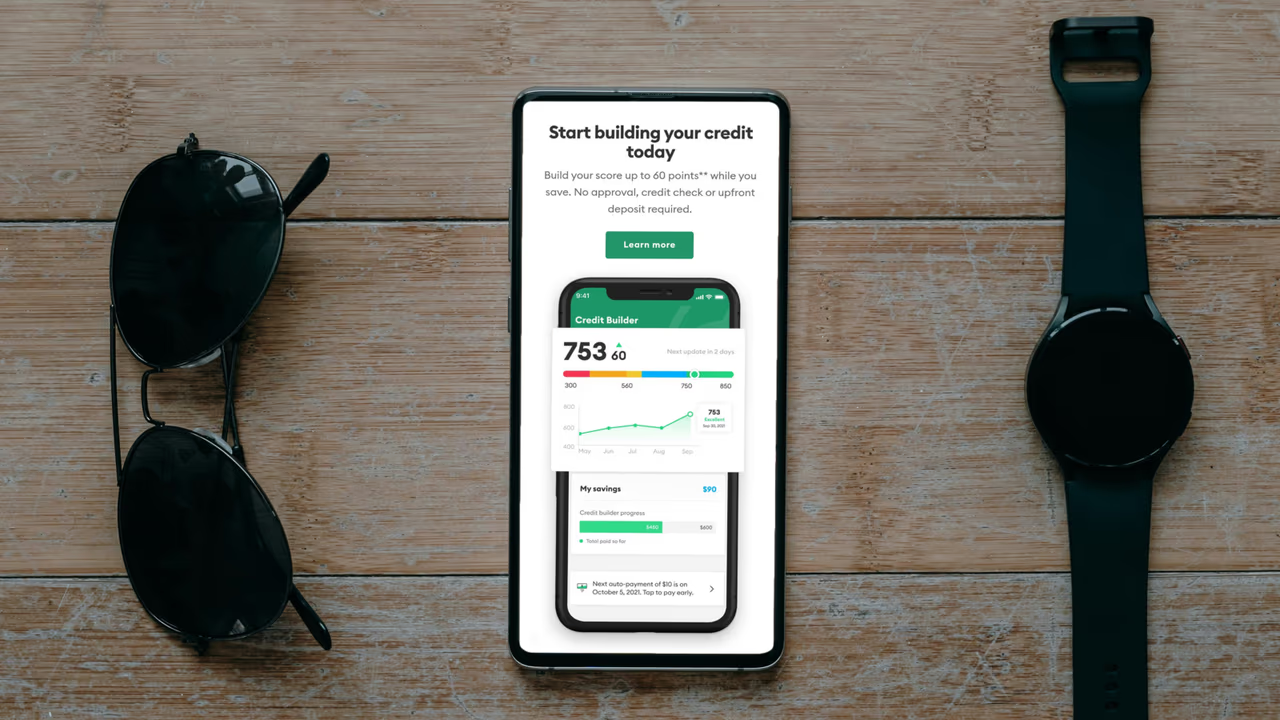
The Chime Credit Builder is a secured Visa that works differently than most secured cards. There is no traditional security deposit. You transfer money from your Chime Checking Account into a Credit Builder secured account in the Chime app, and that balance becomes your spending limit. Spend $100, your available limit drops by $100 until you transfer more in.
There is no hard credit pull at application. Chime evaluates account activity rather than your credit file, which makes approval more accessible if your credit is thin or damaged. You do need an active Chime Checking Account with a qualifying direct deposit of $200 or more per month.
At the end of each billing cycle, Chime automatically pays your statement in full from the secured balance, and that payment posts to all three major credit bureaus (Experian, TransUnion, Equifax). Most cardholders see reportable on-time payment history within 30 to 60 days, and meaningful credit score movement within three to six months of consistent use.
Key Features and Benefits
No Annual Fee, No APR, No Credit Check
Three zeros that matter. The annual fee is $0. Most secured cards charge $25 to $39 a year, and a few charge as much as $95. Over a two-year credit-building runway, that is $50 to $190 you keep.
There is no APR, because there is nothing to charge interest on. Your balance gets paid in full from your secured account at the end of each cycle, so you cannot revolve and accidentally pay 26% on a forgotten purchase. The application does not trigger a hard inquiry, so checking whether you qualify costs you nothing.
Cash Back Rewards (New As of Late 2025)
This is the meaningful change. With a qualifying direct deposit set up to your Chime Checking Account, the card now earns 1.5% cash back on rotating quarterly categories. Cited categories include groceries, gas, restaurants, monthly bills, taxi and rideshare, and travel. Verify the active list at the application page before counting on a specific category.
Two upgrade paths boost the rewards further:
- Chime Plus members (any cardholder with at least one qualifying $200+ direct deposit per month) earn 2% cash back on a chosen spending category.
- Chime Prime members (at least $3,000 per month in qualifying direct deposits) earn 5% cash back on a chosen category, capped at $1,500 in spending per month.
Real spending math: at $400/month in groceries through the Plus tier, the 2% rate produces $96/year. At Prime tier on the same spend, the 5% rate produces $240/year, well under the $1,500 monthly cap.
The catch: the card needs a real direct deposit relationship to earn anything beyond the structural credit-building benefit. If you cannot meet the $200 monthly threshold, treat this as a no-rewards secured card and pick the alternative below.
Auto-Pay From Secured Balance
The auto-pay design is the safety net most secured cards do not have. You cannot miss a payment, because the payment is not optional. The full statement balance is paid from your secured account on the due date, every cycle. That removes the single biggest cause of credit damage among new cardholders, missed payments. It also removes the 30%-of-limit utilization trap, since the statement closes paid in full.
Reports to All Three Credit Bureaus
Monthly reporting to Experian, TransUnion, and Equifax matters because not every secured card does it. A few subprime cards report to one or two bureaus, leaving a chunk of your file invisible to lenders pulling from the missing one. Three-bureau reporting is the standard, and Chime meets it.
How It Really Works
You move money from Chime Checking into the Credit Builder secured account. That balance is your spending limit. Make a $40 purchase, your remaining limit is whatever you transferred in minus $40. Transfer more in, the limit goes back up. When the billing cycle closes, Chime pulls the statement balance from your secured account and pays it. The bureaus see an on-time payment, and the cycle resets.
You are using credit (Chime is reporting your line), paying it on time (the auto-pay handles that), and keeping utilization sane (you only spend what you transferred). Three of the five FICO factors are taken care of structurally. Length of credit history and credit mix come with time and other accounts.
Pros and Cons
Pros
- $0 annual fee, $0 APR, no credit check at application, no minimum security deposit. Most secured cards have at least one of those costs; Chime has none.
- Cash back rewards for direct-deposit members: 1.5% on rotating quarterly categories at the base tier, 2% on a chosen category for Plus, 5% (up to $1,500/month) for Prime at $3,000+ monthly direct deposits.
- Auto-pay from secured balance makes a missed payment structurally impossible.
- Reports to all three major credit bureaus monthly.
- No foreign transaction fees, unusual for a secured card.
Cons
- Requires an active Chime Checking Account with a qualifying $200+ monthly direct deposit. If you do not bank with Chime or cannot meet the threshold, this card is not available to you.
- Cash back depends on direct deposit being active. Without it, you have a secured card with no rewards.
- No graduation path to an unsecured Chime credit card. When you outgrow this product, you apply with a different issuer.
- Your credit limit equals your secured balance, so the card cannot fund a purchase you do not already have the cash for.
- Limited cardholder benefits. No rental car coverage, no purchase protection, no extended warranty.
How Chime Credit Builder Compares
Two cards belong in the comparison set. Most other secured cards either charge fees or miss on rewards.
Chime Credit Builder vs. Capital One Quicksilver Secured
The Capital One Quicksilver Secured is the strongest direct competitor. Flat 1.5% cash back on every purchase, no categories, no caps, $0 annual fee, refundable security deposit starting at $200, no foreign transaction fees, and graduation review to an unsecured Quicksilver after as little as six months of on-time payments.
Two structural differences decide the pick:
- Deposit treatment. Capital One holds your $200 deposit as collateral and refunds it when you graduate. Chime keeps your money in a secured account that you control. Capital One's path lets you eventually get an unsecured product from the same issuer; Chime's does not.
- Rewards reliability. Capital One pays a flat 1.5% no matter your banking relationship. Chime's rewards depend on direct deposit and rotate by quarter (or get richer with Plus or Prime membership). If you can hit the Plus or Prime threshold, Chime's rewards beat Capital One's. If you cannot, Capital One's flat 1.5% beats Chime's no-rewards baseline.
For most credit-builders without a Chime banking relationship, the Quicksilver Secured is the better pick. For Chime customers already getting paid into Chime Checking, especially Plus or Prime members, the Credit Builder is the stronger play.
Chime Credit Builder vs. Discover It Secured
The Discover it Secured takes a different approach: refundable $200 to $2,500 security deposit, 2% cash back at gas stations and restaurants on up to $1,000 combined quarterly purchases, 1% on everything else. Discover also matches every dollar of cash back you earn in your first year, essentially doubling year-one rewards.
Discover runs a soft pull at application (some applicants see a hard pull post-approval), and graduation review begins around month seven, with most users moving to the unsecured Discover it Cash Back within 12 to 18 months. The trade-off: Discover gives better year-one rewards and a real graduation path. Chime gives no deposit lockup and rewards that scale with your banking relationship. If you can pass Discover's underwriting and have $200 to lock up, the Discover it Secured is usually the better card. If your profile is borderline or you specifically want the no-deposit mechanic, the Credit Builder is the right call.
Who Should Get the Chime Credit Builder Card
Great Fit For:
- Existing Chime customers with direct deposit set up. If your paycheck already lands in Chime Checking, the card is essentially free credit-building plus rewards.
- People who want guardrails on their credit-building. The auto-pay-from-secured-balance design protects against the most common credit-building mistake. If you have struggled with missed payments before, this card structurally cannot let you do that again.
- Credit beginners with no credit file. No hard pull, no minimum deposit, three-bureau reporting builds a profile from zero faster than waiting for a traditional issuer to take a chance.
- Chime Prime members. At $3,000+/month in direct deposits, 5% on a chosen category (up to $1,500/month) is a genuinely strong rewards structure on a no-fee card. Most flat-rate rewards cards top out at 2%.
Not Ideal For:
- Anyone who does not bank with Chime. Opening a Chime Checking Account just for this card is overkill. Pick the Capital One Quicksilver Secured or Discover it Secured instead.
- Readers who want to graduate to an unsecured product with the same issuer. Chime does not offer that path. Discover and Capital One both do.
- People who cannot meet the $200/month direct deposit threshold. Without it, you have a no-rewards secured card with extra setup steps.
- Anyone needing a higher credit line for a specific purchase. The limit equals what you transferred in.
Strategies for Maximizing the Chime Credit Builder
Start with $200 to $500 in the secured account. That is enough to run a couple of recurring charges without locking up too much cash. The goal in month one is reportable activity, not optimizing utilization.
Put one or two predictable bills on the card every month: a streaming subscription, a phone bill, a utility. Auto-pay handles them, and you generate consistent on-time payment data without thinking about it.
If you qualify for Chime Plus or Prime, match your bonus category to your largest monthly spending. At $400 to $600/month grocery spend, the 2% Plus rate produces $96 to $144/year, and the 5% Prime rate produces $240 to $360/year on the same spend.
Pull your free credit report at annualcreditreport.com after 60 and 120 days, and confirm the Chime line is reporting to all three bureaus. After six months of clean activity, watch for prequalified offers. Our guide to the best credit cards for fair credit covers what opens up at each score band.
Final Verdict
The Chime Credit Builder Secured Visa is now a genuinely competitive secured card, and that was not true a year ago. The cash back layer turns it from a credit-building utility into a card that earns its slot in your wallet, provided you have the Chime banking relationship to make the rewards work.
If you are already a Chime customer, especially at the Plus or Prime tier, the card is close to a no-brainer. The $0 annual fee, $0 APR, no-credit-check application, auto-pay design, and three-bureau reporting cover the structural needs, and the rewards are real money on top.
If you do not bank with Chime, look at the Capital One Quicksilver Secured first. It pays a flat 1.5% without forcing a banking switch, and it offers a graduation path that the Chime card does not. The Discover it Secured is the alternative if you can clear Discover's underwriting and want the year-one cash back match.
For Chime customers, apply once your direct deposit is established, set a small auto-paid bill on the card, and check your credit reports at 60 and 120 days. Most readers will see meaningful credit score movement within six months, and qualify for an unsecured next card within twelve. Another route is covered in our guide to store cards for building credit.
Updated October 19, 2026: Chime Credit Builder card.