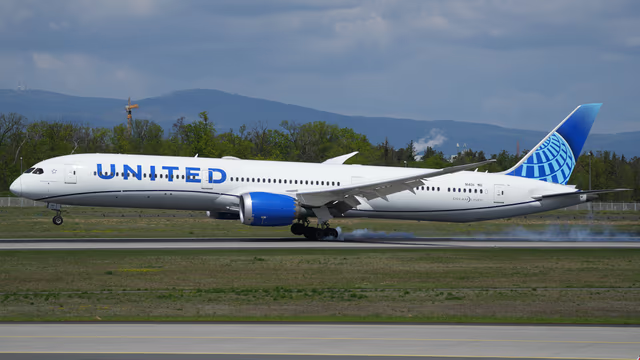




The Chase United Explorer is the card United flyers think about as a checked-bag-and-priority-boarding play. That framing isn't wrong; it's just the small half of the story. The bigger half is what United MileagePlus miles actually do once you stack a few of them up: Polaris business class to Tokyo, Lufthansa first to Frankfurt or ANA business out of LAX when saver space opens. The Explorer is the lowest-fee Chase United personal card that includes a free checked bag, and its fee ($0 the first year, then $150) pencils out faster than most people realize once you stop thinking of it as a domestic-economy card.
Quick Summary
Best For: United flyers taking 3+ round-trips a year, ideally with a companion on the same reservation, who plan to redeem MileagePlus miles for Star Alliance partner premium cabins.
Standout Benefit: Free first checked bag for the cardholder plus one companion on the same reservation, on United-operated flights when the cardholder buys the tickets from United with the card.
Biggest Drawback: Miles only earn into MileagePlus. There's no Ultimate Rewards-style flexibility, so if United and Star Alliance don't serve your travel patterns, the card doesn't either.
Current Offer: Up to 80,000 bonus miles: 70,000 after $3,000 in purchases in the first 3 months, plus 10,000 for adding an authorized user, on both of Chase's card sites.
Apply for the Chase United Explorer Card
Where the Explorer Sits in the Lineup
Chase and United run a four-card co-branded ladder. The no-fee Gateway sits at the bottom and earns 2x on United, gas, and transit. It has no lounge passes and no free checked bag as a standing benefit, though spending $10,000 on it in a calendar year earns two first standard checked bags. The Explorer ($0 the first year, then $150) is the next rung up. The $350 Quest piles on a $200 annual United travel credit, 4x on United (versus the Explorer's 3x), and free first and second checked bags. The $695 United Club Card sits at the top with United Club membership.
The Explorer is the right rung for the largest reader profile: someone flying United three to six round-trips a year, often with a partner or family member, who isn't yet spending enough on United directly to make the Quest's $200 credit and 4x rate worth its higher $350 fee. The math on Quest versus Explorer is real but narrower than the marketing suggests. I've written about why I keep the United Quest in my own wallet, but the Explorer is what I send most readers to as the starting point.
What the Card Actually Earns
The 2026 earning chart is straightforward:
- 3x miles on United purchases, and 9x total on eligible United flights for a MileagePlus member (6x as a member plus 3x from the card)
- 2x miles on dining, including eligible delivery services
- 2x miles on hotel stays booked directly with the hotel
- 1x mile on everything else
- 25% back as a statement credit on food, beverages and Wi-Fi on board United-operated flights and on Club premium drinks
Two things to flag here. First, the 2x on hotels is a real category, not just hotels booked through United, so a direct booking on a Hyatt or Marriott still earns at the bonus rate. Second, the 25% in-flight credit posts as a statement credit and stacks on top of the 3x earning, so you're double-dipping on the same purchase.
Say you take four United round-trips a year, eat out a few times a week and travel for work occasionally, which is the spend profile I see most often from readers who fit this card:
- $4,000 a year on United purchases at 3x: 12,000 miles
- $5,400 a year on dining ($450/month) at 2x: 10,800 miles
- $3,000 a year on hotels booked directly at 2x: 6,000 miles
- $12,000 a year on everything else at 1x: 12,000 miles
That's 40,800 miles a year from ongoing spend, before any welcome bonus. Those miles go furthest when you push them into Star Alliance partner premium cabins, which I'll get to in a minute.
The Free Bag Is the Floor, Not the Ceiling
Here's where the Explorer earns its keep before you even think about miles. The Explorer gives the primary cardholder and one companion on the same reservation a free first standard checked bag on United-operated flights. Chase puts the saving at up to $50 each way per person, or up to $200 per round trip for the two of you. Pair that with Group 2 priority boarding and you're solving two of the three things people actually hate about flying United domestic.
Say a couple flies together four times a year and each checks a bag. At Chase's figure of up to $200 per round trip, that's up to $800 in bag fees saved against a $150 annual fee after the first year, before you've earned a single mile or used a Club pass. For a family of four where two adults can each be on the reservation, the math gets sillier, but only the cardholder plus one companion qualifies, so coordinate which adult is the named cardholder if both parents fly with kids on shared itineraries.
The Group 2 boarding piece is genuinely useful on a 737 with full bins, less useful on a half-empty Tuesday morning regional. Lounge passes round the package out: two United Club one-time passes a year, which Chase values at over $100 if you actually use them. Save them for international connections or long delays. Burning one on a 35-minute domestic layover is a waste.
The Real Reason to Earn United Miles
Now the part that doesn't fit on the marketing landing page. MileagePlus miles book award flights on United and Star Alliance partner airlines, and several of those partners offer premium cabin awards at saver levels that beat anything you'll find in the United metal award chart. This is where the Explorer stops being a checked-bag card and starts being a tool to build a partner award.
A few sweet spots I'd actually use these miles on:
- Lufthansa business class to Europe. If you're flexible, this is the redemption everyone in the hobby talks about.
- ANA business class to Tokyo. ANA's "The Room" hard product on the 777 is one of the best business cabins flying, and award space is genuinely findable if you book at the schedule open.
- Singapore Airlines business class. Tighter saver availability for partners, but when it appears, you're flying one of the best soft products in the sky for similar mileage to the ANA redemption.
- Air Canada Aeroplan and EVA Air business as fallbacks. Aeroplan availability into Western Canada is consistently good, and EVA's Royal Laurel cabin to Taipei is a quietly excellent redemption that doesn't show up on most partner-redemption lists.
- United Polaris business class itself. The cabin is a legitimate hard product across the long-haul fleet now that the older 767 retrofits are mostly behind us.
The welcome bonus plus a year of routine spend at the rates above puts a partner premium-cabin redemption within reach, depending on the price United shows on the day you book. That's the real first-year ROI the bag math doesn't capture.
If you're newer to this and want the broader background on what these miles do, the United MileagePlus complete guide walks through the partner chart and Excursionist Perk in more depth. If you know you want partner premium cabins specifically, Star Alliance award sweet spots goes route-by-route.
Stacking the Earning With MileagePlus Shopping
A piece most Explorer cardholders skip: MileagePlus Shopping is a portal that pays bonus miles when you click through to retailers before checking out. Buy through the portal, pay with the Explorer, and you're stacking portal miles on top of the card's 1x or 2x.
Run the portal first, every time. It takes a few seconds, and the portal miles land on purchases you were going to make anyway.
Travel Protections That Aren't Marketing Filler
The Explorer's insurance package looks unassuming on paper but holds up better than you'd expect:
- Primary auto rental coverage, up to $60,000 for theft and collision damage on most rental vehicles with an MSRP of $125,000 or less, so you can decline the rental company's collision insurance without involving your personal auto policy.
- Trip cancellation and trip interruption up to $1,500 per person and $6,000 per trip for covered reasons.
- Baggage delay reimbursement up to $100 a day for up to 3 days for essentials when bags are delayed more than 6 hours.
- No foreign transaction fees, which on a card that's specifically for an international airline matters more than the line item suggests.
The trip cancellation cap is lower than the Chase Sapphire Preferred's $10,000 per covered traveler and $20,000 per trip, so if you take genuinely expensive trips, the Preferred is the card to charge them to. But for the kind of $1,500-$3,000 vacations most readers are taking, the Explorer's coverage is sufficient and its auto coverage is primary.
Pros
The free bag benefit is the rare card perk that pays for itself before you've thought about it. Two people on the same reservation, three or more round-trips a year, you're net positive on the fee in cash terms.
The 25% in-flight credit and Group 2 boarding turn United domestic from "okay" into "noticeably better than economy on the same metal at the gate next to yours." It's not Polaris, but it's a different experience.
United miles are a credible Star Alliance currency. You're not stuck with United metal. Lufthansa, ANA, Singapore, Aeroplan, EVA, Swiss, and Air New Zealand are all on the table.
The two annual Club passes are worth over $100 by Chase's count, usable on international trips when they actually matter.
Cons
This is a single-airline currency card. If you're not committed to United and Star Alliance, a flexible-points card like the Chase Sapphire Preferred is the better pick. Its points still transfer to United at 1:1, plus 13 other partners.
The Explorer counts against Chase's 5/24 rule, which means if you've opened five or more cards from any issuer in the last 24 months, you're getting auto-declined. Plan your application order accordingly.
Card spending counts toward elite status, but slowly: the Explorer earns 1 Premier qualifying point (PQP) for every $20 in purchases, up to 1,000 PQP a year. If you want elite-friendly card benefits, the Quest (up to 18,000 PQP a year) and the United Club Card (up to 28,000) have stronger plays.
The 2x dining and 2x hotels are fine, but they're not category-leading. If you're optimizing those specific buckets, you're better off on a different card and using the Explorer specifically for United purchases and the bag/boarding/lounge perks.
How the Explorer Compares
Versus the United Gateway (no fee): Gateway earns 2x on United plus 2x on gas stations and local transit, with no annual fee and the same 25% back on in-flight purchases, but it doesn't include United Club passes or a free checked bag on every trip. Instead, spending $10,000 on the Gateway in a calendar year earns certificates for two first standard checked bags on United- or United Express-operated flights, which Chase values at up to $100. If you fly United 0-2 times a year, Gateway is the right call. Three or more flights with a companion, Explorer wins outright on bag savings alone.
Versus the United Quest ($350): Quest adds 4x on United, a $200 United travel credit at account opening and each anniversary, free first and second checked bags, a 10,000-mile award flight discount each anniversary, and 1,000 bonus PQP a year. If you'd use the travel credit and the second bag, the Quest's higher fee can come back to you. If not, Explorer is the better value. The Quest review covers when the upgrade math flips.
Versus the Chase Sapphire Preferred ($95): A lower fee than the Explorer's $150 after the first year, and a totally different tool. Preferred earns Ultimate Rewards points that transfer 1:1 to United plus 13 other partners, and includes stronger trip-cancellation insurance. World of Hyatt is the exception at 4:3 as of October 1, 2026, so 1,000 points become 750. Preferred is the right pick if you want optionality. Explorer is the right pick if you want the bag and boarding perks alongside earning.
For readers with one card slot and a clear "I fly United and only United" pattern, Explorer wins. For everyone else, Preferred is usually the call.
Who I'd Recommend This Card For
You take 3+ United round-trips a year, ideally with a companion on the same itinerary. You're comfortable building toward a single-program currency because United and Star Alliance partners cover where you actually want to fly. You're under Chase's 5/24 limit and willing to spend a slot on a co-branded card rather than a flexible-points one. You'll actually use the two Club passes a year, not let them expire in app inventory.
Skip the card if you fly multiple airlines opportunistically, take fewer than three United trips a year, or are over 5/24. The Gateway covers light United flyers without a fee, and a transferable-points card covers everyone else.
Application Notes
On October 9, 2026, both of Chase's card sites showed up to 80,000 bonus miles (70,000 after $3,000 in purchases in the first 3 months, plus 10,000 for adding an authorized user). Offers can differ by where you apply, so check the page you apply through.
The 5/24 rule is hard. There's no business-card workaround for the Explorer specifically because it's a personal card, so if you're at 5/24 your only option is to wait until older accounts age off the count.
Final Verdict
The Chase United Explorer is the right card for a specific reader: the United flyer taking three or more round-trips a year, often with a companion, who wants the free-bag-and-priority-boarding floor and views MileagePlus as a path to Star Alliance partner premium cabins. For a couple who check bags on a few round-trips a year, bag savings alone can cover the fee ($0 the first year, then $150) before miles enter the picture. The welcome bonus gets you a meaningful chunk of the way to a Lufthansa, ANA, or Polaris partner award in year one. If that profile is you, the Explorer is the lowest-fee Chase United personal card that includes a free checked bag in 2026. Check the current offer here and start building toward whichever Star Alliance partner you've been eyeing.
Updated October 9, 2026: welcome offer and Gateway checked bags.