Back

This Week's Best Points and Miles Opportunities: 5 Major Deals You Need to Know About

Credit Cards
May 26, 2026
The Points Party Team
Hand holding blue credit card at contactless payment terminal

Key Points:

  • Chase is offering 10X points through Paze digital wallet, stackable with existing bonus categories for potential 13X-15X earning rates on select purchases.
  • Discover's $200 welcome bonus combined with first-year cashback match creates over $1,000 in value from a no annual fee card.
  • Delta Amex cardholders now get complimentary inflight Wi-Fi on domestic flights, adding $160-360 annually in value to cards starting at just $150 annual fee.

This week brought some genuinely exciting developments in the points and miles world. Between limited-time earning bonuses, improved credit card benefits, and evergreen strategies that deserve more attention, there's a lot to unpack.

I'm going to walk you through the five biggest opportunities worth your attention right now, from time-sensitive deals you need to grab immediately to long-term strategies that can transform how you book award travel.

Chase Cards Offering 10X Points Through Paze: Act Fast on This Stacking Opportunity

Chase just launched a limited-time promotion that's flying under the radar but deserves your immediate attention. If you hold a Chase Sapphire Preferred, Chase Sapphire Reserve, Chase Freedom Flex, or Chase Freedom Unlimited card, you can now earn 10X total points when you use Paze digital wallet at participating merchants.

What This Actually Means

Paze is a digital wallet backed by major banks including Chase, Bank of America, and Wells Fargo. It's their answer to PayPal and Apple Pay, and adoption has been slow, which is exactly why Chase is throwing points at cardholders to try it.

The deal is straightforward: When you check out at participating retailers and select Paze as your payment method, Chase awards you 10X total points. That's not 10X bonus points on top of your base earning but 10X total, meaning 9X bonus points plus your standard 1X base earn.

The Stacking Sweet Spots

Here's where this gets interesting. If you're using a Freedom Flex or Freedom Unlimited on a category that's already earning bonus points, you can potentially stack the Paze bonus on top.

Dining with Sapphire Reserve normally earns 3X points at restaurants. With Paze, you're looking at 10X total points, a 233% increase in earning power. For a $500 hotel booking with Sapphire Preferred that normally earns 2X on travel, you're getting 5,000 points instead of the usual 1,000.

The key question everyone's asking is whether this stacks with quarterly 5X categories on Freedom cards. Based on similar past Chase promotions, the higher earning rate typically applies, but Chase's terms can be frustratingly vague. I'd recommend testing with a small purchase first.

Where You Can Actually Use It

This is where the promotion hits a speed bump. Paze acceptance is still relatively limited. Current major participants include Panera Bread, Fandango, GameStop, Grubhub, StubHub, and Ticketmaster. The list is growing, but it's not yet ubiquitous.

You'll need to register for this promotion before making purchases, and past Chase offers have been strict about this requirement. Look for the registration link in your Chase account dashboard or check your email for targeted offers.

Important limitations: Registration deadlines typically run 30-60 days from launch, spending caps often hit $1,500-$3,000 in qualifying purchases, and bonus points can take 6-8 weeks to post. A $1,500 spending cap means 15,000 bonus points, worth $150-$225 in travel value depending on how you redeem through Chase.

The Discover Card Opportunity Nobody's Talking About

I'm about to say something that might surprise regular readers: You should probably get a Discover it Cash Back card right now, even if you're deep into the points and miles game.

Discover is offering $200 back after you spend $1,000 in your first three months. That's a 20% return on initial spending, which is excellent. But the real magic is Discover's first-year cashback match.

Understanding Cashback Match

Every new cardholder gets Cashback Match for the first year, meaning Discover will match all the cashback you earn dollar-for-dollar at the end of your first year.

Here's what this actually means: Discover's rotating 5% categories (up to $1,500 in combined purchases per quarter) effectively become 10% back in your first year. The card's standard 1% on all other purchases becomes 2% back. Even that $200 welcome bonus gets matched, turning it into $400 total.

First-Year Earning Potential

Let's model out a realistic first year. You max out the quarterly categories at $1,500 per quarter across four quarters. That's $6,000 earning 5% cashback, which equals $300. With Cashback Match, that becomes $600 total.

Add in $500 per month in non-bonus spending for 12 months. That's $6,000 at 1% cashback, equaling $60. With the match, that becomes $120 total.

Your sign-up bonus of $200 gets matched to $400.

Total first year value: $600 plus $120 plus $400 equals $1,120.

That's over $1,000 in value from a no annual fee card. Show me another card that can compete with those numbers in year one without an annual fee.

Why This Works Even for Points Enthusiasts

I know the objection: "I'm trying to earn Ultimate Rewards and Membership Rewards for business class flights. Why would I want cashback?"

Here's my answer. This is a no annual fee card, so you're not choosing between this and a premium card. You're adding it to your rotation. Points and miles get devalued constantly. Cash doesn't. That $1,000+ you'll earn in year one is immune to airline award chart changes.

Our complete guide to maximizing cashback credit cards explains how cashback strategies complement rather than replace points earning.

Discover's typical quarterly categories include gas stations and fitness clubs in Q1, grocery stores and rideshare in Q2, restaurants and PayPal in Q3, and Amazon, Target, and Walmart in Q4. You need to activate each quarter's categories manually, so set a calendar reminder.

The acceptance reality: Discover isn't accepted everywhere internationally, but in the U.S., acceptance is around 99% of places that take credit cards. For domestic everyday spending during your first year, acceptance really isn't a problem. Plus, Discover works at Costco, one of the few places that takes Discover but not Visa.

If you're ready to add this to your wallet, apply for the Discover it Cash Back to lock in the $200 bonus and cashback match before the offer changes.

American Airlines Award Space Is Better Than You Think

American Airlines AAdvantage miles have a reputation problem. Most casual points collectors will tell you American awards are impossible to find, the pricing is terrible, and you're better off using United or Delta.

They're partially right, but mostly wrong.

Understanding American's Partner Award Chart

American uses dynamic pricing for its own flights, which is frustrating when you're looking at 80,000 miles for a domestic economy flight that should cost 12,500. But here's what most people miss: American's partner award chart is still largely intact.

Economy to Europe on British Airways or Iberia costs 22,500-30,000 miles one-way. Business class to Europe runs 57,500 miles one-way. Business class to Asia on Japan Airlines or Cathay Pacific costs 70,000-80,000 miles one-way. These rates are significantly better than what you'll often find on American's own flights.

The Partner Airline Sweet Spots

American belongs to the oneworld alliance, giving you access to some genuinely excellent airlines for premium cabin travel.

Japan Airlines consistently releases business class awards to Tokyo and beyond. Search 330-355 days out for best availability. JAL's business class product is outstanding with lie-flat seats, excellent service, and some of the best airline food you'll find.

Qatar Airways Qsuites represent the holy grail of business class redemptions. Qatar tends to release space closer to departure, often 2-4 weeks out. Check frequently and be ready to book when space opens.

Iberia offers solid availability to Madrid and throughout Spain. Their business class product on newer aircraft is competitive, and they often have space when British Airways is sold out.

The Multi-Tool Search Strategy

American's own website has gotten better at displaying partner awards, but it's still not comprehensive. You need multiple search tools to see the complete picture.

Start with AA.com to establish a baseline. Then use British Airways Executive Club's search tool, which shows availability on all oneworld partners more comprehensively than American's site. The dates and flights you see on BA.com can typically be booked through American at American's award rates, which are usually better than BA's rates.

Check Qantas Frequent Flyer's search tool, arguably the best for seeing oneworld availability, especially for Qatar Airways and Cathay Pacific. You'll need a free account. For serious award searching, ExpertFlyer's subscription service lets you see exact seat availability by booking class.

Strategic Positioning Changes Everything

Want to dramatically improve your American award availability? Be willing to position, meaning start your international journey from a different city than your home airport.

You live in Denver and want business class to Tokyo. Searching Denver to Tokyo shows limited options, but there's consistent JAL business class availability from Dallas to Tokyo. Book a cheap Southwest flight from Denver to Dallas, then book your JAL business class award from Dallas to Tokyo. The total cost might be 60,000 AAdvantage miles plus $75 for the Southwest flight versus 110,000 miles for a mediocre direct routing.

Best positioning cities include Dallas (American hub with extensive oneworld connections), Los Angeles (JAL, Qantas, Cathay connections), New York JFK (British Airways, Iberia, Qatar, Finnair), Miami (Iberia, British Airways, LATAM), and Chicago (JAL, British Airways, Qatar).

Avoiding British Airways Fuel Surcharges

British Airways levies massive fuel surcharges on award tickets flown on BA metal, often $400-700 in surcharges for a transatlantic business class award. Route through BA's hub London but fly on a partner carrier like Iberia, Finnair, or American. Book BA flights within the Americas where surcharges are minimal. Use Iberia or Aer Lingus instead of BA for transatlantic flights when possible.

The best way to earn American Airlines miles is through Citi AAdvantage cards, which regularly offer 60,000-75,000 mile bonuses with manageable spending requirements.

Delta Amex Cards Just Got More Valuable

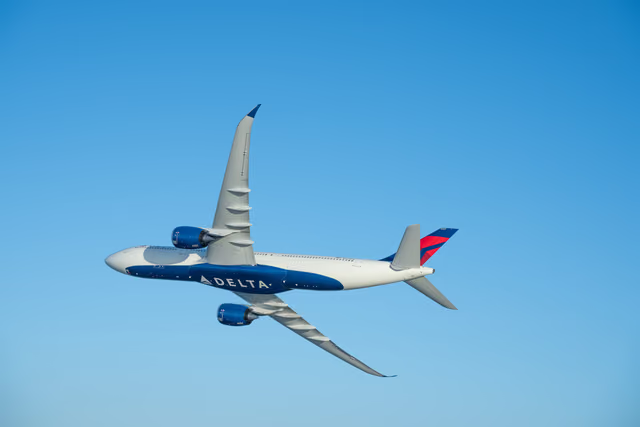
Delta and American Express quietly rolled out a new benefit that's actually more useful than the flashy perks they usually announce with big marketing campaigns. Starting this month, all Delta SkyMiles credit cardholders get complimentary access to Delta's inflight Wi-Fi on domestic flights.

Who This Benefits

Previously, complimentary Wi-Fi on Delta flights was reserved for Delta Diamond Medallion members and Delta Reserve cardholders with the $650 annual fee. Now it extends to holders of Delta SkyMiles Gold ($150 annual fee), Delta SkyMiles Platinum ($350 annual fee), and all corresponding business versions.

This is a significant expansion affecting hundreds of thousands of cardholders who previously had to pay $8-18 per flight for Wi-Fi access.

The Real-World Value Calculation

Delta charges $8 for one-hour Wi-Fi sessions and $18 for day-long access on most domestic flights. If you fly Delta 10 times per year (20 flights round-trip), you're looking at $160 annually for one-hour sessions or $360 annually for all-day passes.

For Gold cardholders paying a $150 annual fee, this benefit alone covers the cost if you take just 10 round-trip flights. For Platinum cardholders, it offsets $360 of the $350 annual fee, before considering other benefits like free checked bags, priority boarding, and bonus SkyMiles earning.

How to Use It

There's nothing to activate. The benefit is automatically linked to your Delta SkyMiles account when you have an eligible Amex card. Board your Delta flight, connect to the "Delta Wi-Fi" network, open a browser and go to wifi.delta.com, sign in with your SkyMiles account, and your complimentary session automatically applies.

I tested this on a recent Atlanta to Seattle flight, and it worked exactly as advertised. No codes to enter, no forms to fill out. Just instant access.

One caveat: The Wi-Fi only works on flights operated by Delta, not Delta Connection partners like Endeavor or SkyWest. However, most mainline Delta flights have Wi-Fi available, especially on routes longer than 90 minutes.

Comparing to Competitors

This move brings Delta Amex cards closer to parity with competing airline credit cards. United Club Card ($525 annual fee) includes complimentary Wi-Fi on United flights. American Airlines AAdvantage Executive Card ($450 annual fee) includes complimentary Wi-Fi on American flights.

What's notable is that Delta is offering this benefit at a lower price point. The Delta Gold card at $150 annual fee now includes Wi-Fi, while you need to step up to premium cards ($450+) with United and American to get the same perk.

The Stacking Opportunity

Where this gets interesting is stacking the Wi-Fi benefit with other perks Delta Amex cards offer. Consider a round-trip Delta flight from New York to Los Angeles for a family of four.

Without the card, you'd pay $280 for checked bags ($35 per passenger times four passengers times two flights) plus $144 for Wi-Fi ($18 per passenger times four passengers times two flights), totaling $424.

With the Delta Gold card ($150 annual fee), checked bags are free for the primary cardholder and up to eight companions, and the cardholder gets free Wi-Fi. Net savings are $280 for checked bags plus $36 for cardholder Wi-Fi, equaling $316. Effective value is $316 savings minus $150 fee, leaving $166 profit on just one trip.

How to Get Retention Offers From Every Major Credit Card Issuer

Your annual fee just hit. You're staring at a $550 charge for that Amex Platinum card, wondering if the benefits still justify the cost. Before you cancel, you should know that one phone call could get you $200-300 back in points or statement credits.

What Are Retention Offers

A retention offer is a bonus (points, miles, or statement credits) that credit card issuers provide to convince you not to cancel your card. Banks offer these because the economics work heavily in their favor. The annual fee revenue, interchange income, and interest charges (if applicable) typically total $500-1,500 annually per customer. If a $150 retention offer convinces you to keep a card generating $1,000 in annual revenue, that's a bargain for the bank.

When to Ask

Timing is everything. The ideal window is 30-60 days after your annual fee posts. Before the fee posts, most banks won't extend retention offers until the fee has actually been charged. Immediately when the fee posts, some banks show no available offers if you call the day the fee hits. The 30-60 day window is the sweet spot where the fee has posted, you've had time to evaluate whether you want to keep the card, and you're still within the timeframe to get the fee refunded if you do cancel.

The Phone Call Script

You don't need to be combative or threatening. The nice-but-firm approach works better than aggressive demands.

"Hi, my annual fee just posted for my [Card Name], and I'm evaluating whether to keep the card. I've been a customer for [X years], and I appreciate the benefits, but the fee is significant. Are there any retention offers available that might help me justify keeping the card?"

Be polite but direct, mention your tenure (loyalty matters), make it clear you're considering cancellation without threatening, ask specifically about "retention offers," and don't accept the first "no" if you get one.

What to Expect by Issuer

American Express is probably the most generous with retention offers, especially on premium cards. Typical Amex Platinum offers include 50,000-60,000 Membership Rewards points or $500-600 in statement credits (often as spend bonuses like spend $4,000, get $500). Amex Gold typically sees 20,000-30,000 MR points or $200-300 in statement credits. Amex Business Platinum offers run 50,000-70,000 MR points or $500-700 in statement credits.

Chase is more conservative but still offers reasonable retention bonuses. Sapphire Reserve typically sees 20,000-30,000 Ultimate Rewards points, usually requiring $4,000-5,000 spend in three months. Sapphire Preferred offers tend toward 10,000-15,000 UR points, often with no-spend or low-spend required.

Citi has gotten stingier in recent years. Citi Prestige offers typically run 20,000-30,000 ThankYou points or $200-300 statement credits. Citi Premier may see 10,000-15,000 ThankYou points or a $95 statement credit basically waiving the fee.

Capital One is hit-or-miss. Venture X occasionally sees 20,000-30,000 miles but it's not guaranteed. Capital One Venture may offer 10,000-20,000 miles or a $95 statement credit.

Bank of America rarely offers formal retention bonuses on most cards. Premium Rewards occasionally sees $100-200 statement credits, but it's uncommon.

Factors That Influence Your Offer

Higher annual spending generally correlates with better offers. Someone who puts $50,000 through their Amex Platinum will likely get a better retention offer than someone who put $5,000. Longer relationships matter as well. Someone who's held a card for five years is more valuable than someone who's had it for 13 months.

Premium cards ($450+ annual fees) almost always have retention offers. Entry-level cards ($0-150 fees) are hit-or-miss. Getting a retention offer doesn't prevent you from getting another one next year, though the amounts may vary.

Evaluating Whether to Accept

Just because you get a retention offer doesn't mean you should automatically keep the card. Run the numbers.

For an Amex Platinum with a $695 annual fee and a 60,000 MR point retention offer (worth roughly $600-900 depending on redemption), calculate the benefits you'll actually use. If you realistically use $300 of the card's benefits annually, the equation is $300 (benefits you actually use) plus $600 (retention value) minus $695 (fee), equaling $205 profit. Still positive, but whether you keep the card depends on if $205 is worth the hassle of tracking credits and maximizing limited benefits.

Common Retention Offer Variations

No-spend bonus: "Here's 20,000 points for keeping your card." Accept it and the points post immediately or within a few billing cycles.

Spend-to-earn: "Spend $3,000 in three months and get 30,000 points." More common with Chase and Amex. You need to meet the spending requirement.

Tiered spend: "Spend $2,000 and get 20,000 points, or spend $4,000 and get 50,000 points." Choose based on your normal spending patterns.

Statement credits: "We'll give you $200 off your next purchase." This is effectively an annual fee refund.

The Annual Fee Calendar Strategy

For anyone with multiple premium cards, create an annual fee calendar. January might be Amex Platinum fee posting, March could be Chase Sapphire Reserve, May might be Citi Prestige, and August could be Capital One Venture X. This systematic approach ensures you never miss a retention opportunity and can plan your card portfolio a year in advance.

Bottom Line: This Week's Action Items

Here's your priority list based on urgency and value:

Do immediately: Register for the Chase Paze 10X promotion if you have an eligible Chase card. This is time-sensitive and requires registration before purchases count.

Do this week: Apply for the Discover card if you don't already have one. The $200 bonus plus cashback match creates genuine value, and there's no annual fee to worry about.

Do this month: If you have a Delta Amex card, test the new Wi-Fi benefit on your next Delta flight. If you don't have one but fly Delta regularly, calculate whether the math now works in your favor.

Do when planning travel: Revisit American Airlines partner awards using the multi-tool search strategy. Don't write off AAdvantage miles based on outdated information. Our guide to maximizing airline miles covers partner transfer strategies that work across multiple programs.

Do at annual fee time: Call and ask for retention offers using the scripts provided. This is free money for a 10-minute phone call.

The common thread across all these opportunities is that they require action. The Chase Paze bonus won't register itself. The Discover cashback match won't happen without you applying for the card. Retention offers won't appear without you asking.

The difference between people who maximize points and miles versus those who complain about devaluations often comes down to one thing: they take action when opportunities present themselves.

This week gave us several opportunities. The question is whether you'll grab them.
This article contains affiliate links. If you apply through our links, we may earn a commission at no cost to you, which helps us continue sharing points and miles strategies with the community.

No items found.
Tags: 
Credit Cards