


Of the five Bank of America rewards cards covered here, the right one for most people is the Customized Cash Rewards card if your spending concentrates in a category, or the Unlimited Cash Rewards card if it does not. Both carry no annual fee. Customized Cash Rewards currently offers a $200 bonus and Unlimited Cash Rewards a limited-time $250 online bonus, each after $1,000 of spending in 90 days.
The complication is that Bank of America cards are worth substantially more to some people than others, because the BofA Rewards tier bonus can add anywhere from 10% to 75% on top of the base rate. Which card wins depends on your spending, and whether any Bank of America card is worth holding depends on your balances.
The Five Cards
Customized Cash Rewards. No annual fee. 3% back in one category you choose from gas, online shopping, dining, travel, drug stores or home improvement, 2% at grocery stores and wholesale clubs, 1% on everything else. $200 bonus after $1,000 in the first 90 days. The choice category can be changed once a month.
Unlimited Cash Rewards. No annual fee. A flat 1.5% on everything, no categories, no caps. Limited-time $250 online bonus after $1,000 in the first 90 days.
Travel Rewards. No annual fee. 1.5 points per dollar on everything, no foreign transaction fees. 25,000 bonus points after $1,000 in the first 90 days. Points redeem as statement credits against travel purchases.
Premium Rewards. $95 annual fee. 2x points on travel and dining, 1.5x on everything else. 60,000 bonus points after $4,000 in the first 90 days.
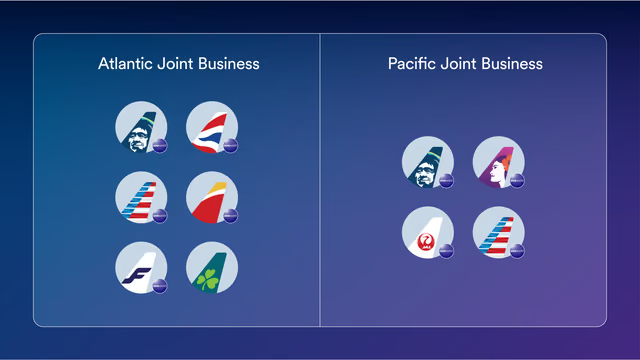
Alaska Atmos Rewards Ascent. $95 annual fee. 3x on Alaska and Hawaiian purchases, 2x on eligible gas, EV charging, local transit, cable and select streaming. The current offer on Alaska's page is 50,000 bonus points and a $99 Companion Fare (plus taxes and fees from $23) after $1,500 in purchases in the first 90 days.
Pick by How You Spend
One category dominates your spending. Customized Cash Rewards, with the choice category set to match. At the entry Member tier that is 3.3%, rising to 5.25% at the top tier. Very few no-fee cards pay more in a self-selected category.
The catch is a combined quarterly cap on the 3% and 2% categories, above which purchases drop to 1%. If your category spending is large, model the effective rate against the cap rather than the headline number.
Your spending is spread evenly. Unlimited Cash Rewards. A flat rate applied to everything frequently beats a high rate applied to a third of your spending, and there is nothing to track or reset.
Be honest about the comparison, though: at 1.65% (Member) or 1.875% (Preferred Plus), this card pays less than a plain 2% cash-back card from another issuer. It only pulls ahead at Preferred Honors, where it reaches 2.25%.
You travel internationally. Travel Rewards, purely for the absence of foreign transaction fees. The earn rate matches Unlimited Cash exactly, so the only differences are the missing 3% foreign fee and the restriction that points must be redeemed against travel.
If you never spend abroad, Unlimited Cash pays the same and the money is unrestricted. There is no reason to take the restriction without the benefit.
You spend heavily on travel and dining. Premium Rewards, but check the tier first. Its 2x on travel and dining becomes 3x at Preferred Honors, which is genuinely competitive with mid-tier travel cards from other issuers. At Member it is 2.2x, and a $95 fee for 2.2x is hard to defend against the no-fee options.
You fly Alaska. The Atmos Rewards Ascent, and mainly for the Companion Fare. Each account anniversary after a year with $6,000 or more in purchases on the card, you get a $99 Companion Fare (plus taxes and fees from $23); used on a trip you would have taken anyway, it offsets much of the $95 fee, which makes the ongoing earn rate close to a bonus. If you don't fly Alaska or Hawaiian, one of the no-fee cards above is the better fit.
No Annual Fee Is Doing More Work Than It Looks
Three of the five cards cost nothing to hold, and that changes how you should think about the choice.
With a no-fee card, a mediocre fit costs you nothing but the opportunity of a better card in your wallet. You can hold Customized Cash and Unlimited Cash together, route spending to whichever earns more on each purchase, and pay nothing for the privilege. There is no break-even to calculate and no annual renewal decision.
The $95 cards are different. Premium Rewards has to return more than $95 of incremental value over the no-fee alternatives, not more than $95 in total rewards. That is a higher bar than it sounds. If Unlimited Cash would have earned you $450 and Premium Rewards earns $520, the card has produced $70 of extra value against a $95 fee and you are behind.
Run that comparison rather than comparing the fee against the card's total earnings. It is the single most common error in evaluating a fee card, and it is why Premium Rewards only makes sense at the higher tiers where the gap widens enough to clear $95.
The Alaska card escapes this logic because its Companion Fare is a discrete benefit with a knowable value. A companion ticket you would otherwise have bought is worth what that ticket costs, as long as you meet the $6,000 yearly spending requirement to receive it.
Where the Real Money Is in Year One
The ongoing rates get the attention, but for a new cardholder the welcome bonus is a large part of the first-year return.
Customized Cash Rewards currently offers a $200 bonus and Unlimited Cash Rewards a limited-time $250 online bonus, each after $1,000 of spending in 90 days, so weigh the welcome bonus alongside the tier bonus when you choose.
The practical consequence: if you are opening a Bank of America card for the first time, the bonus should weigh more heavily than a small difference in ongoing rate, and the $1,000 threshold on three of these cards is low enough that most households clear it without changing anything.
Premium Rewards is the outlier at 60,000 points after $4,000. That is a larger bonus for a larger commitment, and it's worth it only if you can hit the spend naturally.
The Question Behind All of It
None of these cards makes sense in isolation, because the tier bonus changes every number on the page.
The bonus runs 10% at Member, 25% at Preferred Plus, 50% at Preferred Honors and 75% at Premier, based on your three-month combined average daily balance across Bank of America deposit accounts and Merrill investment accounts. Our guide to how BofA Rewards works covers qualification, and there is a card-by-card breakdown of what each tier pays if you want the arithmetic.
The short version for card selection:
At Preferred Honors or Premier, Bank of America cards are among the strongest cash-back options available. 4.5% to 5.25% in a chosen category, or 2.25% to 2.625% flat, is hard to beat without an annual fee.
At Preferred Plus, they are competitive but not dominant. Worth holding if you bank here anyway.
At Member, they are ordinary. A flat 2% card from another issuer beats Unlimited Cash, and the only standout is Customized Cash in a category that genuinely matches your spending.
That is the honest framing, and it is why "which Bank of America card is best" has a different answer depending on something that has nothing to do with the cards.
Limitations to Weigh
A few limitations are worth understanding before concentrating your spending here.
Fixed-value redemptions. Bank of America points redeem at a fixed rate against travel or as cash. Chase, Amex, Citi and Capital One points can also move to airline and hotel programs, where a well-chosen transfer can push value well above a cent per point.
If your goal is premium-cabin international travel on points, a transferable currency from Chase, Amex, Citi or Capital One is the better tool. If your goal is a reliable cash-back return with no redemption learning curve, that limitation costs you nothing.
Tier dependence. The rates that make these cards attractive require balances most people do not have at one institution. A program that pays its best rates to customers with $100,000-plus is, by design, not aimed at everyone.
Our comparison of the Bank of America and Chase ecosystems works through that trade in more detail.
Applying: What to Know First
A few practical points before you submit anything.
Existing customers generally fare better. Approval odds and starting limits tend to be more favorable for people with an established deposit relationship, which is consistent with a program built to reward balances.
Check the tier before the application, not after. If you are close to a threshold, the order of operations matters: get the balances in place, let the quarterly review run, then apply. The card will earn at whatever tier is in effect when rewards post, so there is no advantage to applying first.
A new card is a hard inquiry. Each application costs a few points and adds an account to your file. If a mortgage or auto loan is on the horizon, that matters more than any of the rates on this page.
Building a Two-Card Setup
If you are committing to Bank of America, the pairing that covers the most ground is Customized Cash Rewards plus Unlimited Cash Rewards.
Put your largest category on Customized Cash and set the choice category to match. Put everything else on Unlimited Cash. Both are no-fee, so the pair costs nothing to hold, and between them they cover concentrated and diffuse spending without leaving anything at 1%.
Add Travel Rewards only if you spend abroad, and Premium Rewards only if you are at Preferred Honors or above with real travel and dining spend. There is no reason to pay $95 for a card whose best rate you have not qualified for.
For a broader look at category-choice cards across issuers, including how Customized Cash compares to Citi Custom Cash and Chase Freedom Flex, see our roundup of customizable rewards cards. Citi stopped accepting applications for the Custom Cash on May 28, 2026, so this only applies if you already hold one. And the full Travel Rewards review covers that card's redemption mechanics in depth.
Bottom Line
Customized Cash Rewards if one category dominates your spending. Unlimited Cash Rewards if it does not. Both are no-fee, with a $200 bonus on Customized Cash Rewards and a limited-time $250 online bonus on Unlimited Cash Rewards after $1,000 in 90 days, and between them they cover most households.
Travel Rewards only for the missing foreign transaction fee. Premium Rewards only at Preferred Honors or above. The Alaska card only if you fly Alaska and will use the Companion Fare.
And check your BofA Rewards tier before deciding any of it, because at Member these are ordinary cards and at Preferred Honors they are excellent ones. The cards did not change. The multiplier on top of them did.
Updated October 7, 2026: Unlimited Cash Rewards welcome offer.