



The Atmos Rewards Summit Visa Infinite is one of the few airline cards that can take you to elite status on spending alone. Alaska's card page lists two ways it counts toward status: 1 status point for every $2 you spend on purchases, with no cap, and 10,000 status points each year. Put enough on the card and you can reach Atmos Gold, the level that comes with oneworld Sapphire and its international lounge access, without the flying that would normally get you there.
The question this guide answers is whether that's worth doing. For most people it isn't, but there's a narrow case where it is. Below are the 2026 status levels, what the card earns toward them, what Gold actually gets you, and when the spending makes sense. Every Atmos fact here comes from Alaska's own Atmos Rewards pages, read on September 29, 2026.
Atmos Rewards Status in 2026
Atmos Rewards, the program Alaska and Hawaiian share, counts status points over the calendar year, January 1 to December 31. The four levels, from Alaska's benefits page, are:
- Atmos Silver: 20,000 status points
- Atmos Gold: 40,000 status points
- Atmos Platinum: 80,000 status points
- Atmos Titanium: 135,000 status points
Platinum and Titanium got harder in 2026. Alaska's 2026 updates page says members who earned Platinum on 2025 activity got a 5,000 status point head start in 2026, and Titanium members got 20,000, posted in February 2026.
Alaska also pays milestone rewards at 10,000, 30,000, 55,000, 95,000, 125,000, 150,000, 200,000 and 250,000 status points, on top of each level's own benefits. At each milestone you pick from a short menu of perks, such as bonus points, Wi-Fi passes, lounge day passes or upgrade certificates.
How Flights Will Earn Later in 2026
Alaska has announced a change to how flights earn, "coming later in 2026." You'll choose one of three ways to earn points and status points on flights, and you can change your choice once a year:
- By distance: "1 mile flown = 1 point earned," with no class of service bonuses or minimum miles.
- By price paid: "$1 spend = 5 points," on the fare excluding taxes and fees, including paid upgrades. Award redemptions earn 1 status point for every 20 points redeemed.
- By segments flown: 500 points per segment, and a flat 500 status points for each award segment.
Until that launches, Alaska's status points guide says award flights earn "one status point for every mile you fly," with no class of service bonus.
What the Summit Card Earns Toward Status
The Summit card page shows a $395 annual fee. Here's what it contributes to status:
- 1 status point per $2 spent on purchases, with no limit on status points earned. The status points guide says this counts net purchases, and that fees, including the annual fee, don't earn status points. Neither do the card's bonus categories, which earn extra redeemable points but no extra status points.
- 10,000 status points each year, listed on the card page under "Fastest path to status."
Card status points post to the primary cardholder's account within 4 to 6 weeks. The status points guide says a card transaction counts toward 2026 status if it posts to your card account in 2026.
For comparison, the Atmos Rewards Ascent card ($95) earns 1 status point for every $3 spent on purchases.
The Spend Math, As Worked Examples
These are worked examples, using the card page's 10,000 status points a year and the 1-per-$2 rate. They assume no flying at all.
Say you put $20,000 on the Summit in a calendar year. That's 10,000 status points from spending, and with the 10,000 the card gives each year you'd have 20,000, which is Silver.
Say you put $60,000 on it instead. That's 30,000 status points from spending, plus the 10,000, for 40,000. That's Gold.
Say you put $140,000 on it. That's 70,000 plus 10,000, or 80,000, which is Platinum. And say you put $250,000 on it: 125,000 plus 10,000 is 135,000, which is Titanium.
Gold is where the numbers stop being silly and the benefits get meaningfully better, which is why it's the target most people should think about.
What Gold Actually Gets You
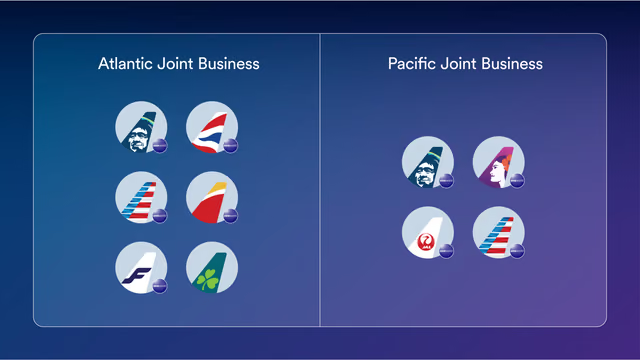
Alaska's global benefits page maps each Atmos level to a oneworld tier: Silver is oneworld Ruby, Gold is oneworld Sapphire, and Platinum and Titanium are oneworld Emerald.
The big step at Gold is lounge access. Gold members can use oneworld business class lounges, with one guest, when they travel on a oneworld member airline to a destination outside the US, Canada and Mexico. Platinum and Titanium add oneworld first class lounges.
Gold also includes, per the global benefits page and the benefits page:
- 50% bonus points on flights, including with Alaska's 30+ global partners (Silver gets 25%).
- Free same-day flight changes when flying Main Cabin or First Class on Alaska.
- Two free checked bags for you and all companions on the same reservation (Silver gets one). Alaska says Gold members keep three free bags for 2026 travel booked before October 1, 2025.
- Group A boarding and priority baggage handling on Alaska and Hawaiian.
- On oneworld partners: priority boarding, priority baggage handling and an extra baggage allowance.
- A complimentary premium drink or chocolate on Alaska flights.
Some benefits come with every level, Silver included. Every status holder gets complimentary First Class upgrades, plus a companion, within North America, between Hawai'i and North America, and between the Neighbor Islands, when available. Every level also gets Premium Class upgrades and preferred seating. The 2026 updates page adds access to Hawaiian's Premier Club lounges for all status holders, plus two guests.
That's why Silver on its own is hard to justify through spending. Its main extra over no status is the upgrade and bag benefits, which matter only if you fly Alaska or Hawaiian regularly.
The Rest of the Summit Card
The status earning isn't the only thing you pay $395 for. The card page lists:
- A 25,000-point Global Companion Award on your card anniversary, which covers a companion's ticket on an award booking for two people on the same itinerary, up to that number of points. You can earn a second one, worth 100,000 points, after $60,000 in purchases in a card anniversary year. The awards can be used on Alaska, Hawaiian, oneworld and Alaska's other partners, in any class of service.
- Eight Alaska Lounge day passes a year, two each quarter.
- 3 points per $1 on eligible dining, foreign transactions, and Alaska and Hawaiian purchases, and 1 point per $1 on everything else.
- No award booking fees on partner airlines, a $50 voucher for a same-day cancellation or a delay of 2+ hours on an Alaska flight, and a TSA PreCheck or Global Entry credit of up to $120 every four years.
The current welcome offer is 70,000 bonus points and a 25,000-point Global Companion Award after $3,000 in purchases in the first 90 days. Alaska says it's an online offer that may not be available elsewhere.
One detail matters for the Gold plan. The same $60,000 that gets you to Gold in the worked example above is also the spending that earns the 100,000-point Global Companion Award. The two are counted differently, though: status over the calendar year, the companion award over your card anniversary year. So the same spending only lands both if the two periods line up.
The Honest Trade-Off
Every dollar you put on the Summit for status is a dollar you're not putting on a card that might earn more for that purchase. The Summit's everyday rate outside its 3x categories is 1 point per $1, so the cost of the status plan is whatever your other cards would have earned on that spending, minus what the Summit earns.
Say you'd otherwise put most of that $60,000 on a card earning 2 points per dollar in a transferable currency. You'd be giving up the difference on every dollar the Summit earns only 1x on. Whether that's worth it depends on how you'd use Gold, and specifically on how often you'd use the oneworld lounges and the extra bags.
When This Strategy Works
You're already close to Gold from flying. Say your flying earns 15,000 status points in a year. With the Summit's 10,000 a year, you'd need 15,000 more, which is $30,000 in spending at 1 per $2, not $60,000. This hybrid path is the version that makes sense for most people who want Gold.
You'd use the Summit's bonus categories anyway. If a large share of your spending is dining, foreign transactions, or Alaska and Hawaiian purchases, the Summit earns 3 points per dollar there, so you give up less by moving that spending to it.
You fly oneworld internationally. Gold's lounge access applies on oneworld flights to destinations outside the US, Canada and Mexico. If you make a few of those trips a year, you'll use it. If you don't, you're paying for a benefit you won't touch.
When to Skip It
You rarely fly Alaska or Hawaiian. Upgrades, bags and preferred seating come with Alaska, Hawaiian and American flights. If you fly them twice a year, there's not much for status to do.
Your long-haul flying isn't on oneworld. Gold's most valuable benefit is oneworld lounge access on international trips. If you fly Delta or United abroad, it won't help.
You're thinking about Platinum or Titanium on spending alone. At $140,000 and $250,000 in the worked examples, those are levels to earn mainly by flying, with the card closing the gap.
Atmos Summit vs. Ascent
For most readers the real choice is between the two personal Atmos cards. The Ascent costs $95 and earns 1 status point per $3, 3 points per $1 on eligible Alaska and Hawaiian purchases, and 2 points per $1 on gas, EV charging, local transit, cable and select streaming services. It also comes with a $99 Companion Fare (plus taxes and fees from $23) each account anniversary after $6,000 in purchases a year, and a free checked bag and preferred boarding for you and up to six guests when you pay for the flight with the card. Its current offer is 50,000 bonus points and a $99 Companion Fare after $1,500 in 90 days.
The Summit's fee is $395 against the Ascent's $95, and it earns status faster, with lounge passes and Global Companion Awards on top. If you're not chasing status and won't use the lounge passes, the Ascent is the better card. Our guide to the best Alaska Airlines credit cards compares them in more detail, and our Atmos Rewards guide covers the program as a whole.
What I'd Do
If I flew Alaska a few times a year, took one or two long-haul oneworld trips and didn't already hold oneworld status, I'd take the Summit, put my dining and travel spending on it, and see how close my flying got me to Gold by the fall. If the gap was small, I'd route enough spending through the card to close it. If it wasn't, I'd use the companion award and lounge passes and reconsider at renewal.
If I were mainly a domestic flyer who likes Alaska and Hawaiian but rarely flies oneworld abroad, I'd take the Ascent for $95 and skip the status plan.
Either way, Gold is the only level I'd consider spending my way to. Work out what your flying earns first, then size the card spending to the gap.
Updated September 29, 2026: Rewritten against Alaska's current Atmos Rewards pages. Corrected the welcome offer, the Silver and Gold benefits, the Ascent's status earning, and the new ways flights will earn, which Alaska says are coming later in 2026 and are chosen by the member.