



The Amex Platinum airline credit gives you up to $200 in statement credits each calendar year for incidental fees, such as checked bags and in-flight refreshments, charged by one qualifying airline you select. Airline tickets, upgrades and award tickets don't count.
The credit comes with the Platinum Card from American Express, and the choice that decides whether you use all of it is the airline you pick. For most cardholders, the right answer is the airline you already pay bag and seat fees on, because those are the charges the credit pays back.
How the Credit Works
You turn the credit on by selecting one qualifying airline in the Benefits section of your Amex online account or by calling the number on the back of your card. Fees charged before you make that selection aren't eligible, so pick your airline before your next trip.
After that, Amex pays back up to $200 per calendar year in statement credits when your selected airline charges an incidental fee to your card. Purchases by additional card members on the same account count too, but the $200 cap applies to the whole account. Amex says the credit typically posts within a few days but can take up to 6 to 8 weeks, and to call the number on your card if it hasn't posted after 8 weeks.
The credit doesn't roll over. Whatever you haven't used by December 31 is gone, and the $200 resets in January.
Which Airlines Qualify
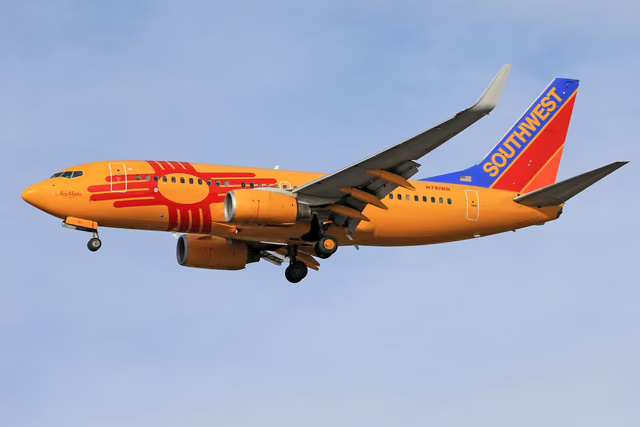
Amex's terms name six qualifying airlines: Alaska Airlines, American Airlines, Delta Air Lines, JetBlue Airways, Southwest Airlines and United Airlines. Amex says the list is subject to change.
Only fees charged by the airline you selected count. Fees from that airline's alliance partners don't qualify. Say you select American and pay a bag fee to one of its partner airlines: that fee won't trigger the credit.
How to Change Your Airline
If you haven't chosen an airline yet, you can choose one at any time. Once you have, you can change it one time each year, in January, online or by phone. If you do nothing, your selection carries over to the next year.
What Counts and What Doesn't
The fee has to be charged by your selected airline separately from your ticket, and the airline has to code it as an incidental fee. Amex's own guide to the benefit lists these as charges that typically count:
- Checked bag fees, including oversized or overweight bags
- Flight change fees
- Seat selection or reassignment fees, excluding seat upgrades
- In-flight food, drinks and entertainment, excluding Wi-Fi
- Fees for booking a flight over the phone
- Annual airline club membership fees and airport lounge day passes
Amex's terms rule out airline tickets, upgrades, mileage purchases, mileage transfer fees, gift cards, duty-free purchases and award tickets. In-flight Wi-Fi doesn't count either. Amex also suggests checking with your selected airline for details on a specific fee.
Picking the Right Airline
Start with one question: which airline do you fly most often, and do you pay for bags or seats on it?
On domestic flights, Delta charges Delta Main and Delta Comfort customers $45 each way for a first standard checked bag and $55 for a second, unless they hold a Delta SkyMiles American Express card or Medallion Status. Say you check one bag at that rate on two domestic Delta round-trips: that's $180 in bag fees before any seat fees. If that's how you fly, pick Delta.
The same logic applies to the other five airlines on the list. Wherever you already pay for bags, seats or lounge passes, the credit typically covers them.
A useful test: look at your card statements from the past 12 months and total your airline fee charges by carrier. The airline at the top of that list is the one to select.
Common Mistakes
The first mistake is picking an airline you don't actually fly. If you never fly it, the $200 runs out on December 31.
The second is never selecting an airline at all. The credit doesn't start until you do, and fees charged before your selection don't count.
The third is assuming every charge qualifies. Tickets, upgrades and Wi-Fi don't trigger the credit, and neither do fees paid to partner airlines.
The fourth is waiting until the last week of December. Amex relies on the airline's processing to set the transaction date, so a late-December fee the airline submits late may not count toward this year's $200.
The fifth is buying things you don't need. If you'd normally travel with a carry-on, don't check a bag just to use the credit.
When the Credit Doesn't Pay Off
If you rarely fly and travel light, $200 in airline fees is hard to reach honestly. The Platinum Card carries an $895 annual fee, and the airline credit is one of several statement credits that have to cover it. If you can't use it, the American Express Gold Card has a $325 annual fee and earns 4X points at restaurants worldwide (on up to $50,000 a year) and at U.S. supermarkets (on up to $25,000 a year).
Both cards earn Amex Membership Rewards points. If you already hold the Platinum and the math no longer works, read our guides to Amex Platinum retention offers and downgrading the Amex Platinum to the Gold before you cancel.
If you keep the card, select the airline you already fly, charge its fees to the Platinum and check that each credit posts.
Updated October 10, 2026: airline credit rules.