


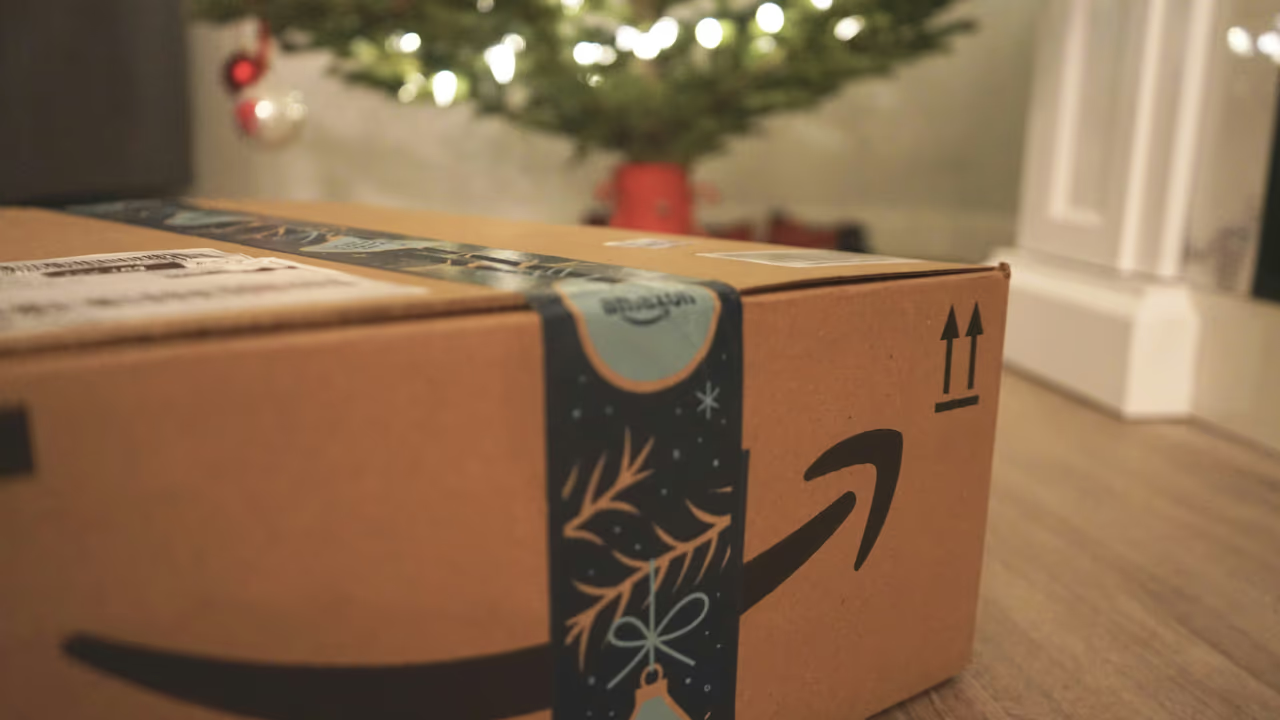
The Amazon Prime Visa is one of those cards I keep coming back to in conversations with readers, but rarely the way it gets pitched in the marketing copy. It earns 5% back at Amazon and Whole Foods, and the headline number is real. The honest read, though, is that this is a single-purpose card masquerading as an everyday spender. If you shop Amazon enough, the math is hard to argue with. If you don't, the card sits in a drawer and the Prime fee starts looking like a tax.
Here's exactly how the Amazon Prime Visa earns, what the welcome bonus looks like in October 2026, and the two competitors I'd compare it against before you apply.
Quick Summary
Best For: Active Prime members who put $200 or more a month through Amazon and Whole Foods. Standout Benefit: 5% cash back at Amazon and Whole Foods with no annual fee on top of Prime. Biggest Drawback: Outside the Amazon ecosystem, the rewards drop to 2% or 1%, and Prime membership ($139 a year) is a real cost. Current Offer (as of October 2026): $150 Amazon gift card upon approval for Prime members, no minimum spend. Verify on the issuer page before applying, since Chase and Amazon adjust this offer periodically.
Amazon Prime Visa Overview
The Amazon Prime Visa is issued by Chase and co-branded with Amazon. It's a Visa Signature card, accepted anywhere Visa works, and the application is run through Chase's underwriting. That matters for two reasons: the 5/24 rule applies (more on that below), and you get standard Visa Signature protections rather than the thinner coverage you'd find on a closed-loop store card.
The card has no separate annual fee. The cost of admission is Prime itself: $139 a year, or $14.99 a month if you pay monthly. Without an active Prime membership the rewards rate at Amazon drops from 5% to 3%, which changes the calculus entirely. Treat the card as a Prime member benefit, not a standalone product.
Rewards are technically Chase points worth 1 cent each, redeemable for cash back, statement credit, gift cards, travel through Chase Travel, or directly at Amazon checkout. They don't transfer to airline or hotel partners, and they don't pool with Chase Ultimate Rewards points from cards like the Sapphire Preferred or Sapphire Reserve. If you're hoping this card feeds your transferable-points stash, it doesn't.
Welcome Bonus and Earning Structure
Current Welcome Offer
As of October 2026, Prime members who are new cardholders get a $150 Amazon gift card credited to their Amazon account upon approval, with no minimum spending requirement. The gift card lands in your account within minutes of approval and applies to your next purchase automatically. That's unusual. Most cash-back cards in this tier require $500 to $1,000 of spend in three months before the bonus posts. Getting $150 with no spend hurdle is the strongest piece of this offer, and it's the part to weigh heaviest if you're on the fence.
The trade-off: the bonus is locked into Amazon credit. If you wouldn't have spent $150 at Amazon anyway, the value is the value of the credit to you, not a flat $150.
How You Earn Rewards
- 5% cash back at Amazon.com, Amazon Fresh, and Whole Foods Market, with active Prime membership. No cap.
- 5% cash back on travel booked through Chase Travel.
- 2% cash back at restaurants, gas stations, and on local transit and commuting (which includes rideshare apps like Uber and Lyft).
- 1% cash back on everything else.
- Without Prime membership, the Amazon rate drops to 3%; the other categories stay the same.
The 5% category is uncapped, which separates this card from rotating-category competitors like the Chase Freedom Flex (5% on quarterly categories, capped at $1,500 in spend per quarter) and the Citi Custom Cash (5% on your top category, capped at $500 in spend per cycle). Citi stopped accepting applications for the Custom Cash on May 28, 2026, so this only applies if you already hold one. If you're a heavy Amazon household, the lack of a cap is the single most valuable feature on this card.
Real Earning Math
Run the numbers on a household that spends $300 a month at Amazon, $100 a month at Whole Foods, $200 a month on dining, and $200 a month on gas. That's $400 a month at 5% ($240 a year in rewards) and $400 a month at 2% ($96 a year). Add the $150 instant bonus on top, and year-one rewards land around $486 before the Prime fee.
Subtract the $139 Prime fee, and you're at $347 net for year one. In year two, without the welcome bonus, the same spending pattern returns $336 in rewards minus $139 in Prime, for $197 net.
That's the realistic shape of the card: a strong year one driven by the bonus, a steady but modest year two and beyond. It works because Prime is a fee you'd pay anyway. If you're calculating Prime purely against the card's rewards, the math gets thinner fast.
What 2% Actually Buys You
The 2% rate on dining and gas is where I see readers overestimate the card. 2% sounds fine in isolation. Compared to alternatives, it's middle of the pack. The Capital One SavorOne earns 3% on dining, grocery stores, entertainment, and streaming, with no annual fee and no Prime requirement. The Citi Custom Cash earns 5% on your top category each cycle (often dining or gas for a typical household), capped at $500 of spend.
If your dining and gas total $400 a month, the Amazon Prime Visa returns $96 a year on that spend. The SavorOne would return $144 on the same dining spend, and the Custom Cash could pull $300 off the dining alone (if dining is consistently your top category). The Amazon card's 2% is fine if Amazon is the main event and dining is incidental, but it's not a reason to choose this card on its own merits.
Key Features and Benefits
Visa Signature Protections
The Amazon Prime Visa carries the standard Visa Signature benefit set: travel and emergency assistance services, auto rental collision damage waiver (secondary in the U.S., primary outside it), and purchase protection on eligible items for 120 days against damage or theft. These aren't headline features, but they're meaningful if you don't already have them on another card.
No Foreign Transaction Fees
The card has no foreign transaction fee, which is a genuinely useful detail that gets buried in most reviews. If you travel internationally a few times a year and have been reaching for a no-FTF card to avoid the 3% surcharge, the Amazon Prime Visa fills that slot, even if it's not earning meaningful rewards on overseas spend.
Cell Phone and Other Protections
The Amazon Prime Visa does not carry cell phone protection, which is worth flagging. Cards in this segment that do carry it (the Wells Fargo Autograph, the Citi Custom Cash as a World Elite Mastercard) often offset their rewards gap with that one benefit. (The Custom Cash has been closed to new applicants since May 28, 2026.) Don't expect this card to replace a phone insurance line item.
Redemption Options
You can redeem rewards as cash back to your statement, deposit to a U.S. Chase checking or savings account, gift cards, travel booked through Chase Travel, or directly at Amazon checkout. The Amazon checkout option is the most useful one for the audience this card is built for: at the cart, you toggle "use rewards," and your point balance applies at 1 cent each.
There is no minimum redemption amount at Amazon. Outside Amazon, the cash-back redemptions usually clear in one to three business days.
Pros and Cons
Pros
- 5% uncapped at Amazon and Whole Foods is the strongest category rate in the cash-back tier for that specific use case.
- $150 instant Amazon credit on approval, no spend requirement.
- No annual fee on the card itself; Prime membership is the gating cost.
- No foreign transaction fees.
- Visa Signature protections including primary auto rental coverage outside the U.S.
- Chase issuer with a real underwriting process and real consumer protections.
Cons
- Requires active Prime membership ($139 a year) to earn the headline 5% rate.
- 2% on dining, gas, and transit is below what dedicated dining or grocery cards offer.
- Rewards don't transfer to airline or hotel partners, and don't pool with Chase Ultimate Rewards.
- Counts toward Chase's 5/24 rule, which can block more valuable Chase travel cards if you're close to the limit.
- No cell phone protection, no extended warranty (verify on the current benefits guide before relying on either).
How the Amazon Prime Visa Compares
Versus the Citi Custom Cash
The Citi Custom Cash earns 5% on your top eligible category each billing cycle, capped at $500 of spend in that category, on a list that includes restaurants, gas, grocery stores, drugstores, streaming, and select travel. (The Custom Cash has been closed to new applicants since May 28, 2026.) Amazon and Whole Foods aren't on that list. So if your top spending categories rotate, the Custom Cash captures more of them. If Amazon is consistently your largest category and the spend is well above $500 a month, the Amazon Prime Visa earns more on that lane.
The Custom Cash also wins for international use. It's a no-FTF card too (technically a 3% FTF, so check the latest terms before traveling), and its rewards convert to ThankYou Points that pool with the Citi Strata Premier or Strata Elite for transferable-partner value. The Amazon Prime Visa has no equivalent path to transferable points.
Versus the Capital One SavorOne
The SavorOne is a no-annual-fee, no-Prime-requirement card that earns 3% on dining, grocery stores, entertainment, popular streaming services, and 1% on everything else. There's also an 8% category on Capital One Travel and 5% on hotels and rental cars booked through Capital One Travel. No foreign transaction fees.
If you don't shop heavily at Amazon, the SavorOne is the smarter cash-back card for a typical household. 3% on grocery stores covers spending the Amazon Prime Visa caps at 1%, and 3% on dining beats the Amazon Prime Visa's 2%. The Amazon Prime Visa's edge is narrow and specific: Amazon and Whole Foods at 5% with no cap. If those two retailers don't dominate your statement, the SavorOne does more for you.
Versus the Amazon Prime Store Card
Worth a brief note. Synchrony also issues an Amazon Prime Store Card that earns 5% at Amazon for Prime members but only works at Amazon. No outside purchases, no Visa acceptance, no airport rentals, nothing. The Visa is the more useful card for almost everyone. The store card exists for applicants who can't qualify for the Visa underwriting, and the trade-off is meaningful: store cards generally report differently to the credit bureaus and offer fewer consumer protections.
Who Should Get the Amazon Prime Visa
Great Fit For:
- Active Prime members spending $200 or more a month at Amazon and Whole Foods, where the 5% uncapped category is where this card pays for itself.
- Households that already pay for Prime for the shipping, video, or grocery delivery benefits, since Prime is a sunk cost the card converts into rewards.
- Readers who want the $150 instant credit and aren't close to 5/24, since the bonus is one of the easiest to capture in this segment of the market.
Not Ideal For:
- Infrequent Amazon shoppers; below roughly $1,000 a year of Amazon spend, the Prime fee dominates the math and you'd net more from a SavorOne.
- Readers chasing transferable points, since the rewards don't feed the Chase Ultimate Rewards ecosystem and don't transfer to airline or hotel partners.
- Readers within one or two slots of Chase's 5/24 limit, where the Sapphire Preferred or Ink Business Preferred typically deserve those slots more.
Application Notes
The application runs through Chase's standard underwriting. The 5/24 rule applies: if you've opened five or more credit cards across all issuers in the last 24 months, you're likely to be denied regardless of credit score. Approval scores typically start around 670, with a meaningful number of approvals in the 640 to 670 range and very few below that.
You don't need an existing Prime account to apply, but you do need one to earn the 5% rate. If you sign up for Prime as part of the application, the 5% rate begins immediately. The $150 welcome credit is for Prime members, and it posts to your Amazon account within minutes of approval.
This card uses one of your 5/24 slots. If you're working toward a Chase Sapphire Preferred, Sapphire Reserve, or Ink card, weigh the Amazon Prime Visa accordingly. The Sapphire family generally returns more long-term value, so I'd take those first if you're close to the limit.
Final Verdict
The Amazon Prime Visa earns its place in one specific wallet: a Prime member who already shops Amazon and Whole Foods at a meaningful clip and wants the rewards to be automatic. For that reader, the 5% uncapped category, the $150 instant credit, and the lack of a separate annual fee combine into one of the better risk-free no-fee cards available in October 2026.
For everyone else, the math thins out fast. The 2% dining and gas rate is outclassed by the SavorOne. The redemption options don't reach transferable points. The Prime fee turns the value proposition into a conditional one rather than an absolute one. If Amazon isn't a core part of your monthly spend, take the SavorOne or pair the Citi Custom Cash with a premium Citi card and earn more across more categories. (The Custom Cash has been closed to new applicants since May 28, 2026.)
If you do shop Amazon heavily and you're not bumping into Chase's 5/24 limit, take the Amazon Prime Visa, capture the $150, and use it as your no-friction Amazon and Whole Foods card. Pair it with a SavorOne or a Custom Cash for the categories Amazon doesn't cover, and the wallet starts to look balanced.
Updated October 7, 2026: Prime Visa welcome offer.