


How Priority Pass Works in 2026
Priority Pass is a membership program operated by Collinson Group. You buy access (directly or through a credit card) and that membership gets you into the 1,900-plus airport lounges and experiences Priority Pass lists across 143 countries. The lounges themselves are run by airlines, third-party operators like Plaza Premium and No1 Lounges, or independent local providers. Priority Pass doesn't own the lounges. It licenses access to them.
What that means in practice: quality varies. The Plaza Premium at Vancouver International is excellent. The Wingtips Lounge at JFK Terminal 4 has been overcrowded for years. Same membership card, very different experiences. The app shows real-time capacity at most US locations now, which helps. Plan around the bad ones; lean into the good ones.
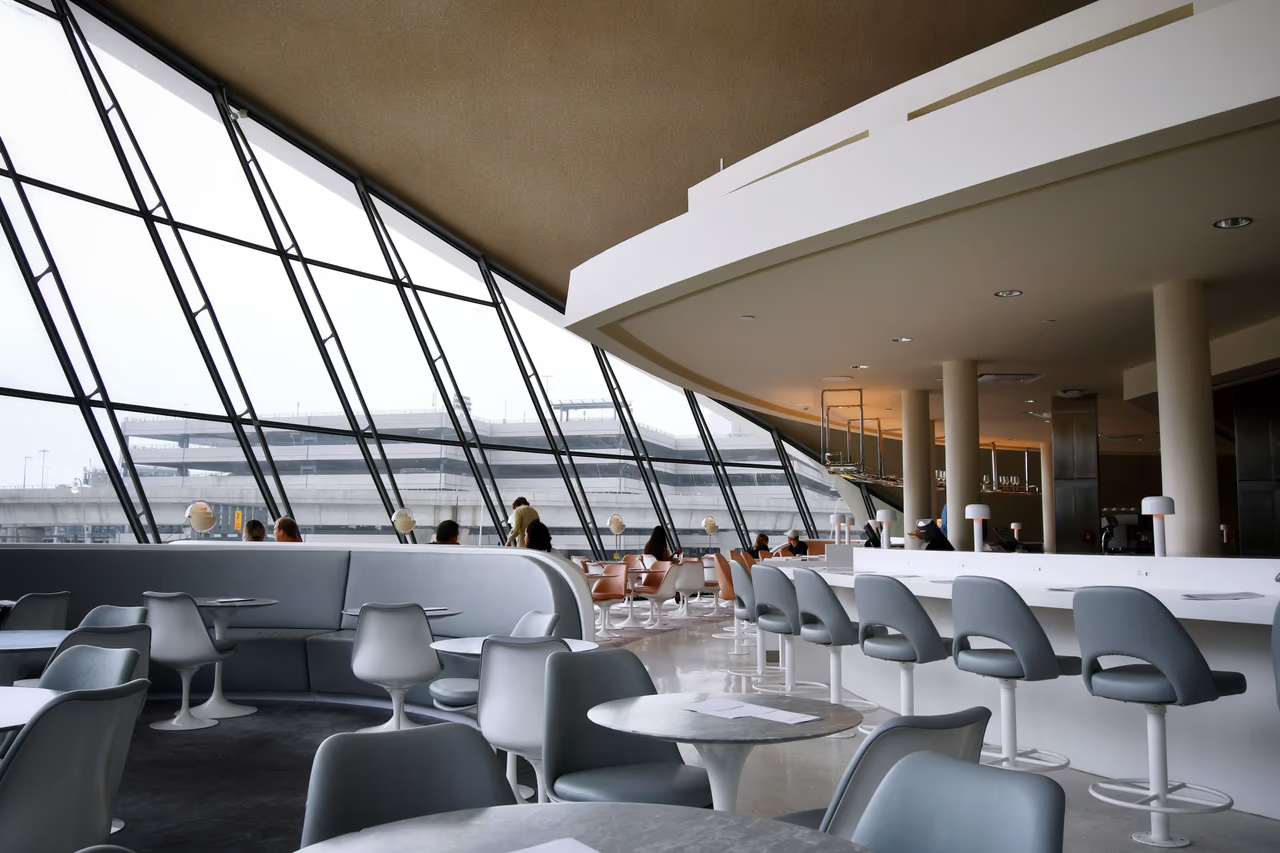
A standard visit gets you up to three hours inside the lounge. Most include hot food, alcoholic drinks, Wi-Fi, showers (at international lounges, less commonly domestic), and a place to charge your laptop. The food quality range is wide. At Cathay Pacific's lounges in Hong Kong, you're eating dim sum to order. At a US regional contract lounge, you might get a steam-tray buffet and bottled juice.
The Three Membership Tiers
If you want to buy Priority Pass without a credit card, here's the pricing as of April 2026:
Standard ($99 per year). Priority Pass pitches this one "for the occasional traveller." Entries are charged per visit rather than bundled, and guests are charged too. Priority Pass does not publish the per-visit rate on its pricing or membership pages, so confirm it at sign-up rather than budgeting from a figure quoted elsewhere.
Standard Plus ($329 per year). The "regular traveller" tier. It includes a bundle of visits before per-entry charges resume, but Priority Pass does not state the size of that allowance on its pricing or membership pages, and neither the visit count nor the overflow rate should be taken from a third party. Aimed at people who fly a handful of times a year and want some certainty.
Prestige ($469 per year). The "frequent traveller" tier, and the one issuers bundle. Cards that include it describe it as unlimited visits for the member. Guests are charged at a rate Priority Pass leaves to the card issuer, which is why the guest line differs on every card below.
The math on standalone Prestige rarely works once you have a card that includes it. A Capital One Venture X costs $395 a year, includes Prestige Priority Pass for two cardholders, and gives you a $300 annual travel credit and 10,000 anniversary miles, which Capital One says equal $100 toward travel. The credit card costs less than the lounge membership and includes a lot more.
Cards That Include Priority Pass
Five mainstream cards include Prestige-tier Priority Pass in April 2026. Each has different guest rules, different dining-credit policies, and different annual fees. The differences matter.
Chase Sapphire Reserve
Annual fee: $795 as of the June 2025 refresh. Priority Pass: Prestige with unlimited visits. Guests: up to two guests free of charge, in Chase's own wording. Restaurant credits: still included at participating Priority Pass dining locations, which is now the rare exception among premium cards.
The Sapphire Reserve refresh in mid-2025 raised the annual fee from $550 to $795 and added a portfolio of new credits, including a $300 dining credit at Sapphire Reserve Exclusive Tables restaurants and $300 in StubHub and viagogo statement credits. Since October 1, 2026, the card has also carried up to $35 a month in DoorDash promos for DashPass members, through the end of 2029. If you'll use those benefits, the effective annual cost lands closer to break-even than the headline number suggests. Priority Pass with restaurant access remains one of the card's quieter advantages now that most other issuers have stripped that benefit. For a deeper look at the refreshed card and break-even math, our Sapphire Reserve review goes into the calculation.
American Express Platinum
Annual fee: $895. Priority Pass: Prestige with select restrictions, including no restaurant credits at any Priority Pass dining location since August 2024. Guests: Amex publishes no Priority Pass guest allowance or fee on its lounge pages, and the Centurion Lounge guest terms are a different network. Centurion Lounge access is included separately, which is the bigger lounge benefit on this card.
The Platinum makes more sense as a Centurion Lounge card than a Priority Pass card now. Priority Pass on the Platinum means lounges only, full stop. If your travel pattern hits airports with Centurion Lounges (Amex's list includes Atlanta, Dallas-Fort Worth, Denver, Houston, Las Vegas, Los Angeles, Miami, New York JFK and LaGuardia, Philadelphia, Phoenix, Salt Lake City, San Francisco, Seattle and Washington National, plus Hong Kong and London Heathrow), the Platinum's lounge value comes mostly from Centurion. The Priority Pass piece is a backup.
Capital One Venture X
Annual fee: $395. Priority Pass: Prestige. Guests: $35 per visit per guest. Restaurant credits: removed in October 2024.
The Venture X is the lowest-fee path to Priority Pass among premium cards, but the guest policy isn't family-friendly. Capital One's lounge terms charge $35 per visit per guest at Priority Pass lounges on the personal card. Capital One also runs Capital One Lounges in DFW, Denver, IAD, and LaGuardia, which are excellent but limited geographically. If your home airport is one of those four, the Venture X is competitive with cards costing twice as much.
Citi Strata Elite
Annual fee: $595 (launched late 2025 to replace the Citi Prestige). Priority Pass: a full Priority Pass Select membership, which Citi values at $469 a year. Guests: Citi's product page does not mention guests. Restaurant credits: not included.
The Strata Elite carries two separate lounge benefits, and they are easy to run together. The Priority Pass side is a full membership: Citi's page offers "complimentary access to 1,500+ airport lounges worldwide," with the annual membership fee valued at $469. Separately, the card grants four single-use Admirals Club passes each calendar year, which reach nearly 50 American Airlines lounges. Four passes is the Admirals Club figure, not a cap on Priority Pass visits.
Hilton Honors Aspire
Annual fee: $550. Priority Pass: Prestige with unlimited visits. Guests: two free guests per cardholder. Restaurant credits: removed in 2024.
The Aspire is unusual because it's a hotel co-brand card that includes Priority Pass at all. If you stay at Hilton properties enough to use the free annual night and the $400 Hilton Resorts credit, the Priority Pass is essentially free. If you don't, the rest of the card doesn't justify the fee.
What Changed in 2024 and 2025
Two changes reshaped Priority Pass's value proposition for US cardholders.
First, restaurant credits got cut. Priority Pass lets partner restaurants in airports without lounges count as a "lounge visit." Historically you'd swipe your membership and get a $28 to $35 credit toward your meal. American Express dropped restaurant access for Platinum and Business Platinum cardholders in August 2024. Capital One followed in October 2024 for Venture X. Citi never fully restored restaurant credits when it relaunched its lounge benefit on the Strata Elite. Chase Sapphire Reserve and a handful of smaller cards still include restaurant credits, but the network is thinner now because some restaurants exited the program after the issuers pulled out.
Second, guest policies tightened, and they now differ card by card in ways worth checking before you travel with someone. Capital One's lounge terms give the personal Venture X no complimentary Priority Pass guests at all, at $35 per guest per visit, while the Venture X Business allows two complimentary guests before the same charge. Chase gives Sapphire Reserve and Sapphire Reserve for Business up to two guests free of charge. Citi's Strata Elite page does not address guests. The pattern: guest access used to be a lever issuers competed on, and now it's tighter across the board.
These changes don't make Priority Pass worthless. They reduce the standalone value enough that the math now leans heavily toward the cards that retain dining credits or include adjacent lounge networks (Centurion on Amex, Capital One Lounges).
Space Availability, and Pre-Booking
One caveat sits on top of every tier and every card, and Priority Pass states it plainly: "Access to lounges is subject to space availability."
A membership is not a reservation. A busy lounge at a busy hour can turn away a Prestige member and a Sapphire Reserve cardholder alike, and the entitlement that cost you an annual fee does not override capacity.
Priority Pass now offers a way around this at some locations. It says "Pre-book is available at select locations for a small fee," reservable after logging in. That is worth knowing before a trip where the lounge is part of the plan rather than a bonus, because it converts an entitlement into a booking.
The practical rule is unchanged by any of it: at a hub, at peak, with guests, assume you may not get in, and treat the lounge as an upside rather than a plan.
Alternatives to Priority Pass
If your travel pattern doesn't fit the Priority Pass model, these other lounge networks deserve a look.
Amex Centurion Lounges. Included with the Platinum, Business Platinum, and Delta Reserve cards. Amex puts the network at 30-plus spaces, in the US and abroad, including Hong Kong and London Heathrow. Centurion Lounges are higher quality than the median Priority Pass lounge: full bars, hot meals to order, and design that doesn't feel like a hotel conference room. Capacity controls now apply: at US locations, Amex admits eligible cardmembers within three hours of the departure time on a same-day, confirmed boarding pass, or within five hours of the connecting flight on a layover.
Delta Sky Club. Included with the Delta Reserve (personal and business). Sky Clubs are useful only if you fly Delta, which is most of the point. The Reserve has restricted access to same-day Delta flights only since February 2025 and capped Sky Club visits at 15 per year unless you spend $75,000 on the card annually.
United Club. Included with the United Club Card. Less granular than Sky Club's restrictions but limited to United and Star Alliance flights. If you fly United regularly out of a hub like ORD, IAH, or EWR, this network can outperform Priority Pass on consistency.
Polaris Lounges. Available only to United Polaris business-class international passengers. Not a credit card benefit. Mentioning them because confused travelers sometimes assume the Polaris experience extends to all United flights. It doesn't.
Star Alliance Gold. If you hold Gold status with any Star Alliance airline (United Premier Gold, Air Canada Aeroplan 35K, Lufthansa Senator), you get access to Star Alliance partner lounges when flying any Star Alliance airline internationally. Domestic US flights don't count. This is a different value proposition than Priority Pass: earn-it status versus pay-for-it membership.
The Real-World Value Math
The break-even on Priority Pass depends on how often you use lounges and what you'd otherwise spend on airport food and drinks.
Whether a Prestige membership at $469 a year pays for itself depends on what a single visit is worth to you, and Priority Pass does not publish a standalone per-visit rate to anchor that against. The shape of the answer is simple enough without one: a quarterly traveler taking four trips a year is paying a lot per visit, a monthly traveler is somewhere near the line, and a weekly business traveler clears it comfortably. Work it out against the day rate your own airport's lounges actually charge.
Almost no one should buy the membership directly, though. The Capital One Venture X bundles Prestige Priority Pass into a $395 annual fee that already includes a $300 travel credit and 10,000 anniversary miles. If you'd otherwise pay $469 for Priority Pass standalone, the Venture X is cheaper and gives you the travel credit. The credits largely cover the fee before you account for the lounge benefit.
The exception: the credit card path requires good credit and willingness to carry another card. If you've already maxed your annual credit applications under Chase's 5/24 rule, or you're consolidating wallets and don't want a sixth premium card, the standalone membership exists as a fallback. It's just rarely the optimal call.
For occasional travelers (two to three trips a year), Priority Pass barely matters. The math says skip it; bring snacks and use the airline app to find empty gates. For frequent travelers (fifteen to thirty trips a year), the question is which lounge network fits your route map, and Priority Pass usually wins on coverage even when it loses on quality at any single lounge.
Is Buying It Standalone Worth It
For most readers, no. The credit card path beats the standalone path every time you'd qualify for both.
The exception lands in two cases. First: you can't or won't carry a premium credit card, and you fly often enough that lounge access matters. Standard Plus at $329 a year bundles a set number of visits, though Priority Pass does not publish how many, so confirm the allowance before you buy. Second: you fly internationally and your home airport is poorly served by the US-focused premium card networks. Priority Pass's strength is global coverage, and standalone membership is a reasonable fit if you live abroad or travel internationally on a budget that doesn't include $400-plus annual card fees.
For everyone else, the calculation is the card, not the membership. Pick the card that matches your travel pattern: Capital One Venture X if your home airport has a Capital One Lounge or you travel internationally on points; Chase Sapphire Reserve if you want restaurant credits and Chase transfer partners; Amex Platinum if Centurion Lounges hit your routes. Priority Pass is the side dish in all three cases. Treat it that way when comparing.
The honest answer most articles don't give: lounge access is a quality-of-life upgrade, not a money-saver. You spend money to make airport time more pleasant. Whether that's worth it depends on how often you're at airports and how much you hate the food courts. Run the math, but don't talk yourself into a card just because Priority Pass shows up on the benefits list.
Updated October 3, 2026: credits.