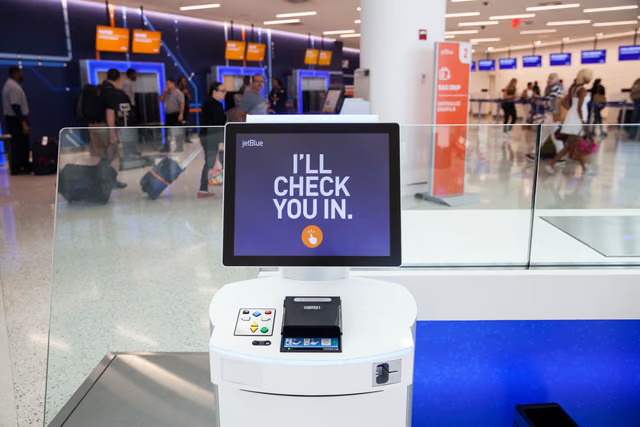




Several do, and the best ones are free. United MileagePlus and JetBlue TrueBlue let households pool miles at no cost, Air Canada Aeroplan and Air France-KLM Flying Blue offer family programs, and Hilton and Hyatt let members send points to each other for free within yearly caps. American, Delta and Southwest only let you move points between accounts for a fee, and Southwest's terms don't allow pooling at all.
Say you have 38,000 United miles and your spouse has 27,000. Whether you can combine them depends entirely on the program, and the rules range from generous to hostile. If your family already earns Chase Ultimate Rewards or Amex Membership Rewards, you may not need to think about pooling at all, because the points move when you need them to move.
Airlines With Free Pooling
These programs built household sharing into the design. Each is free within its limits, and each has caveats worth reading before you set up the share.
United MileagePlus lets up to five members pool miles. The pool leader must be 18 or older, and there is no limit on how many miles each person contributes. New members wait 72 hours before contributing, contributions can be reversed within 24 hours, and anyone who leaves must wait 90 days before joining another pool. Pooling doesn't affect Premier status.
JetBlue TrueBlue allows up to seven members in a pool, with a leader who must be at least 21. Members can be any age and don't need to be related. While you're in the pool, all newly earned points go into it automatically.
Air Canada Aeroplan has Family Sharing for up to eight verified family members, where the Family Lead controls redemptions. Air France-KLM Flying Blue has a Family account for up to eight accounts, with a maximum of two adults and six children, and members can leave after six months.
British Airways runs a Household Account for up to seven people at the same address, plus a Family and Friends list that adds up to five people outside the household. Emirates, Etihad, Qatar and Virgin Atlantic also have family programs, each with its own eligibility rules.
Airlines That Charge to Move Miles
American, Delta and Southwest let you transfer points to another member, and all three charge for it. Recent published fees are:
- American AAdvantage: $5 per 1,000 miles with no processing fee, and a 200,000-mile annual cap on miles sent and on miles received.
- Delta SkyMiles: $10 per 1,000 miles plus a $30 processing fee, with a 150,000-mile annual cap on miles sent.
- Southwest Rapid Rewards: $5 per 500 points, a 2,000-point minimum and a 60,000-point daily maximum. Southwest's terms say members may not pool or combine points.
Alaska's program is now Atmos Rewards, so check its current terms for moving points between members before you plan around it. United also lets you transfer miles for a fee, but with free pooling available, there is rarely a reason to pay it.
A hypothetical shows how the fees work. Say your spouse sends you 20,000 American miles. At $5 per 1,000 miles, that costs $100. The same 20,000 miles moved on Delta costs $200 plus the $30 processing fee. Compare that with the cash fare before you pay, because a domestic economy ticket is sometimes cheaper than the transfer.
Hotel Programs and Their Transfer Rules
Hotel programs mostly work through transfers between members rather than formal pools, and the annual caps matter. Confirm each program's current terms before you send a large balance.
World of Hyatt lets members send points to another member on Hyatt.com, with 525,000 points sent and 525,000 received allowed per calendar year and six free transfers a year. Most transfers post quickly, but some get additional review and can take up to 10 business days. Our news piece on the change has the details.
Hilton Honors lets members pool points with up to 10 friends or family and also transfer points to other members, both at no cost. The reported combined cap is 500,000 points sent per year, in 1,000-point increments.
Marriott Bonvoy allows free transfers between members in 1,000-point increments. The reported limit is 100,000 points sent per year, and both accounts need to have been open for at least 30 days with qualifying activity.
IHG One Rewards charges $5 per 1,000 points to transfer, in 1,000-point increments up to 500,000 a year. The fee is waived for Diamond Elite members and IHG Business Rewards members, and new members wait 30 days before they can transfer.
Why Transferable Points Are Usually the Better Answer
Families spend hours trying to consolidate airline and hotel currencies that were never designed to combine. The cleaner solution is to earn into a transferable currency and treat the airline or hotel balance as a temporary holding tank.
Both spouses can earn Chase Ultimate Rewards and combine them. Chase lets you combine points with one other member of your household, though the other person generally has to share your address. When it's time to book, the consolidating spouse transfers the combined balance to one partner account in one step. Our guides to Chase Ultimate Rewards transfer partners and Amex Membership Rewards transfer partners show which programs each currency reaches.
Capital One works similarly. Miles can be transferred to another Capital One cardholder at no cost, though the transfer generally has to be made by phone, and the combined balance can move to any of Capital One's airline and hotel partners.
For families running a coordinated points strategy, this is structurally easier than combining a Marriott account, a Delta account and a JetBlue account.
Smart Strategies for Families
A few patterns hold up across most family situations.
Designate one collector per program. If three family members each earn a few thousand miles a year, the balance fragments and never reaches the redemption threshold. Pick the person who travels most or holds the co-branded card, route all earning through that account, and let the others earn into transferable currencies that can backfill the lead account.
Prioritize free-pooling programs for family earning. United and JetBlue make pooling explicit, so a family that flies those carriers can run the whole year without paying a transfer fee.
Read each program's household rules before you set up a share. Some require the same address, some verify relationships and some have waiting periods. Setting up a pool incorrectly and having points rejected is more painful than getting it right the first time.
Common Mistakes
The most expensive mistake is the speculative transfer. Moving 30,000 miles to a spouse's account because you might use them later pays the fee for a redemption that may never happen. Confirm the booking exists before transferring.
The second is paying fees for low-value redemptions. Spending $100 or more to consolidate miles for a domestic economy ticket worth $200 in cash is a poor trade. Price the transfer against the cash cost of the trip.
The third, and most common, is missing the credit card alternative. Families who earn Ultimate Rewards or Membership Rewards across multiple accounts often don't realize they can concentrate the points first, then transfer the consolidated balance to a single partner account at the point of booking.
When Paying a Fee Is the Right Move
There are two scenarios where paying to move miles is the correct call.
The first is the close-to-redemption gap. Say you're 12,000 American miles short of a confirmed business-class award worth $4,200 in cash. At $5 per 1,000 miles, moving 12,000 miles from a spouse costs $60. Pay the fee, book the ticket and move on.
The second is the business traveler funding the family. One spouse earns heavily through work and accumulates miles faster than they can use them, while the rest of the family redeems more than they earn. Moving miles from the high earner's account is rational even with fees, as long as the math clears against the cash fare.
Action Plan
Audit every loyalty account in the household. Note balances, expiration dates and which programs allow pooling.
Identify the two or three programs where the family will concentrate earning. Prefer programs with free pooling or those reachable through transferable points.
Consolidate balances with free pooling first, and use paid transfers only when a specific redemption survives the fee.
Shift new earning onto transferable-points cards so the next round of pooling never has to happen at the airline level. Set a calendar reminder to review balances and pooling eligibility every year, because programs change these rules quietly.
Updated October 17, 2026: family pooling rules.