



The 2026 FIFA World Cup kicks off June 11, 2026 in Mexico City and runs through the final at MetLife Stadium on July 19. For the first time, three countries co-host the tournament, with 104 matches spread across 16 cities from Vancouver to Mexico City. If you've been holding points for this, the window to use them is now.
Here's the reality as of May 2026: group-stage hotel award space in the biggest host cities is largely picked over, but the knockout rounds run for another seven weeks and award inventory still pops up daily. This guide walks through which programs to use where, how to handle the knockout-round uncertainty, and where points still stretch furthest with the tournament 22 days away.
Quick Answer
Group-stage hotels in New York, Los Angeles, and Toronto are mostly booked on points. Your best last-minute redemptions are in Mexico City, Kansas City, Houston, and Dallas, plus Hyatt and IHG properties 20-30 miles outside the major host markets. For flights, transferable points programs (Chase, Amex, Capital One, Bilt) give you the most flexibility as knockout-round venues are confirmed.
Why Host City Choice Drives Everything
The 48-team format means 104 matches across 16 venues over 39 days. Each host city has a different hotel footprint, a different airline routing picture, and a different award-availability story right now.
United States (11 cities): New York/New Jersey, Philadelphia, Boston, Atlanta, Miami, Kansas City, Dallas, Houston, Los Angeles, San Francisco Bay Area, Seattle.
Canada (2 cities): Vancouver, Toronto.
Mexico (3 cities): Mexico City, Guadalajara, Monterrey.
The final is at MetLife Stadium on July 19, with semifinals split between Dallas and Atlanta. Mexico City hosts the opening match June 11.
Hotel Programs, Ranked for This Tournament
Different programs win in different cities. Stack two or three rather than going all-in on one.
World of Hyatt
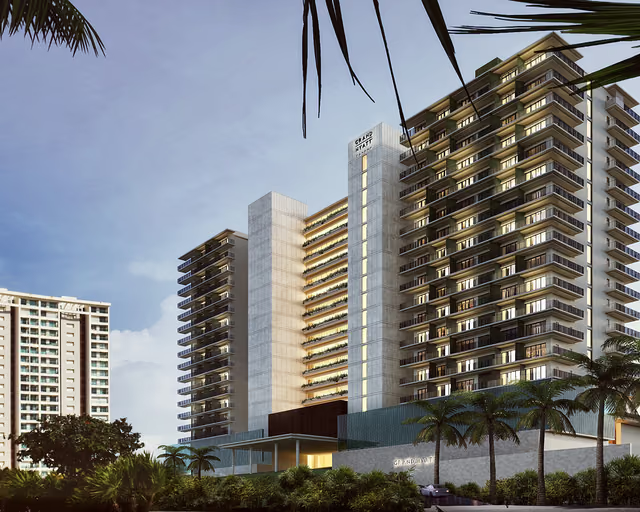
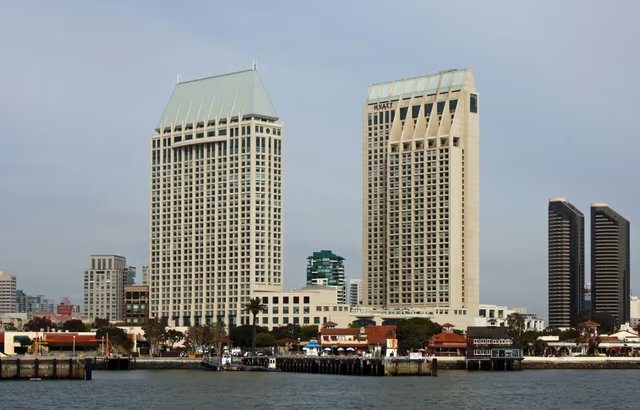
The best value program for premium stays, and the most predictable. Hyatt uses a fixed award chart in most cases, so a Category 4 property is still 15,000 points whether it's a random Tuesday or the night before a quarterfinal. Park Hyatt New York, Hyatt Regency Vancouver, Grand Hyatt Mexico City, and Andaz Mexico City Condesa are the prestige plays. The catch: Hyatt has the smallest footprint of the major chains, so secondary host cities like Kansas City and Guadalajara have limited options. If you don't have a Hyatt balance yet, the World of Hyatt Credit Card earns category bonuses fast enough to fund a Category 4 redemption inside a month of normal spending.
If you find Hyatt award space in a host city right now, book it. Even if your team's path is uncertain, Hyatt awards cancel up to 24-48 hours before arrival without penalty.
Marriott Bonvoy
Broadest coverage with properties in all 16 host cities, but Marriott uses dynamic pricing. A category 5 hotel that runs 35,000 points midweek can climb to 70,000+ during peak match nights. Marriott's value still works in secondary markets (Kansas City, Houston, Dallas) where a Courtyard or Fairfield Inn at 30,000-50,000 points beats hotel cash rates of $400+.
The fifth-night-free benefit on award stays disappeared in 2023, so don't plan around it.
IHG One Rewards
Your friend in secondary host cities. Holiday Inn Express properties often run 20,000-30,000 points per night even during the tournament, and IHG uses fixed pricing on most awards. Kansas City, Houston, Dallas, and the secondary markets around New York and Los Angeles are where IHG points stretch furthest.
Hilton Honors
Solid coverage in US cities, thinner in Canada and Mexico. Hilton's fifth-night-free benefit on award stays is still active, which matters if you're parking yourself in one city for a knockout-round series. Expect 80,000-150,000 points per night in major US markets during peak match dates.
City-by-City: Where Points Still Work
Three representative cities cover most of the real opportunity. The pattern in each generalizes to the rest.
New York/New Jersey (Final)
This is the most expensive and competitive market. Manhattan Hyatt properties for the final on July 19 are largely gone on points, but Hyatt House Jersey City and Hyatt Place Secaucus (both walking distance to NJ Transit lines that connect to MetLife) still surface availability. Budget 50,000-75,000 points per night for quality hotels; luxury Manhattan properties run 100,000+ when you can find them.
If everything looks full, search 20-30 miles out in northern New Jersey or Westchester. The transit ride to MetLife is 35-50 minutes and you'll save 30,000+ points per night.
Mexico City (Opening Match)
This is where points go furthest. World-class hotels cost meaningfully fewer points than US equivalents, the metro connects the stadium to almost everywhere tourists stay, and award availability is still reasonable. Andaz Mexico City Condesa and Hyatt Regency Mexico City both have award space showing up sporadically for opening-week dates. Budget 20,000-35,000 points per night for excellent properties; premium runs 60,000-80,000.
Secondary Markets (Kansas City, Dallas, Houston)
The best overall value of the tournament. These cities have more hotel inventory relative to demand, fewer international travelers, and lower base award rates. IHG, Marriott, and Hilton all show meaningful availability. Budget 20,000-35,000 points per night for solid mid-tier; premium runs 50,000-75,000.
Dallas hosting a semifinal pushes prices for that specific week, but group-stage dates in any of these three cities remain bookable on points right now.
Flights: What Still Works at T-Minus 22 Days
Award flight space tightens dramatically inside 30 days, but transferable-points programs give you options.
From Europe
Star Alliance award space to East Coast hubs through United, Lufthansa, and TAP shows up most days. Virgin Atlantic Flying Club to Delta-operated transatlantic flights is the standout value play, often pricing economy at 30,000-50,000 points one-way during off-peak windows. Air France-KLM Flying Blue runs Promo Rewards monthly with discounted SkyTeam awards.
Expect economy awards 60,000-100,000 miles round-trip during peak World Cup dates. Business class runs 120,000-180,000 miles if you find it.
From South America
Copa Airlines through Star Alliance connects most South American capitals through Panama City. Avianca LifeMiles regularly has better Star Alliance award space than United for these routes, and the transfer ratio from Amex and Citi is favorable.
From Asia and Australia
West Coast host cities (LA, San Francisco, Seattle, Vancouver) make the most sense. United, ANA, Singapore Airlines, and EVA all have Star Alliance award space on these routes. Book one-way segments where possible since knockout-round venue changes may require itinerary shifts.
Domestic Routing Between Host Cities
This is where the tournament gets interesting. If your team advances, you'll need to chase venues across the bracket. Southwest Rapid Rewards is the most flexible US currency for this: no blackout dates, no change fees, points refund to your account if you cancel.
United MileagePlus, American AAdvantage, and Delta SkyMiles all work for major host-city routes, but availability is tightest on the day-after-match flights. Air Canada through Aeroplan covers Toronto and Vancouver connections, and Aeroplan's mixed-cabin awards can save points on awkward routings.
The Knockout-Round Problem
Group-stage matches finish June 27. Round of 32 starts June 28. You won't know which teams play in which city until the day group play ends. This is the central challenge for last-minute points travel.
The workaround is layered booking. Hold refundable cash rooms in two or three candidate knockout cities for the dates your team might play. Once the bracket is set, cancel the cash rooms and rebook on points where available. Hyatt and IHG cancellation policies make this clean; Marriott's dynamic pricing means the points cost may have moved.
For flights, wait until the bracket is set. Day-of-week routings on Southwest, plus Star Alliance economy on United for cross-country moves, are usually findable inside a 48-hour window. The points cost is higher than if you'd booked in advance, but you're booking the right city instead of guessing.
Cards Worth Using During the Trip
You probably can't open a new card and get a bonus in time for this tournament, but the cards already in your wallet earn meaningfully more during World Cup spending. The Chase Sapphire Reserve and Chase Sapphire Preferred earn 3x and 2x on travel and dining respectively, and that covers most match-day spending. The Capital One Venture X earns 2x on everything and includes airport lounge access at most US, Canadian, and Mexican international airports.
The premium-card trip-delay and trip-cancellation coverage matters more than usual here. With multi-leg itineraries and tight stadium schedules, a delayed flight can cost real money. Pay for the trip with a card carrying built-in coverage.
Alternative Accommodation
Vrbo and similar platforms often have better availability than hotels during major events, especially for groups. You can't book these directly with hotel points, but charging the booking to a 3x-travel card recovers some value.
Hotel points-plus-cash rates appear more often than usual during high-demand windows. Marriott and IHG both let you blend points with cash on the same booking. The conversion is rarely a great value, but it's a way to stretch a balance that's a few thousand points short.
Staying 20-30 miles outside host cities and using transit or rideshare to reach stadiums works well in New York, Los Angeles, Mexico City, Toronto, and San Francisco. The savings are typically 30-50 percent on the room rate. For New York specifically, hotels in Newark, Jersey City, and Secaucus put you closer to MetLife than most of Manhattan.
Cross-Border Logistics
Traveling between US, Canadian, and Mexican host cities adds friction that solo-country tournaments don't have. Plan around it.
Entry Requirements
US visitors from visa-waiver countries need a valid ESTA, which takes minutes to apply for online. Canada requires an Electronic Travel Authorization (eTA) for most visa-exempt nationals flying in. Mexico is visa-free for most nationalities for stays up to 180 days, but you'll fill out an FMM tourist card on arrival.
If your itinerary touches all three countries, verify each one's requirements separately. US ESTA does not cover Canada, and Canadian eTA does not cover Mexico.
Connectivity
International visitors should set up an eSIM before departure. Airalo and similar providers cover all three host countries for under $30, which beats roaming charges by an order of magnitude. US-based travelers should check whether their domestic plan extends to Canada and Mexico; T-Mobile and Verizon both include basic data in most plans.
Currency and Payment Cards
All three host countries take card payments widely, but small vendors, taxis outside ride-share apps, and tip cash matter. Use cards with no foreign transaction fees for everything else. Chase Sapphire Preferred, Chase Sapphire Reserve, Capital One Venture X, and most premium travel cards waive the standard 3 percent foreign transaction fee. Verify before departure rather than after the first declined charge.
Charles Schwab's debit card refunds foreign ATM fees worldwide and gives you the interbank exchange rate, which is the cleanest way to get pesos or Canadian dollars at street level.
Common Mistakes Right Now
- Waiting on knockout uncertainty. Group-stage hotel availability is still bookable. Book what you know.
- Ignoring transfer times. Amex to Hilton is instant. Amex to Marriott is 1-2 days. Capital One to Air Canada is up to 36 hours. Move points before you need to redeem, not the day of.
- Booking non-refundable awards. During knockout uncertainty, refundable rates are worth the modest premium.
- Underestimating stadium-to-hotel distance. MetLife is 7 miles from Manhattan, SoFi is 13 miles from downtown LA, and Estadio Azteca is 12 miles from central Mexico City. Factor transit time before picking a hotel.
- Skipping travel insurance. Cards with built-in trip protection cover most scenarios; standalone policies are worth it for high-value bookings.
What to Do Now
If your dates are locked and your team is in group play, search hotel availability in your match cities today. Use the World of Hyatt and IHG apps for clean fixed-rate awards. Set price alerts on flights even if you're not ready to book.
If you're targeting knockout rounds, identify two or three plausible cities based on bracket geography and pre-book refundable cash rooms in each. Once the round-of-32 bracket is set on June 27, rebook on points where the math works.
If you've decided to add a city or two for the experience rather than chasing a specific team, Mexico City for the opening week and Kansas City or Houston for group stage offer the best points value of the tournament. Both have hotel award availability today and reasonable inbound flight options on Star Alliance and Southwest.
The World Cup is on North American soil for the first time in 32 years. Points and miles can't change ticket prices, but they can change which hotels you stay in, which cities you visit, and how much cash you keep in your account for the rest of the year.